OpenClaw SEO Automation: A Safe Local Workflow
If you want OpenClaw to help with SEO, the useful question is not “Can it automate SEO?” It can. The real question is whether you can automate recurring SEO work without handing an untrusted bot open-ended control of your files, inboxes, and production systems.
OpenClaw’s README positions it as a local-first personal AI assistant that can run on your own devices, answer on messaging channels you already use, and automate tools through its Gateway. The OpenClaw security guide also makes the trust model explicit: one trusted operator boundary per gateway, not a hostile multi-tenant environment. That distinction matters for SEO automation, because scheduled crawls, audits, and content tasks often touch shell tools, browser sessions, and private data.
This guide shows a practical OpenClaw setup for SEO work: install it correctly, keep DM access tight, schedule one useful recurring workflow, and retain enough logs and rollback control to stop mistakes quickly.
What OpenClaw Is Good At For SEO
OpenClaw is strongest when your SEO work already has a repeatable operating loop.
Good fits:
- Morning or weekday technical SEO triage
- Recurring checks for
robots.txt, sitemap, canonical, and obvious metadata issues - Pulling results into a messaging channel for review
- Running the same browser or shell workflow on a schedule
- Turning a reviewed process into a workspace skill
Bad fits:
- Unreviewed publishing to production
- Shared multi-user bot setups with mixed trust
- Giving public DMs file mutation and shell access
- Treating “AI automation” as a substitute for a clear checklist
That lines up with OpenClaw’s own design. The scheduled tasks docs show cron jobs as a Gateway scheduler that persists jobs, wakes the agent, and can deliver output to chat or webhooks. The security docs repeatedly recommend tightening access and sandboxing before you expose the bot to untrusted input.
Install OpenClaw The Current Way
The old “install a package and guess the rest” approach is no longer the best starting point.
As documented in the OpenClaw README, the current runtime baseline is:
- Node
24.15+recommended - Node
22.22.3+supported - Node
25.9+supported
Install it with either the official installer or a package manager:
# macOS / Linux
curl -fsSL https://openclaw.ai/install.sh | bash

# or
npm install -g openclaw@latest
Then run onboarding:
openclaw onboard --install-daemon
OpenClaw’s onboarding docs say the guided flow verifies inference with a real completion first, then starts OpenClaw to configure the workspace, Gateway, channels, and optional features. If you need full control over channels, daemon setup, or imports, use:
openclaw onboard --classic
After onboarding, verify that the Gateway is healthy:
openclaw gateway status
openclaw dashboard
openclaw doctor
If you only need to change configuration later, use:
openclaw configure
openclaw agents add <name>
Lock Down Access Before You Schedule SEO Jobs
This is the part most “AI automation” guides skip.
OpenClaw’s security docs treat inbound DMs as untrusted input and recommend deciding identity first, scope second, model last. For SEO automation, that means your first task is not the cron job. It is limiting who can trigger the bot and what tools those messages can reach.
Use this baseline:
- Keep the Gateway on loopback unless you intentionally expose it.
- Use DM pairing or allowlists, not public-open DMs.
- Require mentions in groups.
- Run
openclaw security auditafter config changes. - Prefer sandboxed or read-only execution for recurring SEO checks.
Useful commands:
openclaw security audit
openclaw security audit --deep
openclaw pairing list telegram
openclaw pairing approve telegram <CODE>
Important current behaviors from the docs:
dmPolicy: "pairing"is the default for DM-capable channels.session.dmScope: "per-channel-peer"is recommended when multiple people can DM the bot.groupPolicy="allowlist"andrequireMentionare the safer group defaults.openclaw security audit --fixonly applies narrow safe remediations; it is not a substitute for reviewing the model, tool, and channel posture yourself.
For Telegram specifically, the channel docs say token setup is config-based, not openclaw channels login telegram, and the default DM policy is pairing. A minimal Telegram setup looks like this:
{
  channels: {
    telegram: {
      enabled: true,
      botToken: "123:abc",
      dmPolicy: "pairing",
      groups: { "*": { requireMention: true } }
    }
  }
}
A Real SEO Workflow That Fits OpenClaw
The safest first OpenClaw SEO automation is not “publish content automatically.” It is a repeatable triage loop that checks a real property, reports findings, and stops there.
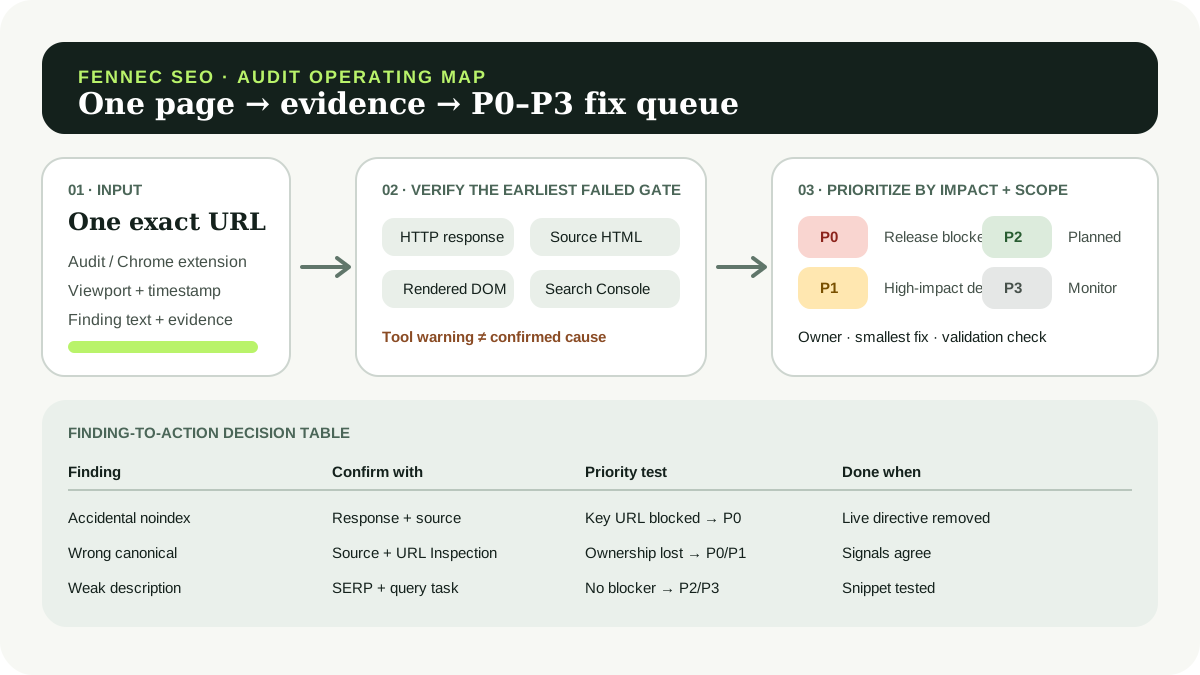
For example, a weekday Fennec triage can ask OpenClaw to inspect:
https://fennecseo.app/https://fennecseo.app/zh/https://fennecseo.app/robots.txthttps://fennecseo.app/sitemap.xml
The job should answer four things:
- Did the critical URLs return the expected HTTP responses?
- Did the page keep a valid title, description, canonical, and hreflang set?
- Did any obvious crawl or metadata regression appear?
- Should a human review the site before doing anything else?
The scheduled tasks docs explicitly support isolated agent-turn jobs, run history, chat delivery, and later disable/edit/remove controls. A workable daily job looks like this:
openclaw cron create "0 9 * * 1-5" \
  "Check https://fennecseo.app/ and https://fennecseo.app/zh/ for robots, sitemap, canonical, title, description, hreflang, and obvious broken internal links. Respond in Chinese. Do not publish or edit production content. If you find an issue, include the exact URL, why it matters, and one reproducible verification step." \
  --name "Weekday SEO triage" \
  --session isolated \
  --announce \
  --channel telegram \
  --to "<YOUR_TELEGRAM_USER_ID>"
Why this version is safer than the old generic examples:
- It uses a real site instead of placeholder URLs.
- It asks for inspection and reporting, not unreviewed production mutation.
- It uses an isolated cron session rather than the rolling main session.
- It sends the result to a reviewed human channel.
If you want a deterministic shell-side probe instead of a model-first turn, OpenClaw cron also supports command payloads:
openclaw cron create "*/30 * * * *" \
  --name "Robots header probe" \
  --command "curl -I -s https://fennecseo.app/robots.txt" \
  --announce \
  --channel telegram \
  --to "<YOUR_TELEGRAM_USER_ID>"
That is useful for narrow checks such as response headers, but remember the same docs note that command cron is an operator-admin Gateway automation surface, not the same thing as an agent exec call. Use it for deterministic probes, not broad unattended shell work.
Use Skills Only After You Verify Them
The current article version should not pretend there is an official seo-health-check skill unless there is one you have actually reviewed.
The skills docs make three things clear:
- Workspace skills in
<workspace>/skillshave the highest precedence. - Third-party skills should be treated as untrusted code.
- ClawHub installs can be verified before you rely on them.
The useful pattern for SEO is:
- Get the workflow working with plain prompts or commands first.
- Turn the stable checklist into a workspace skill.
- Only install third-party skills after verification.
Relevant commands:
openclaw skills install @owner/<slug>
openclaw skills verify @owner/<slug>
openclaw skills update --all
openclaw skills workshop list
openclaw skills workshop inspect <proposal-id>
openclaw skills workshop apply <proposal-id>
This is a better fit for SEO than the old “install random automation skills” advice, because it keeps your real operating procedure ahead of the tool layer.
Logging, Review, And Rollback
If a scheduled SEO job goes noisy or wrong, you need a fast stop path.
OpenClaw’s logging docs say file logs are JSONL, the CLI can tail them live, and logs plus session transcripts are the review surface after an incident. The security docs also point to the default log path and transcript locations.
Use this operating set:
openclaw cron list
openclaw cron get <job-id>
openclaw cron runs --id <job-id> --limit 20
openclaw logs --follow
openclaw cron disable <job-id>
openclaw cron enable <job-id>
openclaw cron edit <job-id> --message "Updated prompt"
openclaw cron remove <job-id>
What to review when a job behaves badly:
- Gateway logs
- The job’s run history
- The session transcript under
~/.openclaw/agents/<agentId>/sessions/*.jsonl - The current
dmPolicy, allowlists, and tool policy openclaw security audit --deep
That gives you a real rollback path:
- Disable the job immediately.
- Read the last successful and failed runs.
- Inspect the transcript and logs.
- Tighten the prompt, tool policy, or channel scope.
- Re-enable only after the run is understandable.
Common Mistakes To Avoid
The current OpenClaw docs do not support several assumptions that older automation posts often make.
Avoid these:
- Treating one shared Gateway as a safe hostile multi-user boundary
- Opening DMs and then relying on prompt wording as the main defense
- Inventing skill names or setup commands that are not in the docs or repo
- Using placeholder website URLs in “practical” workflows
- Scheduling content publication before you have logs, approvals, and rollback
The security guide is especially direct on the first two points: separate trust boundaries need separate gateways, and prompt injection is not solved by prompt text alone.
When OpenClaw Is Worth It For SEO
OpenClaw is worth adding to your SEO stack when you already know the workflow you want to repeat.
It is a strong fit if you want:
- A local-first assistant that can send results into Telegram, WhatsApp, Slack, or Discord
- Repeatable scheduled checks with logs and run history
- A path from prompt -> cron job -> reviewed workspace skill
- More operational control than a black-box SaaS bot
It is a poor fit if what you actually need is a single-purpose crawler or rank tracker with no human-in-the-loop review.
If your next step is website checking rather than assistant setup, use Fennec’s SEO Audit Tool, Robots.txt Checker, Sitemap Checker, and Core Web Vitals pages to define the checklist first. Then give OpenClaw that checklist instead of asking it to invent one from scratch.