Google SEO 30/60/90-Day Plan: What to Fix, Publish, and Measure First

A useful Google SEO 30/60/90-day plan does three things in order: it removes discovery and indexing blockers, publishes the minimum page set needed to cover real search tasks, and measures whether visibility turns into clicks and qualified actions. It is not a ranking guarantee, and it should not be treated as a content calendar detached from crawl, render, and canonical reality.
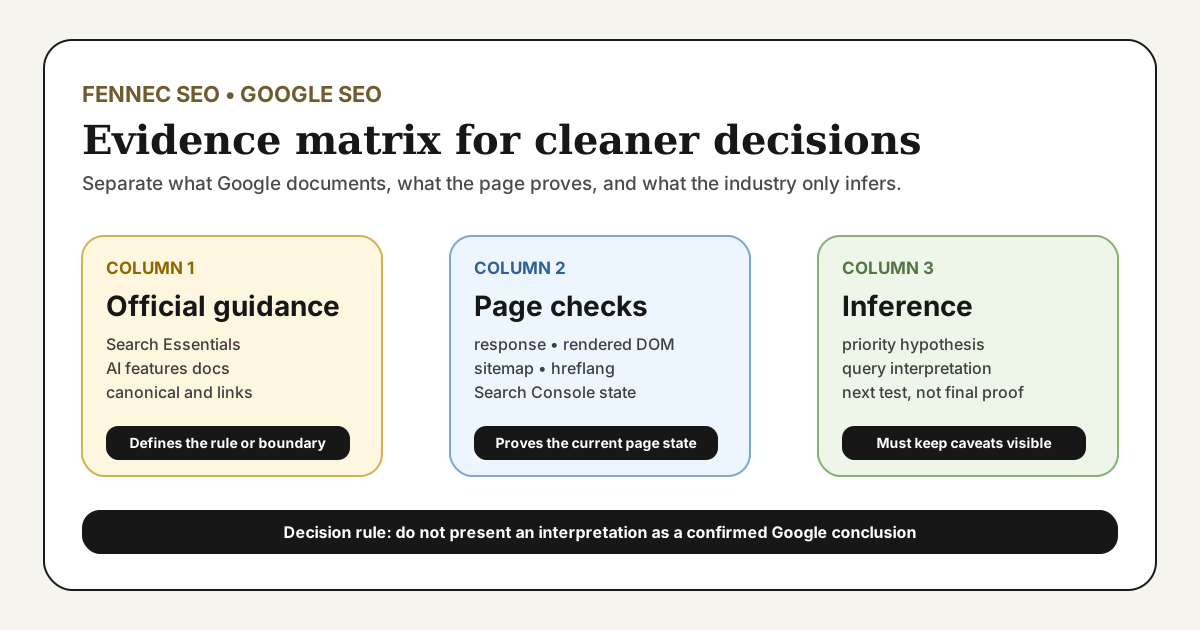
Google’s SEO Starter Guide and Search Essentials remain the safest baseline for the first 90 days. For AI Overviews and AI Mode, Google says the usual SEO fundamentals still apply and there are no additional technical requirements in AI features and your website.
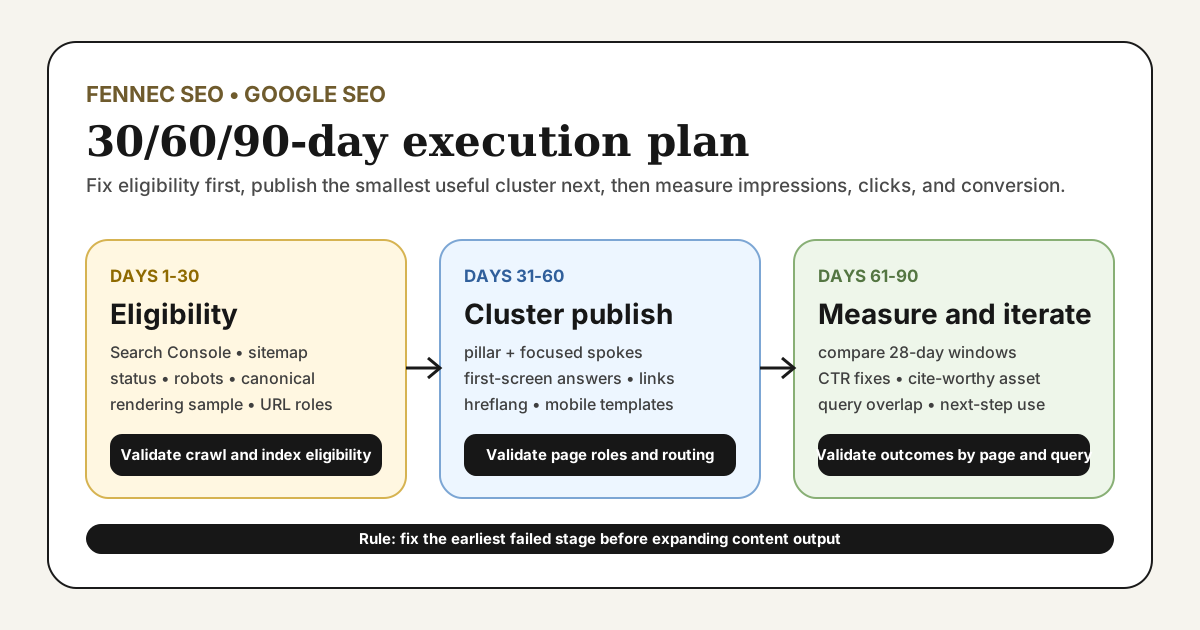
The direct answer: what should happen in each 30-day block?
Use the first 30 days to make important URLs eligible for Search. Use the next 30 days to publish and connect the smallest useful topic cluster. Use the final 30 days to compare outcomes, earn independent evidence, and tighten pages that already have impressions.
If your site is still blocked at discovery, crawling, rendering, or indexing, do not skip ahead to link building or broad content expansion.
Before day 1: define the operating scope
Before the clock starts, record five decisions:
| Decision | What to lock in | Why it matters |
|---|---|---|
| Preferred host | Final canonical domain and protocol | Avoid measuring two versions of the same site |
| Search Console scope | The property you will use for validation | Keeps indexing and performance checks consistent |
| URL sample | Homepage, product page, article pair, Wiki page, excluded URL | Prevents homepage-only audits |
| Conversion event | Demo request, audit start, tool use, download, or another real next step | Separates traffic from business value |
| Baseline window | Usually the latest 28 complete days | Makes later comparisons defensible |
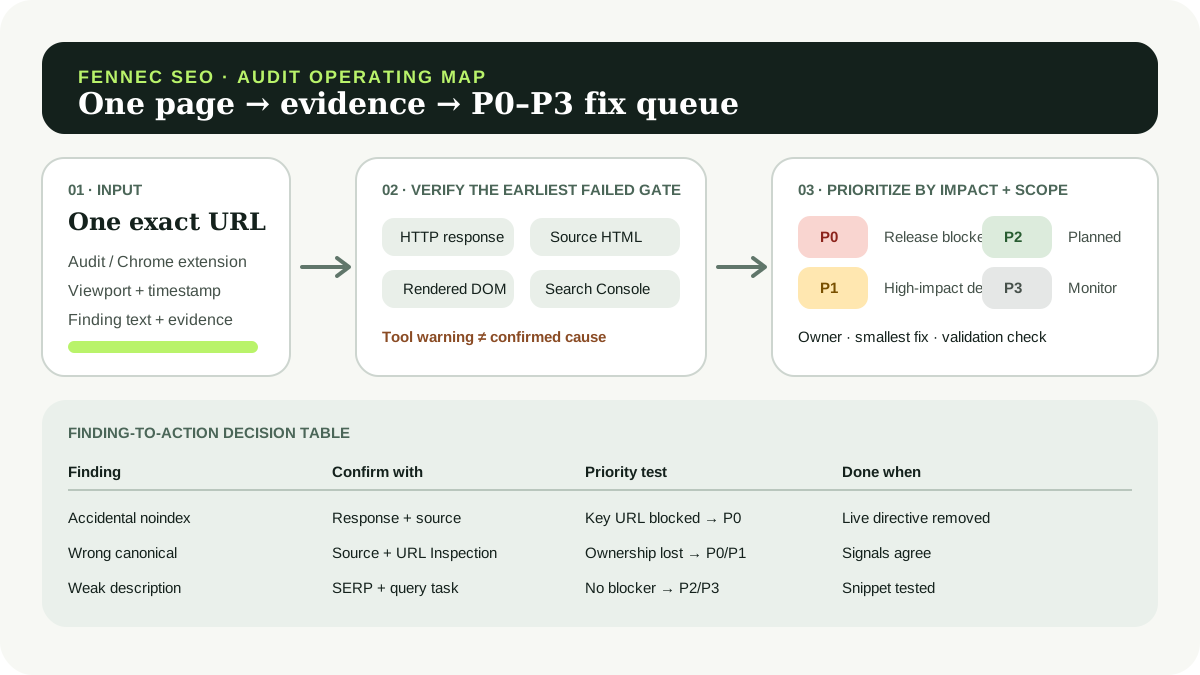
Use one sheet or board to track each finding by URL, failed stage, evidence, owner, fix, and validation date. If you cannot trace a recommendation back to a page and a check, it is not ready for execution.
The 30/60/90 table
| Window | Primary goal | Required work | Validation | Common failure mode |
|---|---|---|---|---|
| Days 1-30 | Establish search eligibility | Verify ownership, submit canonical sitemap, sample URL Inspection, fix status/robots/canonical/render issues, map existing pages to intent | Important templates return the right status, Google can crawl the page, and indexing blockers are documented or fixed | Rewriting titles before proving that Google can process the page |
| Days 31-60 | Publish and connect the cluster | Ship one pillar, two to three focused supporting pages, improve first-screen answers, add crawlable internal links, review mobile templates | New URLs are crawlable, linked, in sitemap, and routed to the right language version | Publishing too many overlapping pages with weak internal support |
| Days 61-90 | Measure, earn evidence, and iterate | Compare date ranges in Search Console, refresh pages with impressions but weak CTR, publish one cite-worthy asset, document winners and dead ends | Query, page, device, and language trends are recorded and tied to the changes made | Declaring success or failure from one ranking screenshot |
Days 1-30: make the site eligible before you scale it
Google says most sites are found automatically as its crawlers explore the web, but eligibility still depends on technical requirements and crawlable paths. In practice, the first month is about proving that your important pages can be discovered, fetched, rendered, and considered for indexing.
What to do
- Verify the site in Search Console and submit the canonical sitemap.
- Sample representative URLs in the URL Inspection tool.
- Review the Page indexing report to separate expected exclusions from real problems.
- Check that important links are real
<a href>links, following Google’s link best practices. - Compare raw HTML, rendered DOM, and Google’s view for one JavaScript-dependent page, using Google’s JavaScript SEO basics.
- Map existing URLs to one intent each: keep, merge, redirect, or noindex.
What to validate
- Final URLs return the intended status code.
- Robots rules do not block pages that should be indexed.
- Canonical, internal links, redirect target, and sitemap all support the same preferred URL.
- The page’s critical copy, title, canonical, and links do not depend on a failing client-side request.
Failure modes to avoid
- Treating every excluded URL as an error instead of checking the URL’s intended role first.
- Requesting indexing for every changed URL instead of fixing the underlying template issue.
- Expanding content output while core templates still have status or canonical conflicts.
Fennec workflow for this phase
Use the Fennec SEO Audit to collect candidate issues, then validate specific causes with the robots.txt checker, canonical checker, sitemap checker, and Bot Simulator. The tool output is a lead, not a verdict.
Days 31-60: publish the smallest useful cluster
Once the site is eligible, publish a compact page set that matches distinct search tasks. For most teams, that means one pillar page plus two or three supporting pages with different jobs, not ten near-duplicate guides.
For the broader workflow, see the Google SEO guide. For the first supporting pages, a useful set often includes a Google SEO audit checklist, a Google keyword research guide, and a Google indexing troubleshooting guide.
What to do
- Publish the pillar page that explains the full workflow.
- Publish supporting pages that solve one independent problem each.
- Improve titles, H1s, and first-screen answers so the main task is clear within the first 100 to 150 words.
- Add descriptive internal links between the pillar, spokes, product pages, and definitions.
- Review one mobile article page and one product page for layout, rendering, and usable navigation.
- Check that English and Chinese pages keep the same facts, dates, and limitations while answering different language intents naturally.
What to validate
- Every new page is linked from at least one crawlable page and appears in the sitemap.
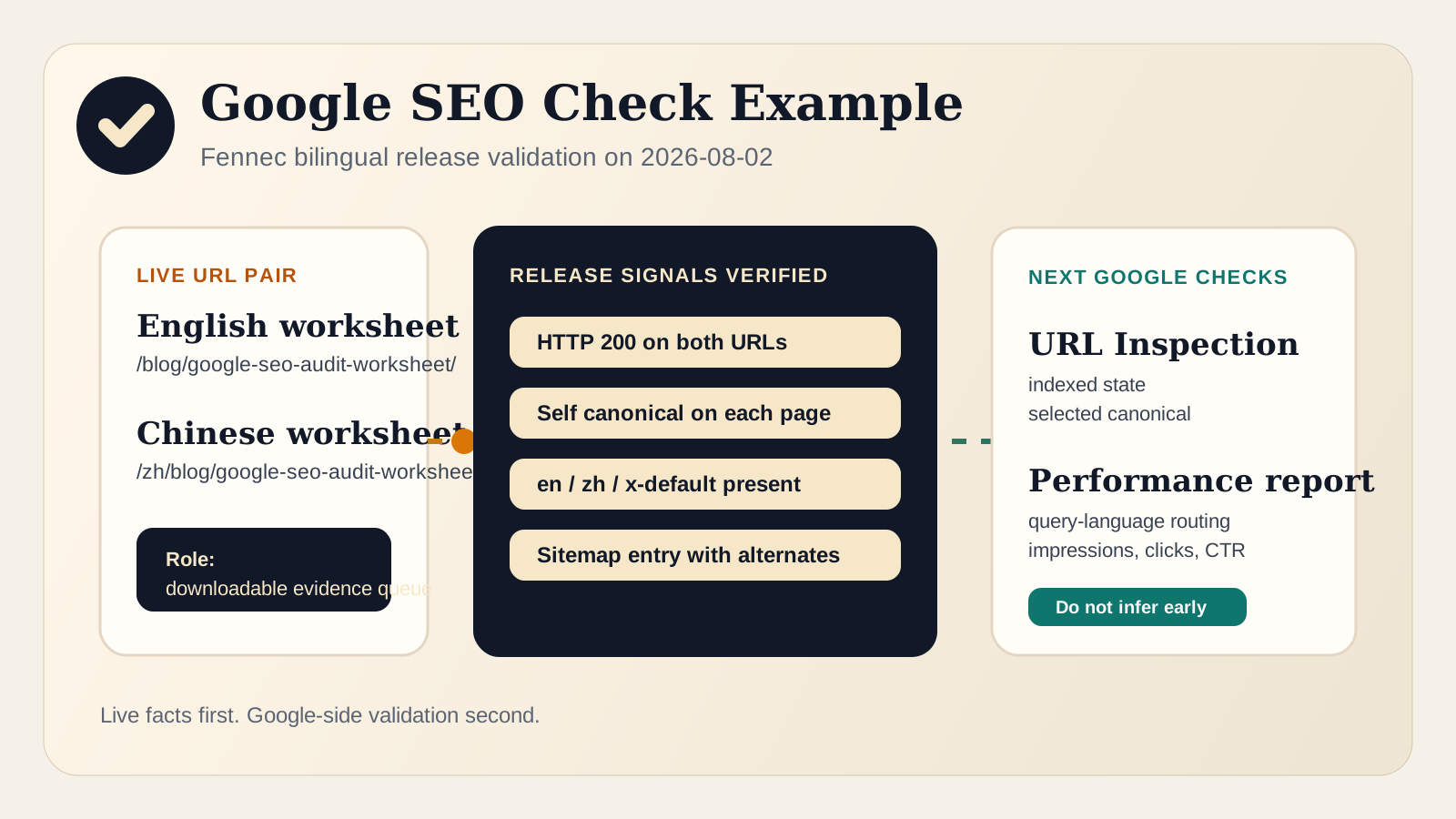
- English and Chinese versions have reciprocal translations, self-referencing canonicals,
hreflang="en",hreflang="zh", and an Englishx-default. - The opening section answers the page’s main task directly instead of delaying the answer behind generic background.
- Product pages remain product pages, Wiki pages remain definitions, and supporting articles stay narrow in scope.
Failure modes to avoid
- Publishing a pillar page and supporting pages that all chase the same exact broad keyword.
- Translating English copy line by line into Chinese instead of rewriting for the Chinese-language search task.
- Adding internal links that rely on buttons, script handlers, or vague anchors instead of stable crawlable links.
Fennec workflow for this phase
Run a page through the link checker to confirm the page is not orphaned, then use the GSC management service page as the handoff point for teams that need ongoing query, indexing, and reporting support after launch.
Days 61-90: measure what changed and earn evidence
The final month is where many teams either overreact or stop too early. Google Search Console’s Performance report exposes clicks, impressions, average CTR, and average position. Use those metrics as operating signals, not as proof that one edit caused one ranking change.
Google also notes that AI feature traffic is included in the overall Web search reporting in Search Console. That means you should keep using the same reporting workflow rather than inventing a separate “AI SEO” scoreboard.
What to do
- Compare two like-for-like date ranges in Search Console, usually complete 28-day windows.
- Segment by page and query before making title or intent changes.
- Refresh pages that have impressions but weak CTR only after confirming the query-page match is sound.
- Publish one cite-worthy asset, dataset, worksheet, or decision model that other pages cannot easily copy.
- Record which URLs gained impressions, which remained unindexed, and which pages overlap on the same query.
- Document every material change with the date, affected URL, and expected outcome.
What to validate
- Pages with new impressions are showing for the intended language audience.
- CTR problems are investigated at query level, not only at site average.
- Conversion or next-step use is tracked separately from traffic.
- Changes made after day 60 can be tied to a page, a template, or a query set rather than to a vague “SEO push.”
Failure modes to avoid
- Calling a page “failed” because it has no visible clicks in a low-volume window.
- Assuming average position alone tells you whether a page needs a rewrite.
- Treating one request-indexing action as recovery proof.
Fennec workflow for this phase
Use the Google SEO guide for the full diagnosis order, the audit checklist to keep evidence structured, and the GSC management page when the team needs recurring query, indexing, and page-level monitoring.
A sample operating log
The example below uses sample data, not a reported production dataset.
| Date | URL | Observation | Evidence type | Action | Validation date |
|---|---|---|---|---|---|
| Day 7 | /blog/example-guide/ | Crawled but not indexed | URL Inspection + Page indexing report | Compare canonical, sitemap, and internal links | Day 14 |
| Day 18 | /product/example/ | Hero copy missing in rendered HTML | Raw HTML vs rendered DOM | Move critical copy server-side | Day 25 |
| Day 43 | /zh/blog/example-guide/ | Impressions growing but CTR weak | Search Console query report | Rewrite title and opening answer | Day 57 |
| Day 72 | /blog/example-guide/ | Same query appears on two pages | Search Console page comparison | Clarify page roles and merge overlap if needed | Day 90 |
The point of the log is not to predict your exact outcome. It is to stop the team from losing track of what changed, why it changed, and how the result should be verified.
Where performance fits
Core Web Vitals still matter because they measure the user experience of loading, interactivity, and visual stability. web.dev describes Web Vitals as guidance for quality signals that matter to users. Use them to improve real page experience, but do not let a marginal performance project outrank a hard indexing blocker in the first 90 days.
The decision rule for the first 90 days
If you need one rule, use this:
fix the earliest failed stage, publish the smallest page set that covers distinct intent, then compare outcomes with the same measurement window.
That rule protects the team from two common failures: shipping too much content before Google can process it, and making ranking claims before the evidence window is mature.
Q&A
Is 90 days enough to judge Google SEO?
Ninety days is enough to establish eligibility, publish a focused cluster, and measure early impressions and clicks. It is not a guarantee that competitive rankings or traffic recovery will happen within that window.
Should a new site build links before fixing crawl and indexing issues?
No. External authority cannot compensate for pages that Google cannot discover, crawl, render, or index reliably. Fix the earliest blocked stage first.
What if impressions rise but clicks do not?
Review the query-page match, title, first-screen answer, snippet alignment, and language routing before concluding that the topic itself has failed.