Google SEO: A Practical Guide from Indexing Diagnosis to Sustainable Growth

Google SEO is the work of making a website discoverable, understandable, eligible for indexing, relevant to a searcher’s task, and credible enough to earn visibility in Google Search. The fastest way to waste an SEO budget is to start with more articles before identifying which stage is broken.
A practical order is:
- confirm that Google can discover the URL;
- verify that Googlebot can crawl and render the important content;
- remove indexing and canonical conflicts;
- match one page to a clear search intent;
- improve usefulness, evidence, and external authority;
- measure impressions, clicks, and business outcomes separately.
This guide follows that sequence. It does not present unofficial theories—such as dwell time, Chrome data, or advertising spend—as confirmed ranking factors. Where certainty matters, it distinguishes Google’s documented guidance, a reproducible site check, a measured outcome, and an interpretation.
What Google SEO means in 2026
SEO does not guarantee a ranking. It improves the conditions under which Google can find a page, understand it, select it as a canonical URL, match it to a query, and present it to a user.
Google’s SEO Starter Guide and Search Essentials remain the safest baseline. For AI Overviews and AI Mode, Google says there are no additional technical requirements or special optimizations; the existing fundamentals still apply in AI features and your website.
That produces two useful boundaries:
- Paid search is not organic SEO. Advertising can generate traffic and useful market feedback, but it should not be described as buying organic trust.
- AI visibility is not a separate indexing system. A page still benefits from being accessible, indexable, useful, and well represented in text, images, video, and structured data.
Four evidence labels to use
| Evidence type | What it supports | Example |
|---|---|---|
| Official guidance | What Google documents or requires | A blocked page may prevent Google from seeing its noindex directive |
| Reproducible check | What anyone can verify on a URL | Raw HTML and rendered DOM have different canonicals |
| Measured outcome | What happened in a defined dataset | Impressions rose after a template fix during a stated date range |
| Interpretation | A plausible explanation, not proof | Better intent alignment may have contributed to the change |
This prevents a common SEO failure: turning correlation, a patent, a leak, or one site’s test into a universal ranking rule.
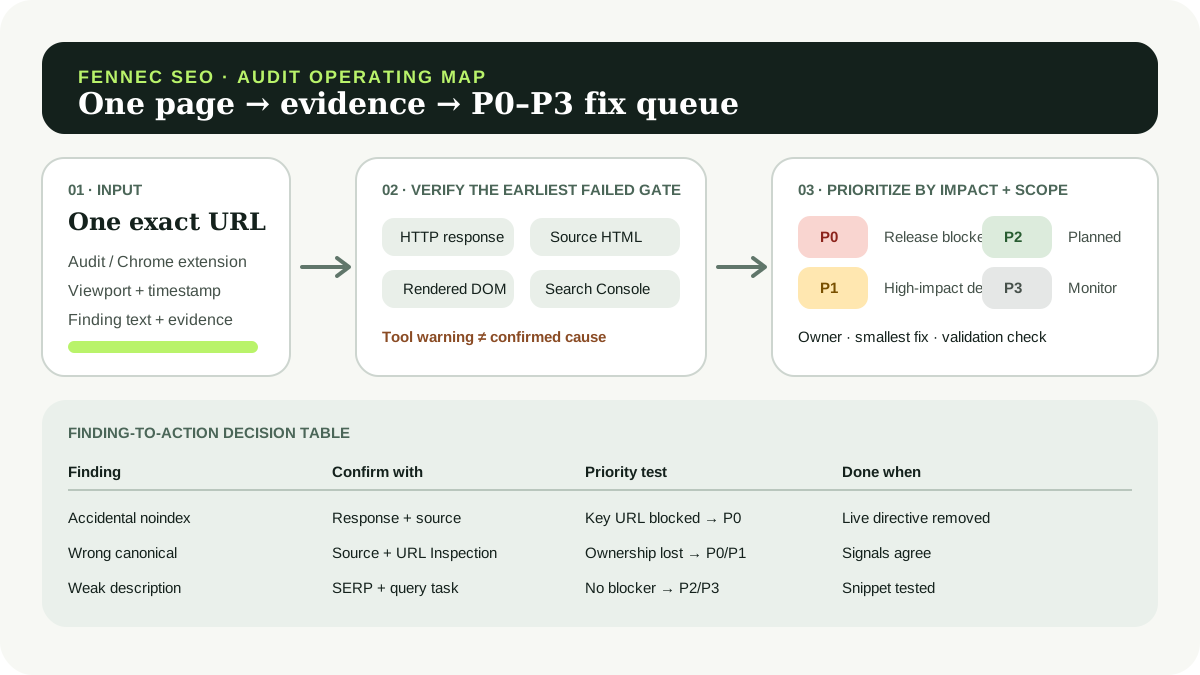
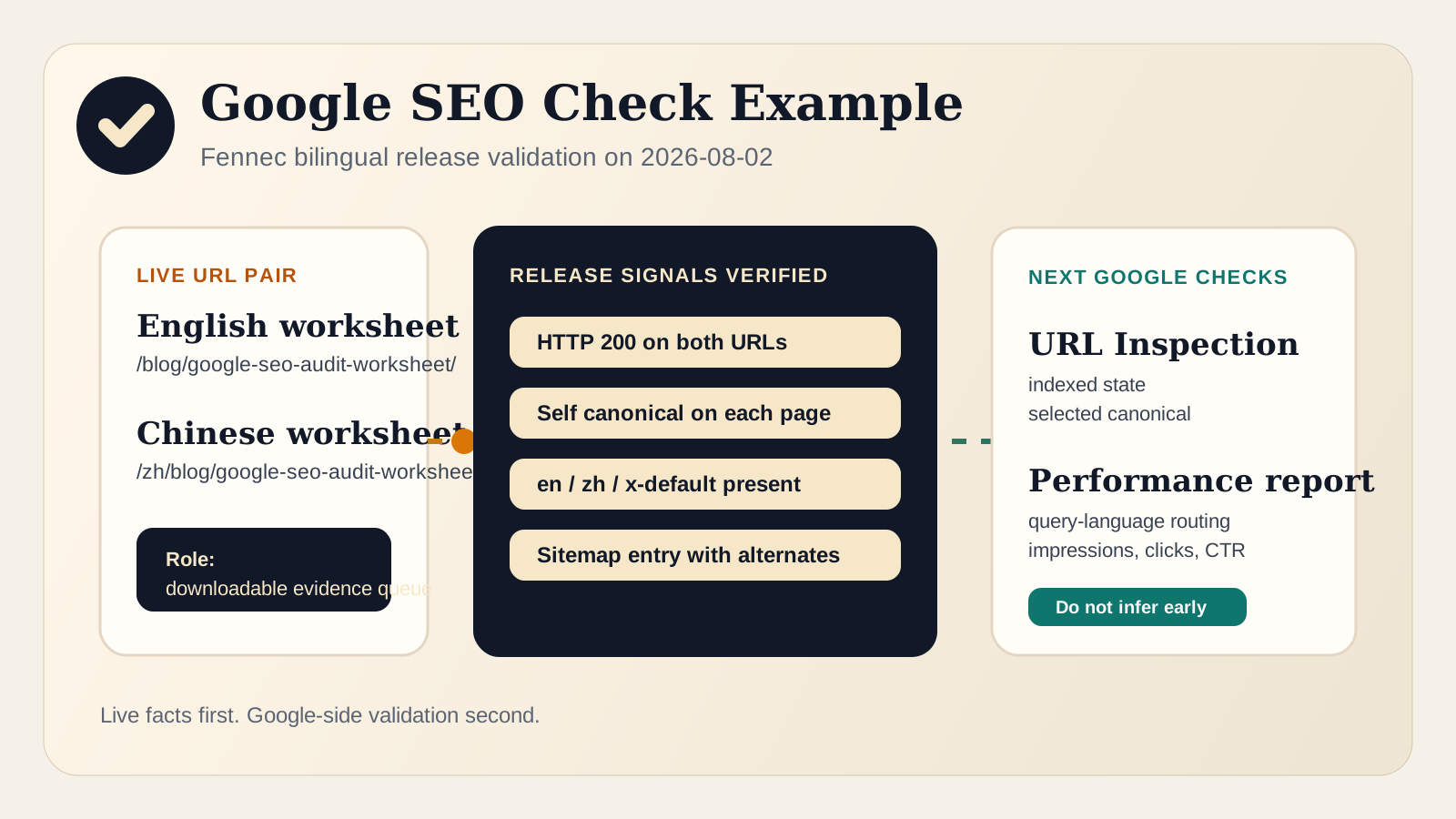
If your team needs a reusable way to separate those claims before changing a page, use the dedicated Google SEO evidence matrix. If you are ready to turn those judgments into an owner-ready action queue, continue with the downloadable Google SEO audit worksheet. If you want to see how that workflow collapses into one bounded bilingual release pass on a Fennec-owned page pair, review the Google SEO check example.
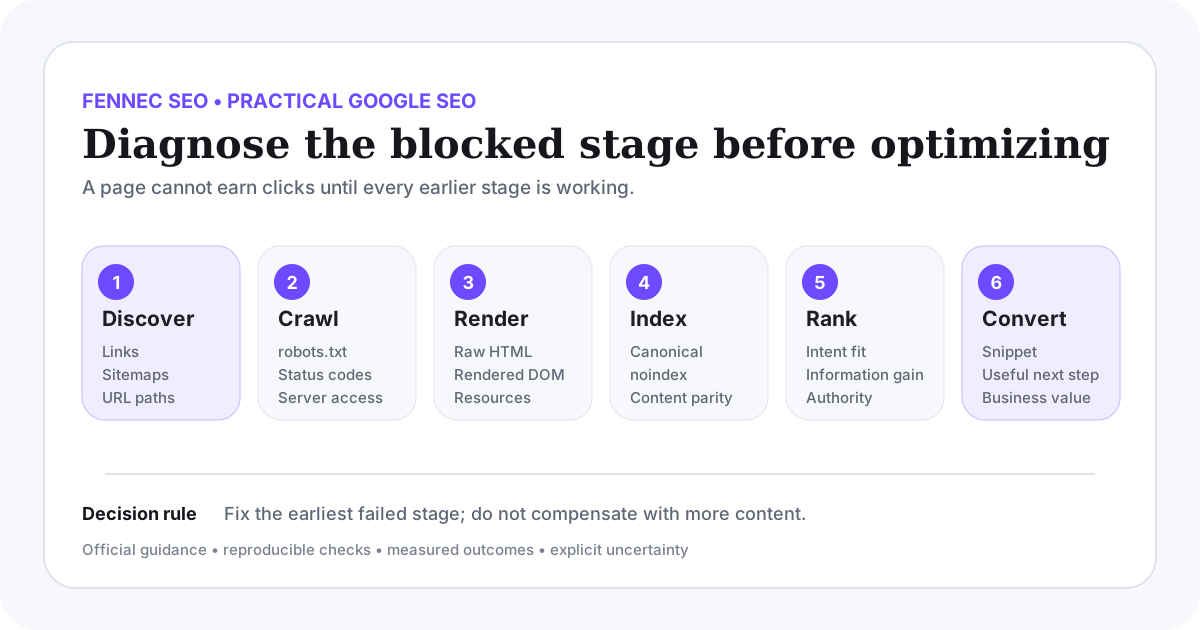
Diagnose the earliest blocked stage
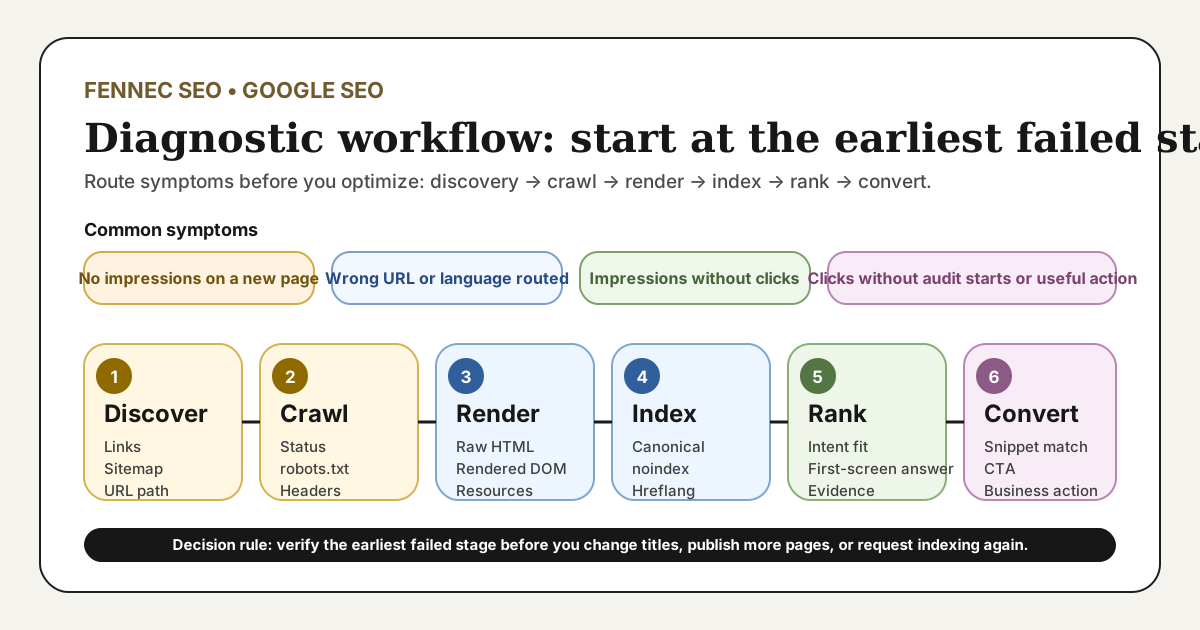
Google describes JavaScript processing as crawling, rendering, and indexing. In an operating workflow, it helps to expand this into six stages: discovery, crawling, rendering, indexing, ranking, and conversion.
If you already have a concrete symptom and need to decide where to start, use the dedicated Google SEO diagnostic workflow before running a broader audit.
1. Discovery
Google needs a path to the URL. Check:
- crawlable internal links using real
<a href>elements; - an XML sitemap containing the preferred absolute URL;
- a logical, stable URL;
- no orphan page hidden from navigation and topic pages.
A sitemap is a discovery and canonicalization signal, not a command to crawl immediately. Google’s sitemap documentation recommends listing the canonical URLs you want in Search.
2. Crawling
Request the URL as a crawler and inspect the response:
- Is the status
200, or is it a redirect,404,soft 404,401, or5xx? - Does robots.txt permit the page and its critical resources?
- Is the server stable enough to respond consistently?
- Are internal links pointing directly to the final URL?
Robots.txt controls crawling; it is not a reliable way to remove an already known URL from the index. Google must be able to crawl a page to see many page-level directives, as its robots meta documentation explains.
Use the Fennec robots.txt checker and link checker to separate access problems from broken paths.
3. Rendering
Compare three views:
- the HTTP response;
- the browser’s rendered DOM;
- Google’s rendered view in URL Inspection.
The important title, main copy, links, canonical, and robots directives should not depend on a fragile client-side request. Google’s JavaScript SEO basics explains that Googlebot queues pages for rendering and later uses rendered HTML for indexing.
Rendering support does not mean rendering is free or instant. Pre-rendering or server rendering can still make critical content available earlier to users and crawlers.
4. Indexing and canonical selection
If a page is crawled but not indexed, check:
noindexin HTML or anX-Robots-Tag;- a canonical pointing elsewhere;
- duplicate or near-duplicate versions;
- empty, gated, or substantially different rendered content;
- soft 404 signals;
- an accidental redirect;
- inconsistent internal links and sitemap URLs.
A canonical is a preference signal, not an absolute instruction. Google describes redirects and rel="canonical" as strong signals and sitemap inclusion as weaker in its canonical documentation. Align all three instead of declaring one URL while linking to another.
Use the canonical checker, sitemap checker, and indexing definition when triaging this layer.
5. Ranking and search appearance
An indexed page may still have little visibility. Now ask:
- Does the page format match the results users prefer for this query?
- Does it answer the primary task near the top?
- Does it add first-hand evidence, a tool, data, a clearer model, or a better decision path?
- Are the title and snippet descriptive rather than exaggerated?
- Does the site have relevant internal and external evidence of expertise?
Do not respond to weak ranking by repeating the exact keyword in every heading. Improve task completion and information gain.
6. Click and conversion
Visibility is not the end. A page can rank yet fail because the snippet misrepresents it, the page is difficult to use, or the next step is unclear.
Measure:
- impressions and query coverage;
- clicks and CTR;
- qualified product-page visits;
- audit starts, downloads, or other relevant actions;
- assisted conversions, not only last-click conversions.
Fix the earliest failed stage. More content cannot compensate for a blocked canonical; more links cannot make an empty page useful.
Build a keyword and intent map
Keyword research is page planning, not a list-generation contest.
Start with four intent groups
| Intent | Query pattern | Appropriate page |
|---|---|---|
| Learn | “what is technical SEO” | Definition or guide |
| Complete a task | “check canonical tag” | Tool or procedure |
| Compare | “SEO audit tools” | Transparent comparison |
| Buy or evaluate | “SEO audit pricing” | Product or service page |
Search the target query and classify the dominant result type, depth, freshness, and audience. Then decide whether your site should create a new page, improve an existing one, or avoid the query.
Give each page one primary job
A pillar page can summarize many stages, but it should link to deeper pages rather than absorbing every subtopic. On Fennec:
- this guide owns the broad Google SEO workflow;
- Technical SEO owns the technical service overview;
- On-page SEO owns page-level optimization;
- Audit owns the product action;
- the Wiki owns concise definitions.
That division reduces cannibalization and creates useful internal paths.
Apply on-page SEO without keyword stuffing
Page-level SEO begins with a coherent promise:
- a descriptive title;
- one clear H1;
- an opening that answers the main question;
- H2 sections based on the reader’s decisions;
- examples, tables, or diagrams where they reduce ambiguity;
- links that explain what the destination adds.
Title and description
Write a title that accurately summarizes the page. A meta description is not a guaranteed Google snippet, but it gives search engines and users a useful summary. Avoid swapping words only to create near-duplicate pages.
Headings and first-screen answer
The first screen should confirm that the visitor chose the right result. Headings should form an information hierarchy, not a place to repeat the primary keyword.
Internal links
Use links to connect a claim to a definition, a diagnosis to a tool, and a summary to a deeper guide. Descriptive anchors are more useful than repeated “click here” or exact-match anchors on every page. See the internal link guide.
Structured data
Structured data can help Google understand eligible page types, but it does not guarantee a rich result or a ranking. Google’s general structured data guidelines require markup to represent visible, non-misleading page content.
Use Article and BreadcrumbList accurately. Do not add unsupported reviews, invented ratings, or FAQ markup solely to chase an appearance that Google may not show.
Keep the technical foundation coherent
A compact technical review should cover:
| Area | Healthy state | Common failure |
|---|---|---|
| Status | Final URL returns the intended status | Error template returns 200 |
| Robots | Important page and resources crawlable | Blocking a page that contains noindex |
| Canonical | Self-reference or deliberate equivalent | Canonical points to another language |
| Sitemap | Preferred canonical URLs only | Redirects and parameter URLs included |
| Hreflang | Reciprocal, valid language mapping | Missing self-reference or wrong locale |
| Rendering | Critical content present and stable | Main copy appears after a failing API call |
| Mobile | Same essential content and metadata | Mobile version omits important content |
| Performance | Fast, stable, responsive experience | Oversized hero delays main content |
Run a technical SEO review, then validate the representative templates affected by each fix. A passing homepage does not prove that articles, product pages, and localized routes are healthy.
Create content that improves the result set
Google’s people-first content guidance asks whether a page provides original information, substantial analysis, clear sourcing, and value beyond other results.
Use that as an editorial gate:
- State the reader’s task. What decision or repair should become easier?
- Add a specific contribution. Use a test, dataset, workflow, template, screenshot, expert review, or well-scoped synthesis.
- Show provenance. Link primary sources and identify the author or reviewer.
- Declare limitations. Name the date range, sample, exclusions, and uncertainty.
- Remove padding. A shorter complete answer is better than a longer generic one.
AI can assist research, outlining, translation, and editing. It does not remove the need to verify facts, own the recommendation, and add something the source material did not already provide. Google’s spam policies focus on manipulative and scaled-abuse patterns, not a simplistic ban on a writing tool.
Build authority without pretending every link is equal
Useful external authority can come from:
- original data or tools others cite;
- expert contributions with real editorial review;
- relevant partnerships and community resources;
- digital PR tied to a verifiable finding;
- accurate product documentation and public methodology.
Avoid paid link schemes, mass guest posting, and unrelated directory submissions. Third-party authority scores can help prioritize investigation, but they are not Google metrics.
Internal links distribute context inside your site; independent mentions supply evidence from outside it. You normally need both, in proportions that depend on the query and competitive field.
Measure progress in Search Console
The Search Console Performance report provides clicks, impressions, CTR, and average position. Google recommends paying more attention to trends in impressions and clicks than to position alone.
Review the cluster at page and query level:
- Is the pillar earning new non-branded queries?
- Which queries have impressions but weak CTR?
- Are several pages appearing for the same query?
- Did a technical fix improve discovery or indexing before clicks?
- Are English and localized pages appearing for the intended audience?
Search Console omits some anonymized queries and aggregates data differently by property and page. Treat the numbers as operational measurements with documented limitations, not a complete record of every search.
A 30/60/90-day Google SEO plan
If you need a symptom-to-stage route first, use the Google SEO diagnostic workflow. If you need owners, validation checks, and failure modes for each phase, use the dedicated Google SEO 30/60/90-day plan.
Days 1–30: establish eligibility and a baseline
- verify ownership and submit the canonical sitemap;
- sample important templates in URL Inspection;
- fix blocking status, robots, canonical, and rendering conflicts;
- map existing pages to intent;
- merge or redirect obvious duplicates;
- record baseline indexed pages, impressions, clicks, and non-branded queries.
Days 31–60: publish and connect the cluster
- publish the pillar and first three focused supporting pages;
- improve titles, first-screen answers, headings, and internal links;
- add original diagrams, examples, and checklists;
- connect relevant product, Wiki, and blog pages bidirectionally;
- review mobile layout and representative Core Web Vitals.
Days 61–90: earn evidence and iterate
- publish one cite-worthy asset or dataset;
- seek relevant, editorially earned mentions;
- compare 28-day periods in Search Console;
- refresh high-impression, low-CTR pages;
- separate pages that serve different intents and consolidate those that do not;
- document what changed, when, and what happened next.
The practical decision rule
Good Google SEO is not “publish more and wait.” It is a controlled loop:
diagnose the earliest failure → make one traceable improvement → verify the page → measure the right stage → keep, revise, or reverse the change.
Start with a representative Fennec SEO audit, but treat every automated finding as a lead to verify. The goal is not a perfect tool score. The goal is a site that Google can access and understand, and that people choose because it completes their task better than the alternatives.
Q&A
How long does Google SEO take?
There is no universal timeline. Technical fixes may be recrawled quickly, while competitive non-branded growth can take months. Track discovery, indexing, impressions, and clicks as separate milestones.
Should a new site publish content or fix technical SEO first?
Fix anything that prevents discovery, crawling, rendering, or indexing first. Then publish useful pages against a deliberate intent map instead of waiting for technical perfection.
Can AI-generated content rank in Google?
Google focuses on content quality and policy compliance rather than the production tool. AI-assisted content still needs original value, accurate sourcing, editorial review, and a clear audience.
Do I need backlinks to rank?
Not every query requires the same level of external authority, but links and independent mentions can help establish discovery and trust. They cannot rescue an inaccessible or unhelpful page.
Do AI Overviews require special SEO markup?
Google says there are no additional technical requirements or special optimizations for AI Overviews and AI Mode. The existing SEO fundamentals remain relevant.