Hreflang, Canonicals, and Sitemaps for AI Search and Multilingual SEO

AI search does not replace multilingual SEO hygiene.
If your English page points hreflang to /zh/, but the Chinese page canonicalizes back to English, Google receives two different instructions about the same content set. The result is not “more coverage.” It is ambiguity.
That matters for classic search results and for AI-powered search features that still depend on crawlable, indexable, well-understood pages.
This article focuses on one practical question:
How do you keep hreflang, canonical tags, sitemaps, and internal links aligned so the right language URL is the one Google can trust?
If you need the broader technical foundation first, pair this workflow with Technical SEO, Audit, Canonical Checker, Hreflang Checker, and Sitemap Checker.
Why This Still Matters For AI Search
Google’s AI features do not replace the normal rules for discovering and understanding pages. If the wrong language version gets indexed, if alternates are incomplete, or if a sitemap only lists one locale, the page set becomes harder to interpret.
For multilingual publishers, the operational risk is simple:
- the wrong locale ranks
- the right locale is crawled too slowly
- localized snippets or summaries are inconsistent
- internal links keep pushing crawlers back to the default language
This is why multilingual signals should be treated as a system, not as isolated tags.
The Three Signals Do Different Jobs
hreflang, canonical tags, and XML sitemaps are related, but they do not mean the same thing.
| Signal | Main job | Common mistake | Better rule |
|---|---|---|---|
hreflang | Tells Google which alternate language or regional version belongs in the set | Missing return links or wrong language codes | Every version should reference itself and its alternates consistently |
| Canonical | Tells Google which URL is the preferred version for that specific page | Canonicalizing every translation to English | For true translations, each locale should usually be self-canonical |
| XML sitemap | Helps discovery and keeps important localized URLs visible | Listing only default-language pages | Include every important language URL and keep lastmod accurate when content changes materially |
The safe mental model is:
hreflanghandles language relationships.- canonical handles duplicate preference.
- sitemaps support URL discovery.
When teams try to make one signal do all three jobs, multilingual bugs start.
Do Not Canonicalize Real Translations Back To English
One of the most common multilingual failures is this pattern:
- English page is indexable
- Chinese page exists at a stable
/zh/URL - Chinese page adds
rel="canonical"pointing to English hreflangstill claims both pages are alternates
That is a mixed signal.
If the Chinese page is a real translation, not a near-duplicate template clone, it should normally canonicalize to itself and use hreflang to connect the pair.
Example:
<link rel="canonical" href="https://example.com/zh/blog/sample/" />
<link rel="alternate" hreflang="en" href="https://example.com/blog/sample/" />
<link rel="alternate" hreflang="zh-Hans" href="https://example.com/zh/blog/sample/" />
If you instead canonicalize the Chinese page to English, you are effectively telling Google that the English URL is the preferred document and the Chinese URL is secondary noise.
That can undercut the whole reason you created the localized page.
Pick One Hreflang Implementation And Keep It Clean
Google supports hreflang in:
- HTML
<link rel="alternate" hreflang="..."> - HTTP headers
- XML sitemap annotations
You do not need all three.
In practice, most content sites should choose the easiest implementation to maintain correctly. For many Astro or CMS sites, that is HTML tags. Large platforms sometimes prefer sitemap-based annotations because templates vary by page type.
The important rule is not “use more methods.” The important rule is:
Use one method consistently enough that it does not drift.
If your HTML says zh-Hant, your sitemap says zh, and your language switcher points to /cn/, the extra implementation does not strengthen the signal. It multiplies maintenance failure points.
Locale-Adaptive Pages Are Usually The Wrong Shortcut
A locale-adaptive page changes language or content based on IP, Accept-Language, cookies, or JavaScript detection while keeping the same URL.
That may look user-friendly, but it is harder for crawlers to interpret and validate. Google has long warned that locale-adaptive setups need extra care because crawlers do not browse like every real visitor.
For most multilingual content programs, stable language URLs are safer:
/blog/example//zh/blog/example/
Stable URLs make it easier to:
- crawl each version directly
- assign self-canonical tags
- connect
hreflang - list alternates in sitemaps
- test with Bot Simulator and Audit
If you use a language selector or fallback homepage, x-default can help. But it is usually a selector-page signal, not a substitute for proper localized URLs.
Internal Links Must Respect The Active Language
Many multilingual sites technically generate hreflang, but still leak authority and crawl attention back to the default language through navigation, breadcrumbs, related posts, or CTA buttons.
That creates a second class of mixed signal:
- metadata says “this page belongs to Chinese users”
- body links keep sending crawlers and users to English destinations
For content clusters, each language version should link naturally to the right localized supporting pages:
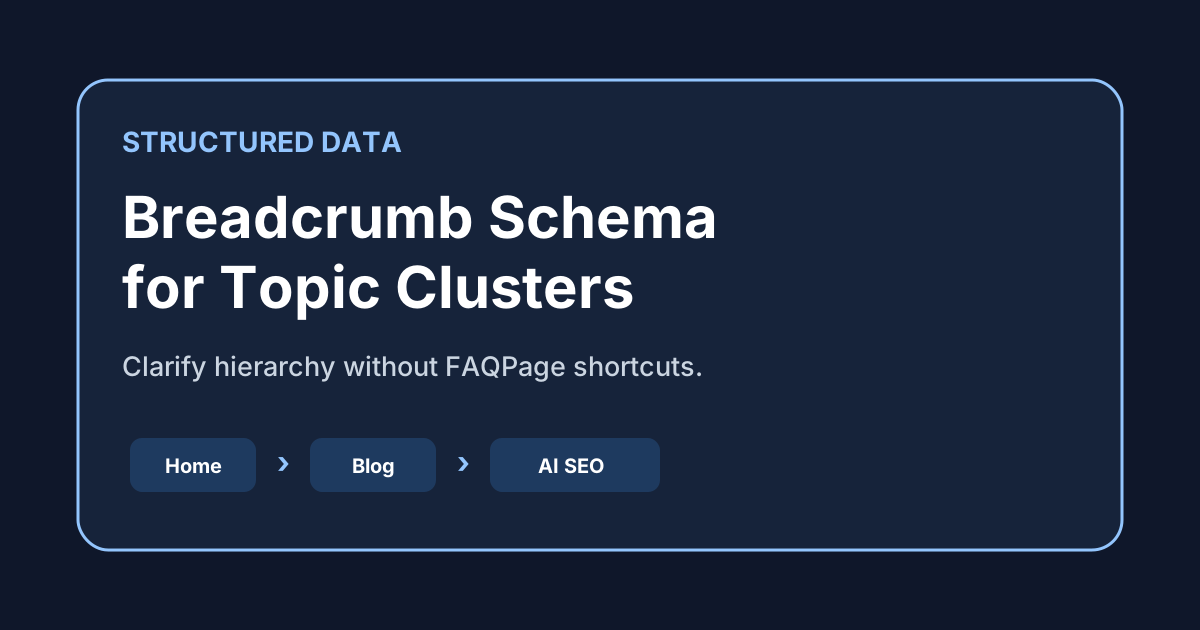
- Breadcrumb Schema for Topic Clusters
- Noindex, Nosnippet, Max-Snippet, and X-Robots-Tag for AI Search
- How to Test What AI Crawlers See
- Agent-Friendly Website Audit Checklist
And the product links around the article should also stay localized where possible:
If the Chinese article keeps linking back to English tools or English supporting posts by default, your localization system is unfinished.
A Practical Five-Step Workflow
Use this workflow before publishing or refreshing a bilingual article set.
1. Confirm URL structure first
Decide the permanent language paths before publishing:
- English:
/blog/topic-slug/ - Chinese:
/zh/blog/topic-slug/
Do not change locale prefixes casually after indexing begins.
2. Add self-canonical tags on each language page
Each real translation should usually canonicalize to its own URL, not collapse into another language version.
3. Connect alternates with hreflang
Every page should reference:
- itself
- the matching alternate language pages
x-defaultonly when you really have a neutral selector or fallback page
4. Put both URLs in the XML sitemap
Make sure the sitemap exposes both language pages and stays current after edits, migrations, or slug changes. If you use sitemap annotations for alternates, validate the generated output rather than trusting the CMS.
5. Test live output, not only templates
Check the rendered URL, response headers, canonicals, and internal links on the live page or preview build. This is where Extension, Audit, and Technical SEO become useful.
A Bilingual Validation Checklist
Before shipping, verify these points for both URLs:
| Check | Why it matters |
|---|---|
Each page returns 200 | Basic crawlability and indexability |
| Canonical is self-referential | Prevents translation collapse |
hreflang codes match the actual locale | Reduces alternate mismatch |
| Alternate links are reciprocal | Helps Google trust the set |
| Sitemap includes both URLs | Supports discovery and monitoring |
| Navigation and related links stay in-language | Reduces default-language drift |
| Structured data URLs match the page locale | Prevents mixed entity signals |
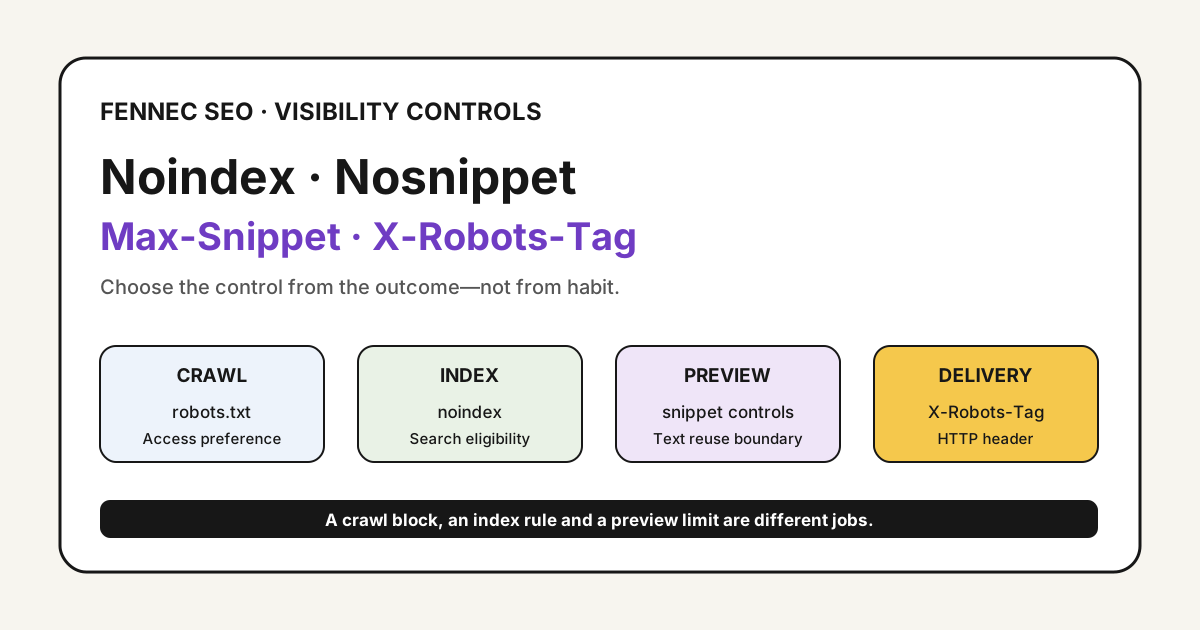
This is also the right moment to review snippet controls and indexing directives. A bilingual page pair with correct hreflang but conflicting noindex or nosnippet rules is still unstable. If that is your problem, continue with Noindex, Nosnippet, Max-Snippet, and X-Robots-Tag for AI Search.
Four Failure Patterns To Catch Early
1. Correct hreflang, wrong canonical
The tags say alternates exist, but the canonical says only English matters.
2. Correct sitemap, broken language switcher
Google can discover the localized URL, but users and crawlers keep re-entering the default locale through internal links.
3. Correct page tags, stale sitemap
The page pair is fine, but the sitemap still lists an old slug or omits the Chinese URL after a migration.
4. Correct translations, weak localized templates
The body is translated, but title, description, breadcrumbs, structured data, or CTA links remain in the wrong language.
Validation Commands
Use direct checks before you trust the page:
curl -I https://example.com/blog/topic-slug/
curl -I https://example.com/zh/blog/topic-slug/
Inspect the page source or rendered HTML for:
- canonical
hreflang- language-specific internal links
- indexability directives
Then compare them with:
Sources
- Google Search Central: Managing multi-regional and multilingual sites
- Google Search Central: Tell Google about localized versions of your page
- Google Search Central: How to specify a canonical URL with rel=“canonical” and other methods
- Google Search Central: Build and submit a sitemap
- Google Search Central: AI features and your website
The Practical Standard
For multilingual AI search readiness, do not chase special tricks.
Keep the operational basics aligned:
- one stable URL per language version
- self-canonical for real translations
- consistent
hreflang - localized internal links
- sitemap coverage for every important locale
That is the safer way to help Google understand which page belongs to which audience, without promising rankings, citations, or AI summaries you do not control.
Q&A
Should every translated page canonicalize to the English original?
No. If the page is a true translation, Google recommends giving each language version its own canonical URL and connecting alternates with hreflang.
Do I need HTML tags, HTTP headers, and sitemap hreflang at the same time?
No. Google supports multiple implementations, but using one method consistently is usually easier to maintain and audit.
Does x-default belong on every localized page?
Usually not. It is most useful for a language selector or fallback page when you want a neutral default destination.
Can AI search visibility improve if multilingual signals are inconsistent?
Do not count on that. Mixed signals make it harder for Google to understand which language page should be crawled, indexed, and shown.