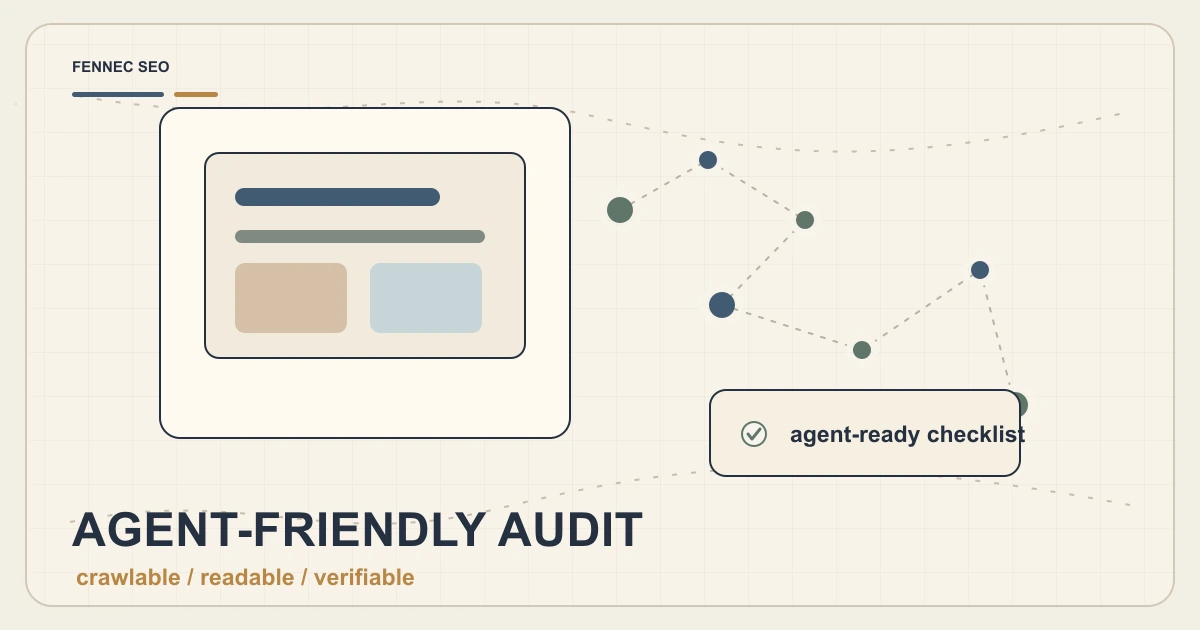

AI agents are starting to browse, compare, fill forms, and complete tasks for users. That changes how we think about technical SEO.
The goal is no longer only “Can Google index this page?”
The next question is:
Can an AI agent understand the page, navigate it, and complete the user’s task without guessing?
This checklist turns that question into an audit.
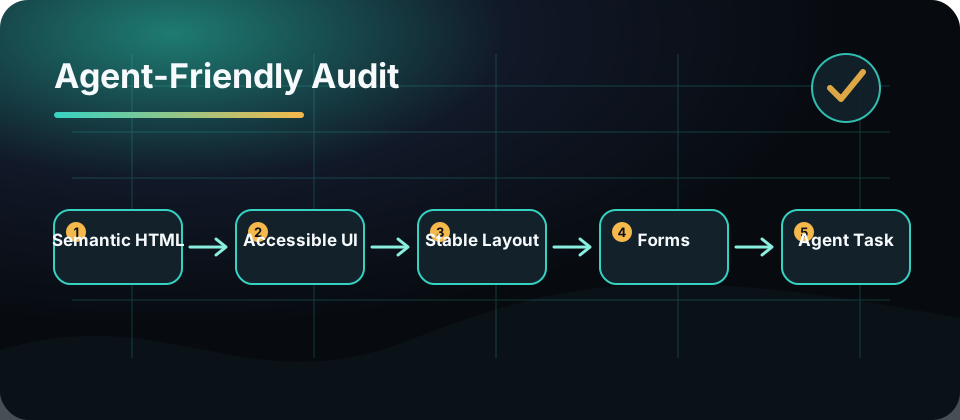
1. Semantic HTML
Agent-friendly pages start with meaningful HTML.
Check:
- One clear
<h1> - Logical heading order
- Real
<a>links for navigation - Real
<button>elements for actions - Lists marked as lists
- Tables used for tabular data
- Forms use labels and input types
- Main content wrapped in semantic regions where possible
Semantic HTML helps browsers, screen readers, crawlers, and agents understand what each element does.
2. Accessibility Tree
Many agents and assistive tools rely on accessibility signals.
Check:
- Buttons have accessible names
- Form fields have labels
- Images have useful alt text when informative
- Decorative images are not noisy
- Error messages are connected to fields
- Dialogs and menus manage focus
- Keyboard navigation works
Use this rule: if a keyboard user cannot complete the task, an agent may struggle too.
3. Stable Layout And Clear States
Agents often work from screenshots, DOM, and accessibility data. Layout shifts and hidden states make actions harder.
Audit:
- Core actions are visible without hover
- Buttons do not move unexpectedly
- Cookie banners do not block primary tasks forever
- Modals have clear close controls
- Loading states resolve predictably
- Mobile and desktop show equivalent main content
- Forms preserve typed data after errors
This overlaps with Core Web Vitals, especially CLS and INP.
4. Crawlable Navigation
Agent-friendly sites still need classic crawl paths.
Check:
- Important pages are linked in HTML
- Navigation does not require only JavaScript click handlers
- Breadcrumbs are present on deep pages
- Footer links expose core tools and resources
- XML sitemap includes canonical URLs
- Internal links use descriptive anchor text
For Fennec, important paths include Audit, Extension, Bot Simulator, Schema Markup, and GSC Management.
5. Machine-Readable Context
Do not chase special AI markup first. Start with proven context signals:
- Title and meta description
- Canonical URL
- Open Graph tags
- Article schema
- Breadcrumb schema
- Product or SoftwareApplication schema where relevant
- Organization and author consistency
Use Schema Markup to validate the structured data that actually matches page content.
6. Form And Action Audit
If agents will complete tasks, forms matter.
Check:
- Inputs have visible labels
- Required fields are clear
- Error messages explain the fix
- Submit buttons describe the action
- Success states are obvious
- Login walls are not accidental
- Pricing and checkout paths are understandable
For SaaS and tools, this can affect conversions from both human users and agent-assisted sessions.
7. Content Extractability
An agent should be able to extract:
- What the page is about
- Who created it
- When it was updated
- What problem it solves
- What action to take next
- What sources support the claims
If the page needs a human to infer everything from design alone, it is not agent-friendly.
8. Bot And Rendering Tests
Run technical tests:
- Compare browser view and crawler view
- Compare raw HTML and rendered DOM
- Test mobile and desktop
- Check robots.txt
- Check redirects
- Validate canonical and hreflang
- Confirm primary content is visible
Use Bot Simulator and Technical SEO checks together.
Agent-Friendly Scorecard
| Area | Good signal |
|---|---|
| HTML structure | Headings, links, buttons, forms are semantic |
| Accessibility | Controls have names and keyboard flow works |
| Layout | Stable, predictable, low friction |
| Navigation | Important pages are linked and crawlable |
| Context | Metadata and schema match visible content |
| Actions | Forms and CTAs are clear |
| Rendering | Main content appears consistently |
Takeaway
Agent-friendly optimization is not a separate trick. It is technical SEO, accessibility, UX, and structured content meeting in the same place.
Make pages semantic, stable, crawlable, accessible, and easy to act on. That helps humans first, and agents second.