AI Mode Changed My Content Brief: How I Write for Query Fan-Out in 2026
I used to write content briefs around a primary keyword, three secondary keywords, and a list of related questions. That still helps, but in 2026 it feels incomplete.
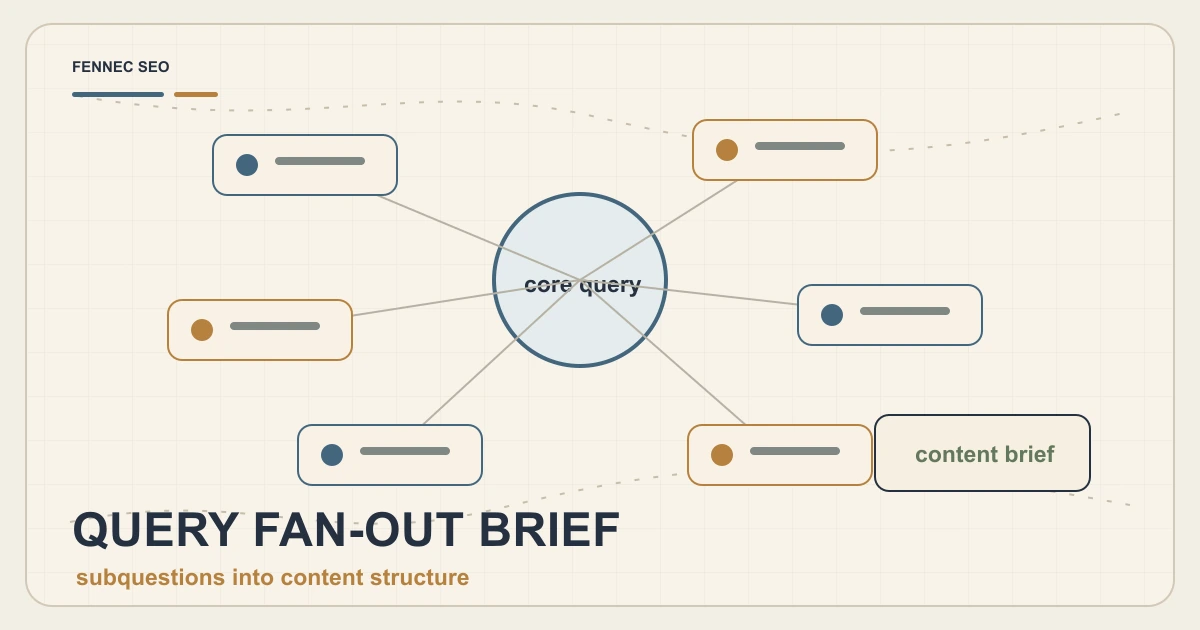
Google’s AI search experience is no longer just matching one query to one page. In its official AI optimization guide, Google explains that generative AI features use retrieval-augmented generation and a technique called query fan-out. In plain English, the system can break one search into a set of related searches, gather supporting pages, and build a more complete answer.
That changes how I brief content.
I do not think the answer is “write longer posts.” The answer is to write pages that survive follow-up questions.
The Old Brief Is Too Flat
The old SEO brief usually asked:
- What is the target keyword?
- What are the top-ranking pages?
- What headings do competitors use?
- How many words should we write?
- Which internal links should we add?
That brief can still produce a decent article, but AI Mode and AI Overviews raise the bar. A page now needs to be useful not only for the first search, but also for the follow-up questions hiding inside that search.
If someone asks “how do I improve SEO for an AI search result,” they may also need:
- What does Google actually say about AI search optimization?
- Is this different from normal SEO?
- What technical basics still matter?
- How do I make my author and brand trustworthy?
- How do I measure whether this work is helping?
That is where query fan-out matters. If my article only answers the headline query, it may be too shallow to become a useful source.
A Coffee Journey: Comparison, Images, Help, Then Local Stock
Google’s October 1 coffee examples make the follow-up journey concrete: compare brewing methods in AI Mode, ask about a photographed latte pattern with Lens, get pouring advice through Search Live, and look for nearby equipment. These are different ways into a coffee task, not one interchangeable interface.
The sequence below is an illustrative content-planning exercise based on those examples, not a captured Google session or a record of the system’s internal queries. Google’s AI features documentation says AI Mode and AI Overviews may issue related searches through query fan-out; it does not reveal the exact subqueries behind this coffee example. A reader’s visible follow-up questions and the system’s hidden retrieval work are not the same thing.
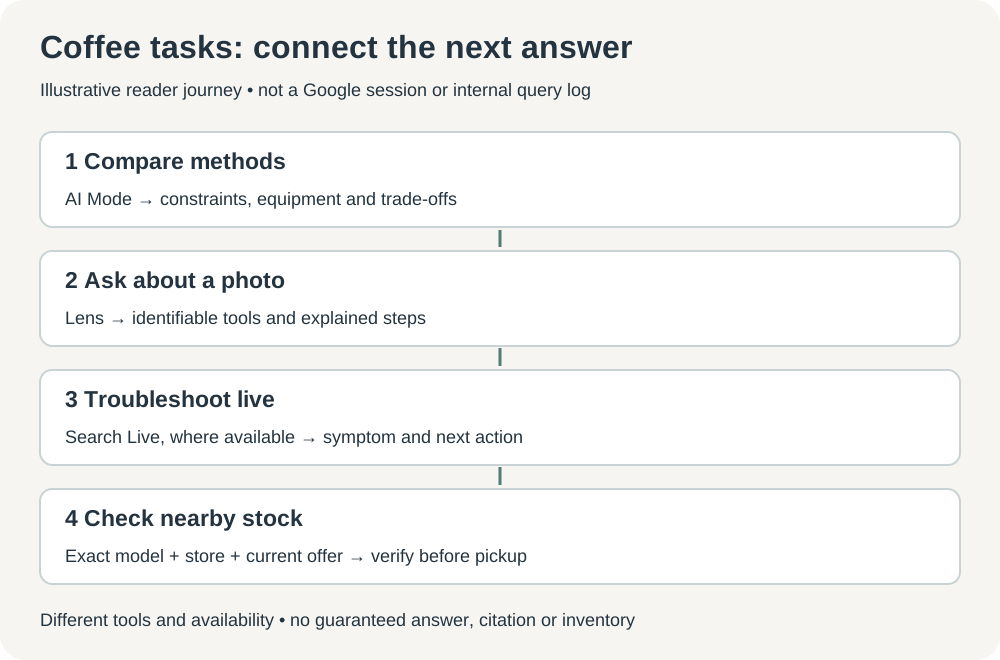
| Reader’s next decision | Example input for the exercise | What the destination page needs to resolve |
|---|---|---|
| Choose a brewing method | Compare French press, pour-over and cold brew for equipment, effort and taste | Explain the trade-offs and what changes with technique; label opinions and measured results separately |
| Understand a visual result | Show a latte-art photo and ask what tools and steps it needs | Pair an identifiable image with text explaining equipment, milk texture and sequence; a decorative photo alone cannot teach the technique |
| Troubleshoot while doing it | Ask for help while pouring, using Search Live if available | Provide an observable symptom → possible cause → next action, with a useful video or image sequence; do not pretend a static article gives live feedback |
| Obtain the missing tool | Search for an appropriate grinder or kettle nearby | Identify the exact model, store, price and inventory freshness; distinguish a local offer from a generic product recommendation |
Build the hand-off around the missing answer
Suppose a reader chooses pour-over and now needs a grinder. The comparison page should explain the equipment requirement, then link to the relevant equipment explanation or exact product—not send every reader to an undifferentiated shop homepage. A technique page should define the pictured tool before asking the reader to buy it. If stock cannot be verified, say so and direct the reader to the merchant’s current offer; never turn a search result into a guarantee of same-day pickup.
Here is a small desk exercise you can reproduce with your own pages:
- Start with one comparison URL and write down the reader’s decision and missing constraint, such as available equipment or preparation time.
- Follow the actual contextual link to the technique page. Can its text and images explain the next action without requiring a new search? Mark the hand-off missing if there is no relevant destination.
- Follow any product or store link. Match the model or variant, check when availability was updated, and verify the merchant’s current pickup information before making a purchase decision.
- Record the starting question, destination URL, unresolved question and evidence needed. A usable output is a list of specific gaps, not a claim that an AI engine cited the pages.
The expected outcome is a connected answer path: method choice → technique or equipment explanation → a verifiable offer. It need not all live on one enormous page. Use the query fan-out definition to distinguish related retrieval from keyword cloning; use multimodal search and the image discoverability audit for image-specific checks. Keep the decision-focused sections connected with internal links and clear reader-intent research.
The original announcement also mentions optional connected-app personalization for finding classes. That is a separate, user-authorized capability, not a requirement for a coffee article to be useful. Feature availability, language, device and account conditions can differ. This mapping promises neither identical AI answers nor inclusion, rankings or citations.
My 2026 AI Mode Brief
Here is the brief format I use now.
1. Start With The One-Sentence Answer
Before I write the outline, I write the answer I want the page to be known for.
For example:
To improve AI search visibility, create crawlable, well-structured pages that answer the main question clearly, add original experience, and connect the topic to trusted author and brand entities.
This sentence becomes the north star. If the article cannot support that answer, the article is not ready.
2. Map The Follow-Up Journey
I list the follow-up questions a reader would naturally ask after the first answer.
For an AI search article, my follow-up map might include:
- What changed in Google AI Mode?
- How does query fan-out affect content planning?
- What should stay the same from traditional SEO?
- What proof should a creator include?
- How should the page be refreshed after publication?
This keeps the article focused on a real user journey instead of a keyword checklist.
3. Add Original Proof
Google’s AI guidance keeps pointing back to helpful, reliable, people-first content. For me, that means every serious article needs at least one of these:
- A personal workflow
- A real checklist
- A before-and-after example
- A screenshot or audit result
- A practical template
- A clear opinion based on doing the work
This is where smaller creators can win. A large site may have authority, but a creator can publish lived experience that is harder to copy.
4. Make The Page Easy To Extract
I now write with “source-worthiness” in mind.
That does not mean writing for robots. It means making key ideas easy to understand, quote, and verify:
- Use descriptive H2s and H3s
- Answer important questions directly before expanding
- Avoid vague claims
- Add links to primary sources
- Use lists when a process has steps
- Keep definitions clean and consistent
When a page has clear sections, both humans and search systems can understand what each section contributes.
5. Connect The Author Entity
This is the part many content teams skip.
If a page is written by a person, I want that person to look like a real entity, not a random byline. That means:
- A stable author page on the site
- A short, specific author bio
- Links to the author’s own site or public profile
- Consistent names across posts and schema
- Article schema that identifies the author as a Person
For my own posts on Fennec SEO, adding my personal site, Anna SEO Journey, helps connect my byline with an external author identity. It is not magic, but it is a cleaner entity signal.
What I Stopped Doing
The biggest change is what I no longer put in a brief.
I no longer ask writers to create ten near-identical articles just because keyword tools show ten variants. Query fan-out makes that strategy feel weaker, not stronger.
I also stopped treating AI Overviews as a separate content universe. Google’s guidance says the basics still matter because generative AI features are rooted in core Search ranking and quality systems. The smart move is not to abandon SEO. The smart move is to make SEO content more complete, more original, and easier to trust.
A Simple Template You Can Copy
Here is the content brief template I would use for a new AI SEO article:
- Main reader question:
- One-sentence answer:
- Follow-up questions:
- Original proof or experience:
- Primary sources to cite:
- Internal links:
- Author entity signals:
- Schema needed:
- Refresh date:
- Success metric:
That last line matters. If the goal is AI search visibility, I want to know what I will check later. It might be Google Search Console queries, branded searches, AI referral traffic, or whether the article starts earning citations and mentions.
My Takeaway
AI Mode does not make content strategy mysterious. It makes weak content briefs more obvious.
A strong 2026 article should answer the first question, support the next five questions, and show why this author is a trustworthy source. That is the kind of page I want attached to my name.
The workflow is simple: write for the journey, prove the advice, connect the author, and make the page easy to understand.
That is where I am putting my effort now.
Sources I Checked
- Google Search Central: AI optimization guide
- Google Blog: AI Mode in Search
- Google Blog: Coffee tasks across Search tools
- Google Search Central: AI features and your website
- Fennec SEO: Google’s Official AI SEO Guide
Q&A
Does query fan-out mean I need a separate article for every long-tail keyword?
No. Query fan-out makes thin keyword cloning less useful. A stronger page answers the core question clearly, then covers the natural follow-up questions a real reader would ask.
Can content creators appear in AI Mode without being huge publishers?
Yes, but the page needs to be crawlable, specific, useful, and backed by real experience or evidence. Small sites can compete when they publish original examples and clear explanations.
What should I audit first for AI search visibility?
Start with indexability, titles, headings, author information, schema markup, internal links, and whether the page answers the main question in a concise, source-worthy way.