Query Fan-Out SEO: A Content Brief Template for Google AI Mode

Classic SEO briefs were built around one primary keyword. AI Mode makes that feel too small.
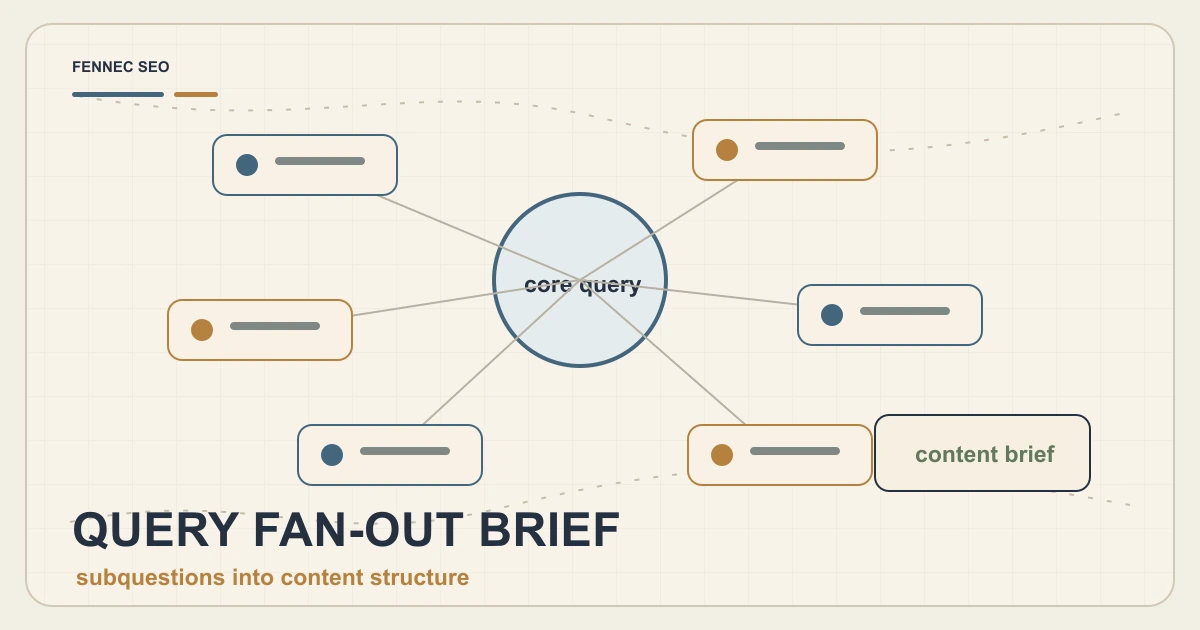
Google’s AI search guidance describes retrieval-augmented generation and query fan-out: the system can use multiple related searches to build a more complete answer. For content teams, the takeaway is practical:
Plan around the user’s problem, not only the first query they type.
This template helps writers build pages that answer the main question, the hidden follow-up questions, and the decision the reader is trying to make.
The Old Brief Is Too Thin
A traditional brief often includes:
- Primary keyword
- Search volume
- Suggested title
- H2 outline
- Competitor links
- Word count target
That can still help, but it misses the messy middle of AI search. A user asking “how to measure AI search visibility” may also need to know:
- Which Search Console reports matter?
- Can AI Overview clicks be measured perfectly?
- What is a citation audit?
- Should we track AI crawlers?
- What technical issues block visibility?
- Which pages should be refreshed first?
If the article ignores those subquestions, it may rank for the keyword but fail the task.
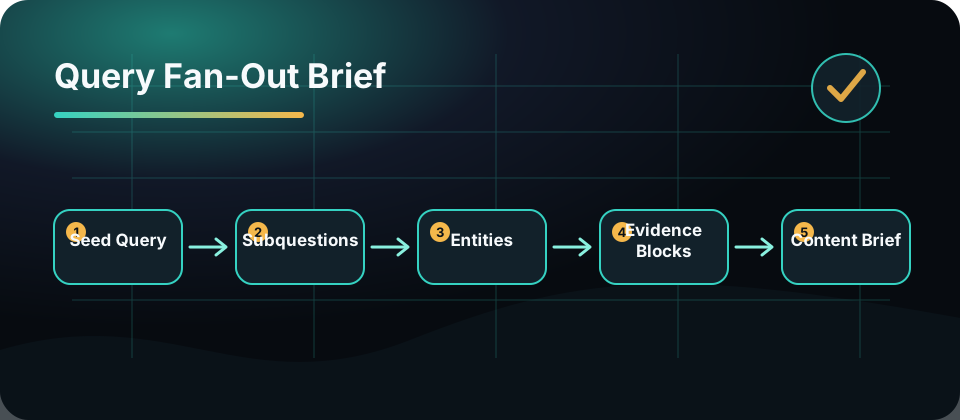
The Query Fan-Out Brief Template
Use this structure before writing.
1. Main User Problem
Write the human problem in one sentence:
The reader wants to ____ so they can _____.
Example:
“The reader wants to measure AI search visibility so they can decide which SEO pages to refresh first.”
2. Primary Search Intent
Choose one:
- Learn
- Diagnose
- Compare
- Decide
- Implement
- Monitor
Do not mix all intents in one page unless the topic demands a guide.
3. Fan-Out Questions
List 6 to 10 related questions:
- What does the user need before the answer?
- What do they ask next?
- What risk might stop them?
- What proof do they need?
- What action should they take after reading?
These questions become sections, examples, tables, or FAQs.
4. Entity And Source List
Add entities that should appear naturally:
- Google Search Console
- AI Overviews
- AI Mode
- Googlebot
- GPTBot
- OAI-SearchBot
- structured data
- canonical URL
- robots.txt
Then add source links. For AI search topics, start with Google’s AI optimization guide and official docs for any crawler or platform you mention.
5. Original Proof
Every serious page needs something the next generic result does not have.
Pick one:
- A scoring model
- A checklist
- A workflow
- A dashboard layout
- A decision table
- A test method
- A before-and-after rewrite
For example, a Fennec page can show how to combine GSC management with technical SEO audits and bot simulation.
6. Internal Link Map
Plan internal links before writing:
| Section | Internal link |
|---|---|
| Measurement | /gsc-management/ |
| Technical eligibility | /technical-seo/ |
| Bot behavior | /bot-simulator/ |
| Structured data | /schema-markup/ |
| Page experience | /core-web-vitals/ |
| Extension workflow | /extension/ |
This makes the article part of a cluster, not an isolated post.
7. Next Action
Every brief needs a next action:
- Run an audit
- Refresh a page
- Build a dashboard
- Test a crawler view
- Update schema
- Compare rendered content
The next action should match the user’s intent. A learning article can invite a checklist. A diagnostic article can invite a scan.
Example Brief
Topic: AI search visibility audit
Main problem:
“The reader wants to know whether important SEO pages are visible and useful in AI search so they can prioritize fixes.”
Intent:
Diagnose and monitor.
Fan-out questions:
- Which pages are eligible?
- Which queries changed?
- Are AI impressions rising?
- Are clicks falling?
- Does the page answer the question early?
- Does the page use primary sources?
- Are bot rules blocking discovery?
- What should be refreshed first?
Original proof:
Use a 0 to 2 scoring table across technical eligibility, answer clarity, source quality, originality, and internal links.
Next action:
Run a Fennec page audit and add the page to the AI Search Watchlist.
Common Mistakes
Mistake 1: Writing One Page Per Tiny Variation
Query fan-out does not mean you should create a page for every long-tail phrase. That can drift into scaled, low-value content.
Create stronger pages around real user problems.
Mistake 2: Ignoring Technical Eligibility
A brilliant article still needs to be crawlable, indexable, canonicalized, and visible in the rendered page.
Mistake 3: No Original Layer
If the page only summarizes public guidance, it is easy to replace. Add your own workflow, checklist, or example.
Takeaway
Query fan-out does not make content mysterious. It makes weak briefs obvious.
A strong AI Mode content brief starts with the user’s real task, expands into subquestions, adds evidence, maps entities, plans internal links, and ends with a clear next action.
That is how you create pages that deserve to be used as sources.