Google Keyword Research Guide: Turn Queries Into Page Decisions

Google keyword research is not the job of collecting the biggest spreadsheet. It is the job of deciding which search tasks deserve a page, which existing page already owns the intent, and what evidence will prove that choice was correct after publishing.
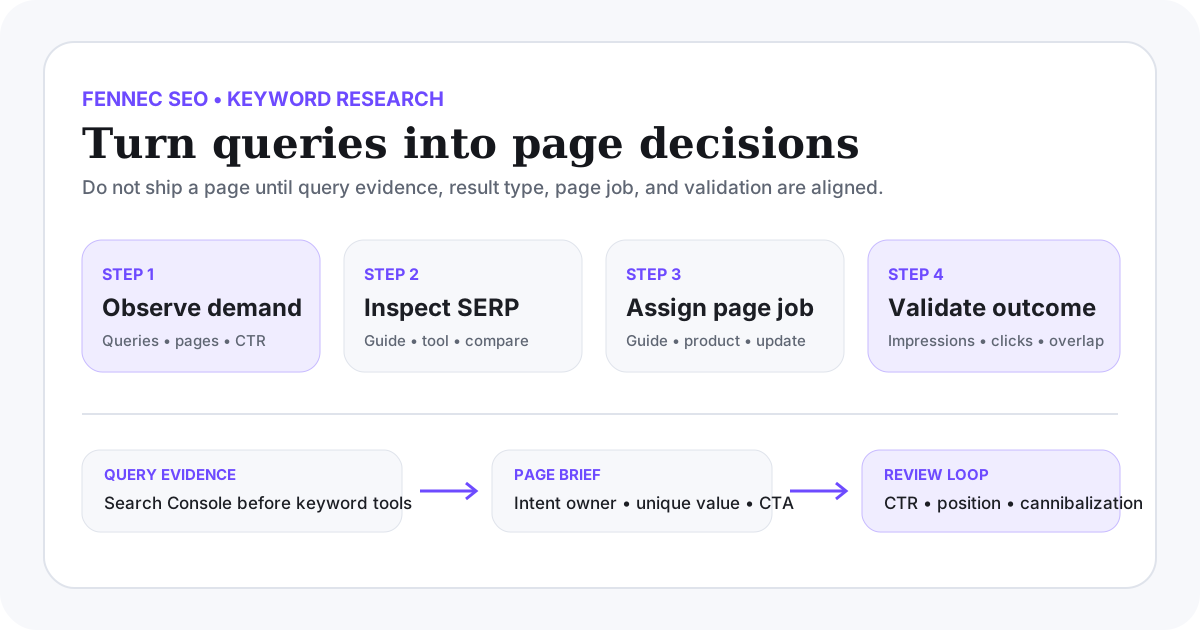
For Google SEO, a practical keyword research workflow usually runs in this order:
- review the queries and pages your site already has in Search Console;
- inspect the current search results to understand the dominant page type;
- group related queries by one primary page job;
- write a page brief before writing copy;
- validate the decision after launch with query and page data.
Google’s SEO Starter Guide and people-first content guidance both point toward the same principle: create content because it helps people complete a task, not because a keyword tool exported another variant.
Start with page decisions, not keyword lists
Before evaluating search volume, answer four questions:
- what task is the searcher trying to complete;
- what page type is Google already rewarding;
- does your site already have a page close to that intent;
- can you add original evidence, workflow, or decision support that the current results do not provide.
That keeps keyword research tied to page planning. It also reduces cannibalization, where several pages on the same site compete for the same intent without giving users a clearer choice.
Use Search Console as the first evidence source
If the site already receives impressions, Search Console is more valuable than an external volume estimate because it shows how Google has actually matched your pages to queries.
The Performance report lets you review queries, pages, clicks, impressions, CTR, and average position. Use it to answer:
- which pages already earn impressions for the topic;
- which queries cluster around the same user task;
- whether one page is already close to winning the intent;
- whether clicks are low because the page is weak, the snippet is weak, or the intent is mismatched.
Build a query evidence sheet
For each candidate topic, record:
| Field | Why it matters |
|---|---|
| Query | The exact phrasing users already trigger |
| Landing page | Shows whether the site already has an intent owner |
| Clicks and impressions | Separates demand from actual traction |
| CTR | Indicates whether the result earns visits when shown |
| Average position | Helps judge whether the page is close enough to improve |
| Country and device | Avoids mixing different markets into one page brief |
| Intended next step | Clarifies whether the page should teach, diagnose, compare, or convert |
If one existing page already attracts the right query family, improving it is usually safer than creating a second page. If several pages share the same query family, fix the overlap before expanding the cluster.
Treat keyword tools as directional inputs
External tools are useful, but they do not replace observed Google demand. Their best role is to expand the language of the market, not to make the final page decision alone.
Google Ads’ Keyword Planner helps discover keyword ideas and directional volume ranges. That is useful for market language, adjacent modifiers, and campaign forecasting. It is not proof that a new SEO page will rank or convert.
Use external tools for:
- finding synonyms and modifiers your customers use;
- spotting commercial and comparison language;
- estimating whether a topic is broad or niche;
- comparing whether one market uses different wording than another.
Do not use them to justify duplicate pages that differ only by word order or one near-synonym.
Use Google Trends to expand language, then Search Console to decide
Google Trends is useful before a page brief when you need to compare terms, regions, or related searches. It is not a replacement for a page-level performance report: a trend can suggest a question worth checking, but it cannot show which URL Google has already matched to that question on your site.
Use the two tools in sequence:
| Step | Google Trends contribution | Search Console decision | Guardrail |
|---|---|---|---|
| 1. Frame the comparison | Compare a small set of terms using the same country, language, category, search type, and date range | Record the existing page that should own the task | Do not treat a Trends chart as search volume or a ranking forecast |
| 2. Expand the wording | Review related searches and regional language differences | Filter the candidate page and query family | Keep variants together when they ask for the same outcome |
| 3. Test the page owner | Treat an emerging phrase as a hypothesis | Check impressions, clicks, CTR, average position, and which URL receives the query | A missing query row is not proof of no demand; Search Console can omit low-volume or anonymized data |
| 4. Choose the action | Keep a record of the comparison settings and date | Improve the current owner, resolve overlap, or write a distinct brief | Do not open a second URL just because a phrase is rising |
For a fair comparison, preserve the Trends settings in the brief so another reviewer can repeat it. Then compare like-for-like final Search Console windows. Page and property totals are aggregated differently, so do not use a property total to diagnose a specific URL.
Fennec example: strengthen the owner, not the URL count
In Fennec’s final Web Search window from July 20 to August 16, 2026 (Search Console Pacific Time), this English guide received 602 impressions, 0 clicks, and an average position of 21.36. The visible google seo research (215 impressions, position 19.44), google seo keyword research (94, 24.19), and google seo keyword analysis (36, 22.22) queries already routed here. The Chinese counterpart did not return a visible page row.
That is an improvement opportunity for this paired guide, not evidence that Chinese demand is absent and not a reason to launch another keyword-research URL. The response is to make the existing page more useful—such as by adding this reproducible Trends-to-Search-Console workflow—then recheck the same query-to-page routing after a comparable final-data window.
Inspect the current Google results before writing
A keyword list does not reveal what Google believes the task requires. Search the query manually and classify:
- the dominant page type: guide, tool, category, product, comparison, or forum;
- the freshness level of the leading results;
- whether the result set expects a definition, a workflow, a checklist, or a transaction;
- whether English and Chinese results behave differently for the same concept.
This inspection prevents a common failure: publishing an article for a query where Google mostly rewards tools, or publishing a product page for a query where users want a detailed tutorial.
Map one query family to one page job
Use a simple intent map:
| Page job | Typical query pattern | Best action |
|---|---|---|
| Learn | what is, guide, tutorial | Build or improve a guide |
| Diagnose | why not indexing, how to check | Build a troubleshooting guide or tool page |
| Compare | best, vs, alternatives | Build a comparison with clear criteria |
| Evaluate or buy | tool, software, pricing | Send the user to a product or service page |
For Fennec, the Google SEO guide owns the broad workflow, this article owns keyword-research method, and Keyword Analysis owns the product action. That division is more useful than forcing one page to do all three jobs.
Write the page brief before the draft
Do not open the CMS and start writing from a keyword export. First write a short page brief with:
- primary query family;
- user task and audience;
- dominant result type in current search;
- the page that currently owns adjacent intent on your site;
- the unique evidence or workflow your page will add;
- the internal links needed from the pillar page, product page, and related glossary pages;
- the next useful action after reading.
If you cannot state the unique contribution in one sentence, the topic probably is not ready for a new page.
Failure modes that break keyword research
Mistaking demand for permission to create a page
A keyword can have demand while still being a poor page candidate for your site. If the page would repeat what you already cover, or if the result set clearly rewards another format, do not create it yet.
Ignoring existing page ownership
If Search Console already shows impressions for a nearby page, a new URL can split internal links, confuse canonical signals, and weaken the cluster. Update the existing page unless the user task is genuinely different.
Grouping by wording instead of task
google keyword research, keyword research for google, and how to do keyword research for seo may belong to one guide if they ask for the same outcome. Multiple phrases do not automatically mean multiple pages.
Copying tool metrics into the article as facts
Estimated volume, difficulty, and CPC are tool outputs, not Google policy. Label them as estimates and keep official claims separate from market-model inputs.
Forgetting the validation plan
Keyword research is incomplete until you know how success will be measured. A page without a validation plan is just a guess with formatting.
Validate the decision after publishing
After launch, track whether the page earns the intended query set and whether visitors take the next useful step.
Review:
- impressions for the intended query family;
- clicks and CTR;
- average position trends;
- whether another page on the site starts competing for the same terms;
- whether English and Chinese versions attract the expected language audience;
- whether readers move to the related product or diagnostic page.
If impressions rise but clicks remain weak, the snippet or search fit may need work. If another URL starts taking the same query family, you may have created overlap instead of coverage.
A practical Fennec workflow
For a real Fennec content workflow:
- export current query and page patterns from GSC Management or Search Console;
- inspect the live result set for the target query family;
- use Keyword Analysis to expand modifiers and compare language variants;
- decide whether to update an existing page or create one focused guide;
- publish only after the page can naturally link to the next useful action, such as Audit or a related troubleshooting guide.
This keeps the article responsible for education, the product page responsible for action, and the broader Google SEO cluster responsible for internal context.
What a finished keyword research pass should produce
A finished Google keyword research pass should end with:
- one clear page owner for the query family;
- a short brief explaining why this page exists;
- evidence from Search Console or a documented data gap if the site is new;
- a list of internal links and adjacent pages to protect against overlap;
- a validation checklist for impressions, clicks, CTR, average position, and page cannibalization.
That is enough to move from keyword speculation to page decisions that can be tested.
Sources
- Google Search Central: SEO Starter Guide
- Google Search Central: Creating helpful, reliable, people-first content
- Google Search Console Help: Performance report
- Google Search Console Help: Performance report data and aggregation
- Google Search Console Help: common performance-report tasks
- Google Trends Help: get started with Google Trends
- Google Ads Help: Discover new keywords in Keyword Planner
Q&A
What should Google keyword research decide first?
It should decide whether you need a new page, a stronger existing page, or no page at all. Demand alone is not enough; the page must match the user's task and the result type Google already prefers.
Is search volume enough to choose a keyword?
No. Search volume is only one input. You also need to review current queries, result format, page overlap, and whether your site can produce a page that is more useful than the existing results.
How do you validate a keyword research decision after publishing?
Track queries, impressions, clicks, CTR, average position, and page overlap in Search Console. Validate whether the page earned the intended query mix and whether users reached the next useful action.
How should Google Trends and Search Console work together?
Use Trends to compare language, regions, and related searches, then use Search Console to decide from your site's actual query-to-page performance. A Trends signal is a hypothesis, not proof that a new URL should exist.