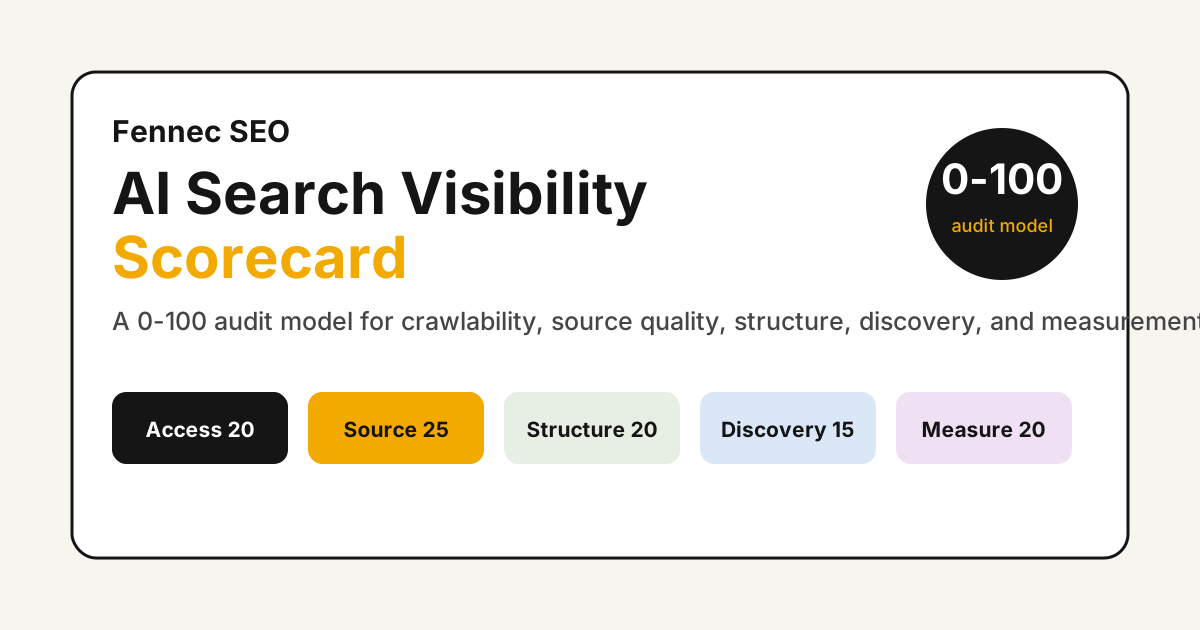
AI Search Visibility Scorecard: A 0-100 Audit Model

AI search work gets messy when every team uses a different vocabulary.
One person asks whether a page ranks. Another asks whether it appears in AI Overviews. A third asks whether agents can read it. Someone else wants to know whether GPTBot should be blocked.
Those are related questions, but they are not the same audit.
This scorecard gives you a practical way to evaluate one page or one cluster on a 0-100 scale. It does not promise AI citations. It helps you decide whether the page is technically accessible, source-worthy, structured, measurable, and ready for the agent-readable web.
Use it with GSC Management, AI Overview, Audit, Bot Simulator, and Schema Markup when you need a repeatable review instead of another vague “AI SEO” checklist.
What This Score Measures
The score measures readiness, not guaranteed visibility.
Google’s AI optimization guidance still points site owners back to durable SEO fundamentals: useful content, crawlable pages, clear structure, and a good page experience. OpenAI and other agent ecosystems add another layer: agents need to discover, fetch, parse, and trust pages before they can use them.
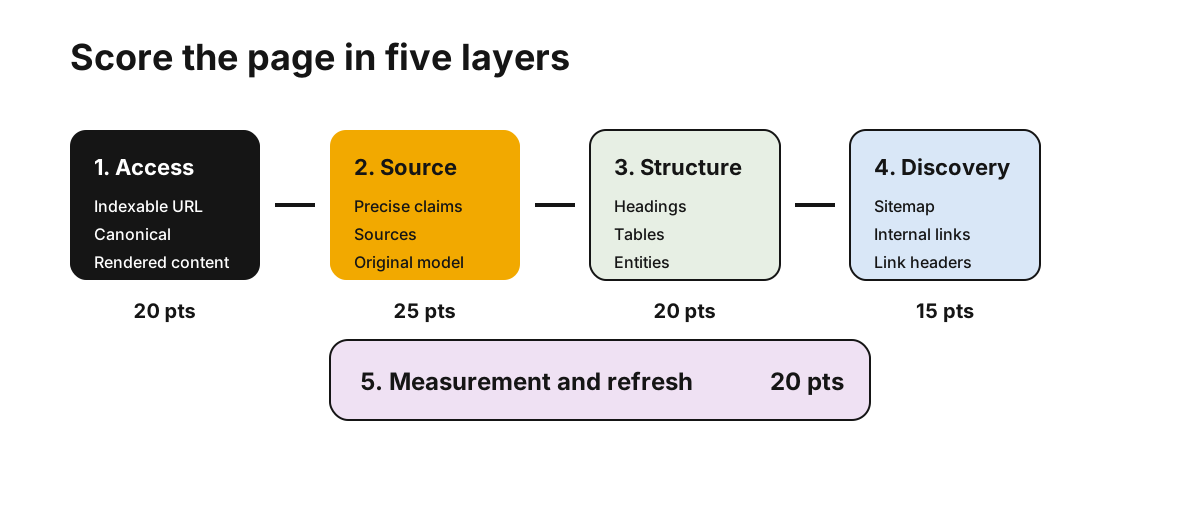
That means a useful AI search audit should ask five questions:
| Layer | Max score | Core question |
|---|---|---|
| Technical access | 20 | Can crawlers and agents fetch the right page cleanly? |
| Source-worthiness | 25 | Is the page specific, current, attributable, and worth citing? |
| Content structure | 20 | Can systems extract the answer, entities, and supporting evidence? |
| Discovery signals | 15 | Do sitemap, internal links, schema, and agent discovery point to the page? |
| Measurement and refresh | 20 | Can the team monitor movement and improve the page with evidence? |
Total: 100 points.
Layer 1: Technical Access - 20 Points
A page cannot earn AI search visibility if crawlers cannot fetch its best version.
Score this layer first:
| Check | Points |
|---|---|
Returns a clean 200 for the canonical URL | 4 |
Not blocked by robots.txt, noindex, or accidental X-Robots-Tag | 4 |
| Canonical points to the intended URL | 3 |
| Main content appears in raw HTML or rendered DOM without fragile interaction | 3 |
| Mobile and desktop versions expose the same primary content | 2 |
| Important assets needed for rendering are not blocked | 2 |
| Page is fast enough for repeat crawling and human use | 2 |
Use Technical SEO, Canonical Checker, Core Web Vitals, and Bot Simulator to verify the basics.
Do not skip this layer. Many AI visibility problems are still ordinary crawl, render, canonical, or speed problems wearing a new label.
Layer 2: Source-Worthiness - 25 Points
AI systems need pages that can support an answer.
Score the page on whether it deserves to be used as a source:
| Check | Points |
|---|---|
| The page answers a specific query or task better than a generic article | 5 |
| Claims are precise, bounded, and not inflated | 4 |
| Sources are linked near the claims that depend on them | 4 |
| The article includes original workflow, data, scoring, checklist, or examples | 4 |
| Author, brand, and update context are visible | 3 |
| The page explains limitations and avoids guaranteed AI visibility claims | 3 |
| The page connects to supporting cluster pages | 2 |
For example, an article that simply says “AI SEO is important” should score low. A page with a concrete audit model, examples, source links, and clear next actions should score higher.
This is where AI Overview Citation Audit, Query Fan-Out SEO, and Author Entity SEO belong in the cluster.
Layer 3: Content Structure - 20 Points
AI search systems and agents need structure they can extract.
Score the content shape:
| Check | Points |
|---|---|
| H1 and H2s mirror real user questions and subtopics | 4 |
| The page gives direct answers before deeper explanation | 3 |
| Tables, lists, and steps are used where they reduce ambiguity | 3 |
| Entity names, product names, and concepts are used consistently | 3 |
| Internal links explain relationships between cluster pages | 3 |
| Structured data fits the page type without stale rich-result promises | 2 |
| Images or diagrams clarify the workflow rather than decorate it | 2 |
Do not add schema just because a checklist says so. Use Schema Markup for durable clarity: Article, Breadcrumb, Product, Organization, WebSite, and SoftwareApplication where they match visible page facts.
Also remember the project’s structured data policy: visible Q&A is fine, but normal articles should not emit FAQPage structured data.
Layer 4: Discovery Signals - 15 Points
Discovery is where classic SEO and Agent SEO start to overlap.
Score whether the page is easy to find from multiple machine-readable paths:
| Check | Points |
|---|---|
| Included in XML sitemap with the canonical URL | 3 |
| Linked from relevant hub, category, and cluster pages | 3 |
| Linked from at least one older article where natural | 2 |
Appears in llms.txt or another curated resource map when important | 2 |
Has useful HTTP Link discovery on the site or hub where appropriate | 2 |
| Robots policy expresses search and AI use preferences clearly | 2 |
| Language alternates are correct for EN/ZH versions | 1 |
This is also the handoff to the Agent SEO cluster. If a site wants agents to discover resources before parsing full HTML, Link Headers for AI Agents is the next technical step.
Keep reader-selected discovery outside the score. Google’s Preferred Sources can let an eligible publisher offer an interactive button that helps a willing reader make that choice, but it is not a ranking switch or a prerequisite for AI visibility. Record eligibility, placement, and attributable outcomes in the measurement log; do not award discovery points merely because the button exists. See how to evaluate Preferred Sources before implementing it.
Layer 5: Measurement And Refresh - 20 Points
If you cannot measure the page, you cannot improve it responsibly.
Score the operating loop:
| Check | Points |
|---|---|
| Page has a baseline in Search Console: queries, impressions, clicks, CTR | 4 |
| The team tracks AI Overview or AI search appearance manually or in a dashboard | 3 |
| Query fan-out variants are mapped to the page or cluster | 3 |
| The page has a refresh trigger such as click drop, impression growth, or stale source | 3 |
| Log or crawler data confirms important bots can reach the page | 3 |
| Conversion or assisted action quality is tracked where relevant | 2 |
| Changes are recorded with date, reason, and expected outcome | 2 |
For the measurement side, start with GSC Management and the GSC generative AI dashboard workflow. For crawler confirmation, use the server log analysis workflow.
How To Interpret The Score
Use the total score to decide the next action:
| Score | Meaning | Next action |
|---|---|---|
| 85-100 | Strong candidate | Monitor, test snippets, and keep sources fresh |
| 70-84 | Good but incomplete | Fix the weakest layer before expanding the cluster |
| 50-69 | Not ready yet | Prioritize access, structure, or measurement gaps |
| Below 50 | High risk | Do not treat this page as an AI search asset until basics are fixed |
The layer score matters more than the total. A page with 90 overall but 5/20 in measurement is not operationally ready. A page with 72 overall but strong source-worthiness may only need technical cleanup.
Example: One Page Scored
Here is a sample score for a technical article. This is a model, not Fennec production data.
| Layer | Score | Note |
|---|---|---|
| Technical access | 18/20 | Clean canonical, indexable, stable rendered content |
| Source-worthiness | 21/25 | Strong workflow and sources, but author context could be clearer |
| Content structure | 17/20 | Good headings and tables, one section needs a direct answer |
| Discovery signals | 10/15 | Sitemap and internal links are good, no Link header discovery yet |
| Measurement and refresh | 12/20 | Search Console baseline exists, but no refresh log |
| Total | 78/100 | Good candidate, fix discovery and refresh process next |
This tells the team what to do next. It does not say “write more AI SEO content.” It says: improve discovery, clarify ownership, and add a measurement loop.
Weekly Workflow
Run the scorecard like this:
- Pick 5 priority URLs from Search Console, product strategy, or content refresh needs.
- Score each URL across the five layers.
- Mark the lowest layer for each page.
- Fix only the issues that would change the score.
- Record the change date and expected metric movement.
- Recheck after enough crawl and reporting time has passed.
For Fennec, a practical order is:
- Audit for page-level technical issues
- Bot Simulator for crawler and agent views
- GSC Management for query and page movement
- AI Overview for citation-oriented review
- Schema Markup for durable structured data checks
Common Mistakes
Avoid these scorecard errors:
- Treating
llms.txtas a Google ranking requirement - Giving a high score to a page with no measurement baseline
- Adding schema that does not match visible content
- Scoring the whole site when the problem is page-specific
- Ignoring Chinese and English versions as separate URLs
- Blocking AI-related crawlers without understanding the search and training distinction
- Using a scanner score as the only business metric
The scorecard is a decision tool. It should make the next fix obvious.
Next Action With Fennec
Pick one page you care about and score it today.
Start with a page that already has impressions or commercial value. Run Audit, compare the rendered page in Bot Simulator, review its Search Console data in GSC Management, then use this scorecard to decide whether the next move is technical cleanup, content refresh, discovery work, or measurement.
If the page is already strong but weak on discovery, continue with Link Headers for AI Agents.
Sources
- Google Search Central: AI optimization guide
- Google Search Central: AI features and your website
- Google Search Central: Get started with Search Console
- Google Search Central: Preferred Sources
- OpenAI: Crawlers and user agents
- Cloudflare Docs: managed robots.txt and Content Signals
Q&A
Does a high AI Search Visibility Score guarantee citations?
No. The scorecard is an audit model for readiness and evidence quality. It cannot guarantee rankings, AI citations, or traffic.
What is a good score?
A score above 80 means the page is usually ready for monitoring and iterative improvement. A score below 60 means technical access, source quality, or measurement gaps should be fixed first.
Should I score every page?
Start with pages that already get impressions, product pages, comparison pages, documentation, and articles you want AI search systems to cite or summarize.
How often should I rescore pages?
Review priority pages monthly, and rescore after major template changes, content refreshes, crawler policy edits, or Search Console movement.