Google SEO Check Example: Verify a Bilingual Release with Fennec

A useful Google SEO check example does not start with theory. It starts with one real page pair, confirms the release signals you can verify immediately, and labels the checks that still require Google-side data later.
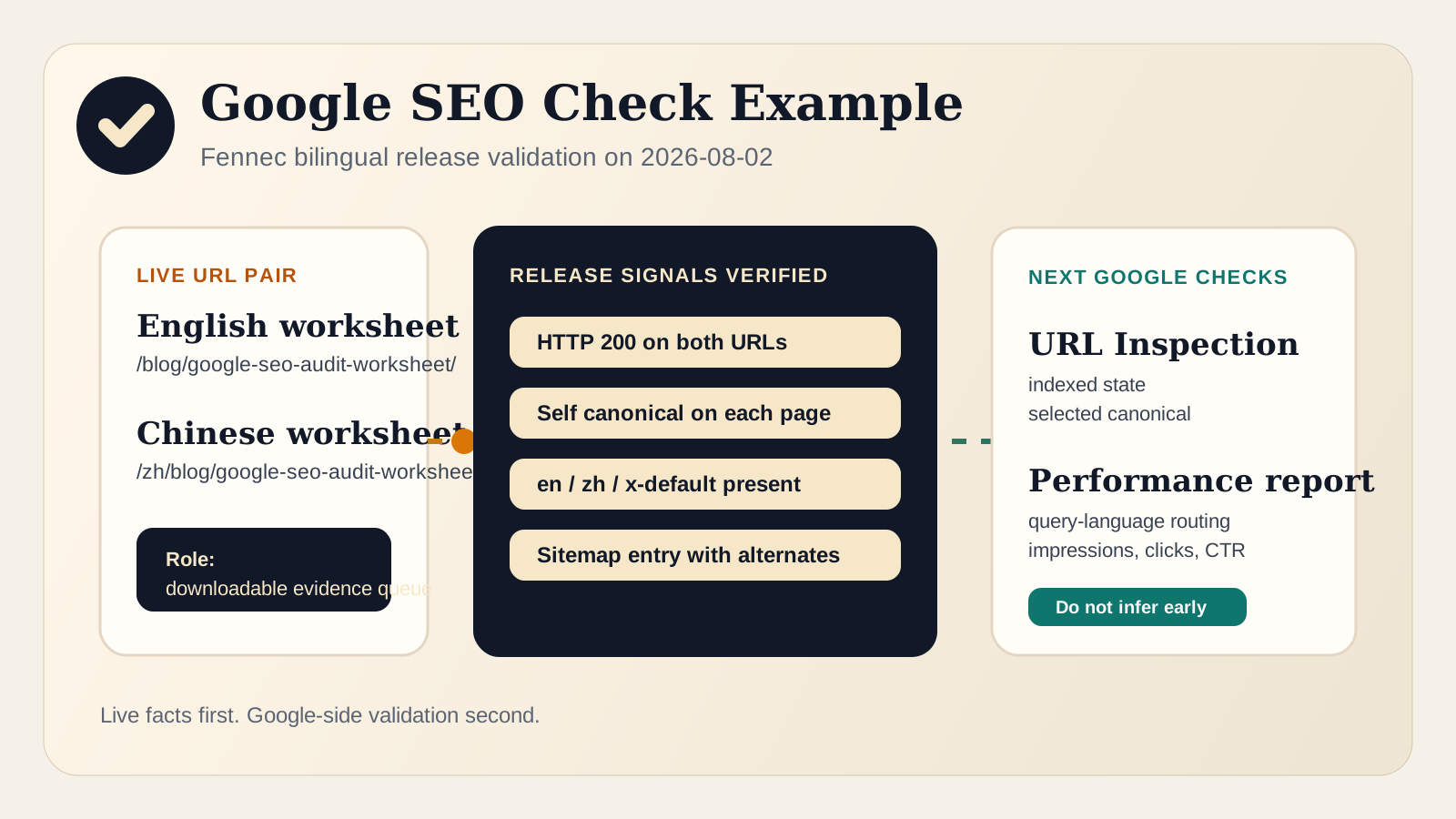
This worked example uses a Fennec-owned bilingual pair that is already live:
/blog/google-seo-audit-worksheet//zh/blog/google-seo-audit-worksheet/
The live page checks below were repeated on 2026-08-02. They confirm release health, not ranking success. Where only Search Console can answer the question, this page says so directly instead of pretending HTML can prove it.
The direct answer: what did this Google SEO check confirm?
| Check | Observed state on 2026-08-02 | Evidence type | What it still does not prove |
|---|---|---|---|
| Live response | Both URLs returned HTTP 200 | Live response | Google has reprocessed the pages |
| Canonical | Each page exposed a self-canonical | Source HTML | Google selected the same canonical |
| Language routing signals | hreflang="en", hreflang="zh", and English x-default were present | Source HTML | The intended query is already landing on the intended language URL |
| Discovery support | Both URLs appeared in sitemap-0.xml with reciprocal alternates | Sitemap + source | Google discovered the pages through the strongest internal path |
| Page role clarity | Titles and H1s match the worksheet role, not the pillar-guide role | Source HTML + page copy | The query mix is already aligned with that role |
| Cluster handoff | The page points to the pillar guide, audit checklist, diagnostic workflow, evidence matrix, and product next steps | Source HTML + page copy | Readers are actually choosing the next intended action |
The Google-only follow-up is still separate:
- URL Inspection for indexed state, last crawl, and Google-selected canonical.
- Performance report for query, page, language, impressions, clicks, CTR, and average position.
That separation matters. Google’s localized versions guidance, canonical documentation, crawlable links guidance, and sitemap documentation define the signals you can inspect immediately. They do not turn a clean release into a ranking guarantee.
Why this pair is a good example
This page pair is useful because it is:
- bilingual, with one English and one Simplified Chinese URL sharing the same slug;
- recent enough that release validation still matters;
- connected to the broader cluster through the Google SEO guide, Google SEO audit checklist, Google SEO diagnostic workflow, and Google SEO evidence matrix;
- tied to real product handoffs like Audit and GSC Management.
It is also bounded. This is not a whole-site audit. It is one release-health pass on one owned page pair.
Step 1: confirm the page role before checking signals
Before you inspect canonical tags or hreflang, decide what the page is supposed to do.
For this example, the role is:
- not the broad workflow owned by the Google SEO guide;
- not the full queue owned by the Google SEO audit checklist;
- not the evidence classifier owned by the Google SEO evidence matrix;
- specifically a downloadable worksheet asset that helps the team log one evidence-backed finding at a time.
That role decision protects the check itself. If the page were accidentally rewritten like a general guide, a clean canonical would not make it the right page.
Step 2: verify the live response first
Start with the smallest reproducible check: can the preferred URLs answer with the expected response right now?
curl -I -A 'Mozilla/5.0' https://fennecseo.app/blog/google-seo-audit-worksheet/
curl -I -A 'Mozilla/5.0' https://fennecseo.app/zh/blog/google-seo-audit-worksheet/
On 2026-08-02, both returned HTTP 200.
That is necessary, but still incomplete. A clean 200 does not prove:
- indexing;
- correct canonical selection;
- correct language routing;
- search-demand fit.
This is why a release check should route forward to the Google SEO diagnostic workflow when a later-stage symptom appears, instead of turning one successful response check into a broad conclusion.
Step 3: verify canonical and hreflang in the source HTML
Next, inspect the page source instead of relying on a browser impression.
curl -s -A 'Mozilla/5.0' https://fennecseo.app/blog/google-seo-audit-worksheet/ \
  | rg '<link rel="canonical"|hreflang=|<title>|<h1'
curl -s -A 'Mozilla/5.0' https://fennecseo.app/zh/blog/google-seo-audit-worksheet/ \
  | rg '<link rel="canonical"|hreflang=|<title>|<h1'
The bounded check you want here is simple:
- the English page declares its own canonical;
- the Chinese page declares its own canonical;
- both expose
enandzhalternates; - the English URL is used as
x-default; - the title and H1 still describe the worksheet role clearly.
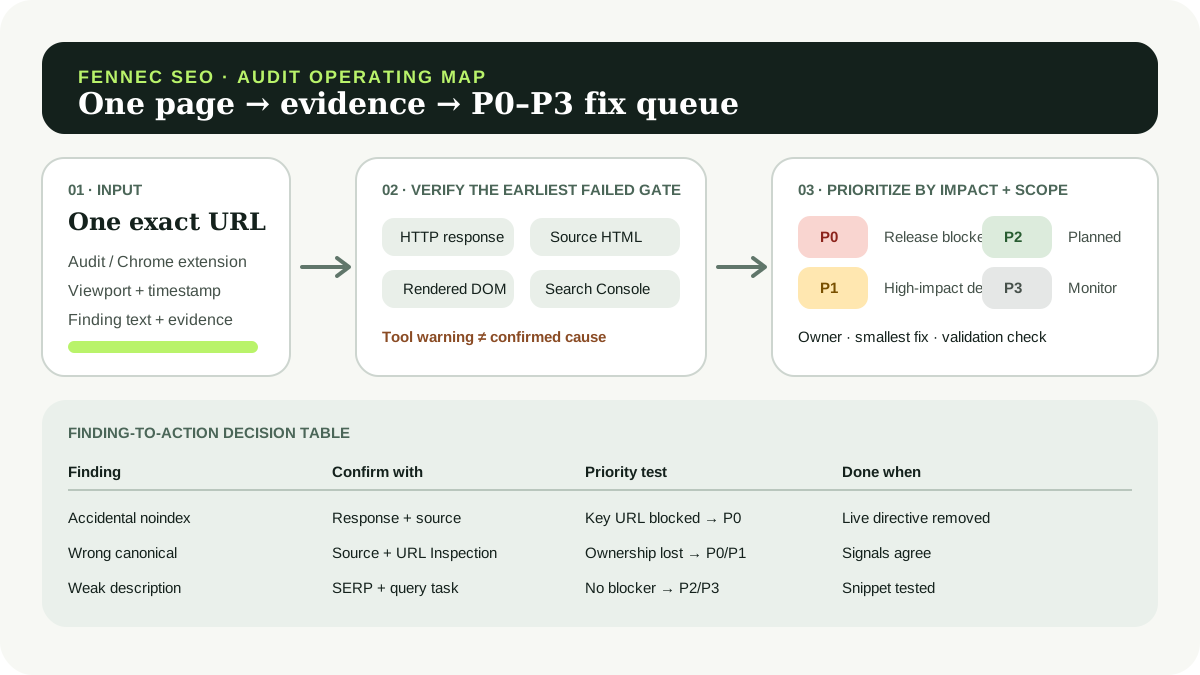
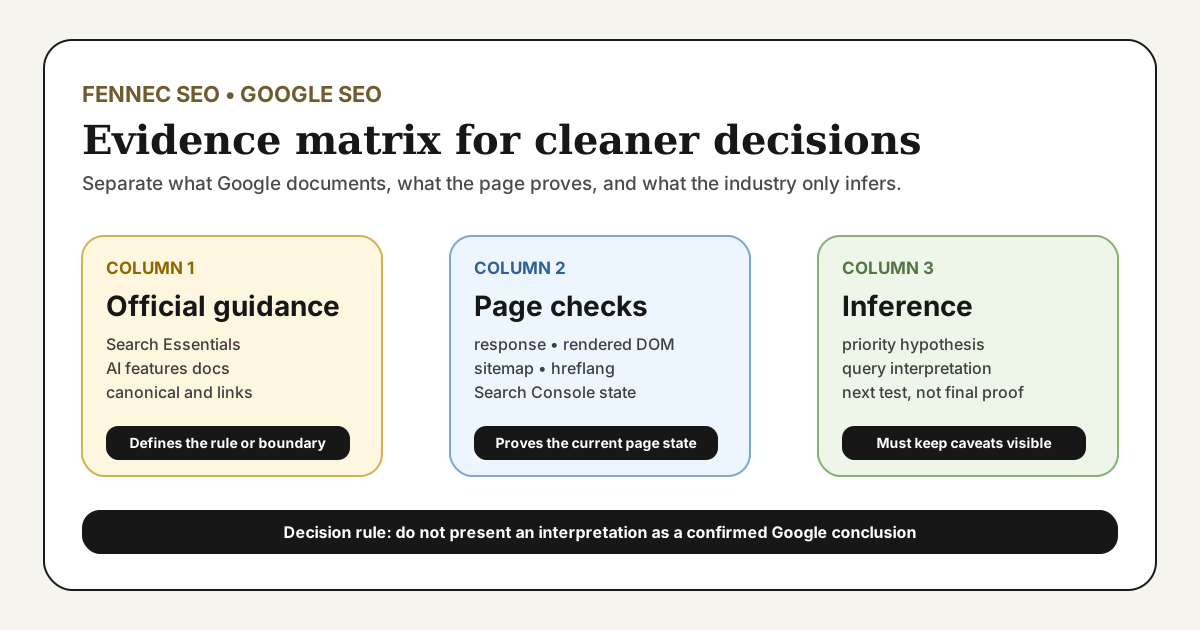
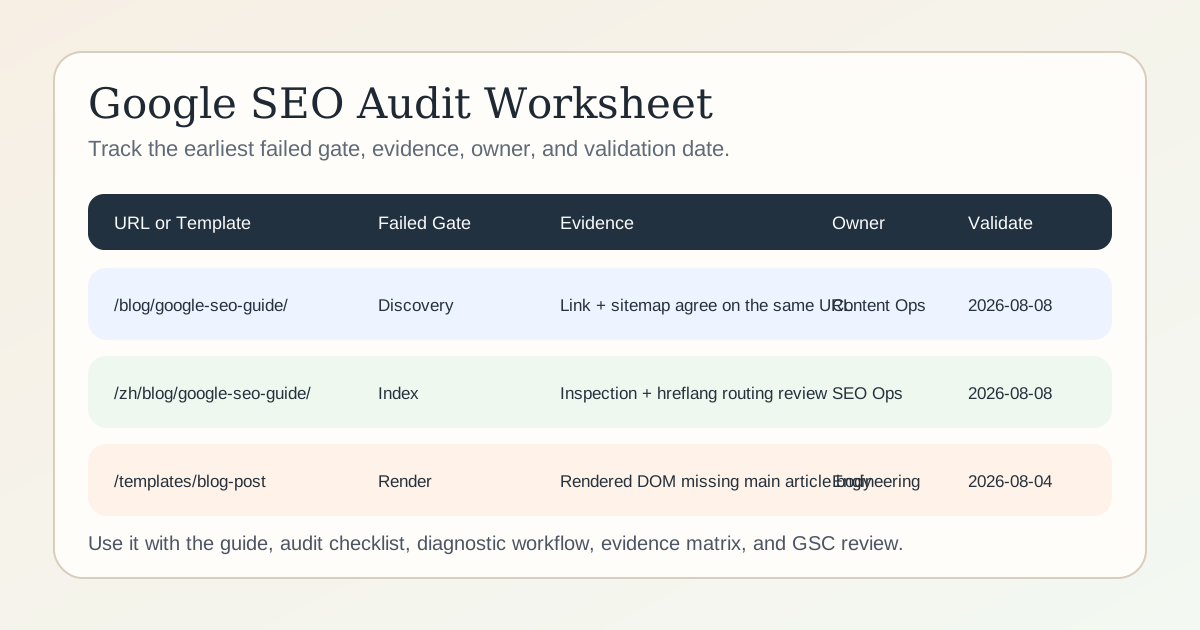
If any of those signals conflict, log it in the Google SEO audit worksheet before you start editing copy. If the team keeps mixing what Google documents, what the live HTML says, and what they merely suspect, normalize that first with the Google SEO evidence matrix.
Step 4: verify discovery support, not just page syntax
The page can look perfect and still be weakly discoverable. Google’s crawlable links guidance and sitemap documentation are relevant here.
For this sample pair, the release-health check is:
curl -s -A 'Mozilla/5.0' https://fennecseo.app/sitemap-0.xml \
  | rg 'google-seo-audit-worksheet'
That confirms both URLs are present in the sitemap with their alternates. Then check the page’s real cluster path:
- the Google SEO guide explains the wider workflow;
- the Google SEO audit checklist expands a row into a broader review batch;
- the Google SEO diagnostic workflow decides the earliest failed layer;
- the Google SEO evidence matrix separates proof from inference;
- Audit and GSC Management own the next product actions.
On Fennec, use link checker and sitemap checker to gather candidates quickly, then return to the HTML and live sitemap as the final proof.
Step 5: decide whether rendering still needs escalation
For this page pair, the key release signals are already visible in source HTML: title, canonical, alternates, H1, and the main content structure. That means this example does not begin with a rendering emergency.
But the rule is still important: if the main answer, CTA, or critical links disappear after rendering, or only appear after a fragile client-side request, escalate to Bot Simulator and compare raw HTML with the rendered DOM. Google’s JavaScript SEO basics explain why this matters.
Use the rendering check only when the symptom justifies it. Do not run every page through a JavaScript theory when source HTML already contains the critical signals.
Step 6: record what only Google can validate later
This is where many teams get sloppy. They verify the page, then write a conclusion that only Search Console can support.
For this example, the checks that remain open are:
- whether Google selected the same canonical as the page declares;
- whether the page is already indexed in the expected state;
- whether English queries land on English and Simplified Chinese queries land on Chinese;
- whether the worksheet pair earns the right query family at all;
- whether readers move from the article to Audit or GSC Management.
Those are Google-side or behavior-side checks. Track them with URL Inspection, the Page indexing report, and the Performance report. If you have Fennec access, continue the same workflow in GSC Management.
A sample worksheet row from this release check
The row below is a worked example, not a Search Console performance claim:
| Field | Example value |
|---|---|
url_or_template | /blog/google-seo-audit-worksheet/ and /zh/blog/google-seo-audit-worksheet/ |
failed_gate | monitor |
evidence_source | Live response, source HTML, sitemap |
evidence_summary | Both URLs returned 200, exposed self-canonical plus en / zh / x-default, and appeared in sitemap-0.xml on 2026-08-02 |
next_action | Wait for Google-side rechecks in URL Inspection and Performance report |
validation_check | Confirm indexed state, selected canonical, and query-language routing in Search Console |
This is the handoff point between the Google SEO check example and the reusable Google SEO audit worksheet.
What this example prevents
Declaring success too early
A clean bilingual release is a prerequisite, not proof of performance.
Mixing release facts with ranking interpretation
HTML can prove a canonical tag exists. It cannot prove that Google selected it.
Expanding scope before one batch is closed
One bounded page pair is enough to confirm whether your release process is coherent before you start diagnosing the whole cluster.
When to use this page
Use this page when you need one concrete Google SEO example that shows:
- how a bilingual release should be checked on real URLs;
- how Fennec tools fit into that release pass;
- where the live-page evidence ends;
- where Google-side validation begins.
If you need the broader operating model, return to the Google SEO guide. If you need a full queue, use the Google SEO audit checklist. If you need a reusable evidence row template, use the Google SEO audit worksheet. If you need to separate documented rules, live page facts, and interpretation, use the Google SEO evidence matrix.
Sources
- Google Search Central: Localized versions
- Google Search Central: How to specify a canonical URL
- Google Search Central: Make your links crawlable
- Google Search Central: Build and submit a sitemap
- Google Search Central: JavaScript SEO basics
- Google Search Console Help: URL Inspection Tool
- Google Search Console Help: Page indexing report
- Google Search Console Help: Performance report
Q&A
What makes a useful Google SEO check example?
It should use a real URL pair, separate live page facts from later Search Console validation, and show the smallest reproducible sequence of checks.
Can one release check prove rankings or recovery?
No. It can confirm release health and routing signals, but ranking, click behavior, and query-language matching still need later Google-side validation.
Why split live checks from Search Console follow-up?
Because HTML, canonicals, hreflang, and sitemap inclusion are visible now, while indexed state, selected canonical, and query routing require Google reports.