Google SEO Evidence Matrix: Separate Official Guidance, Page Checks, and Industry Inference

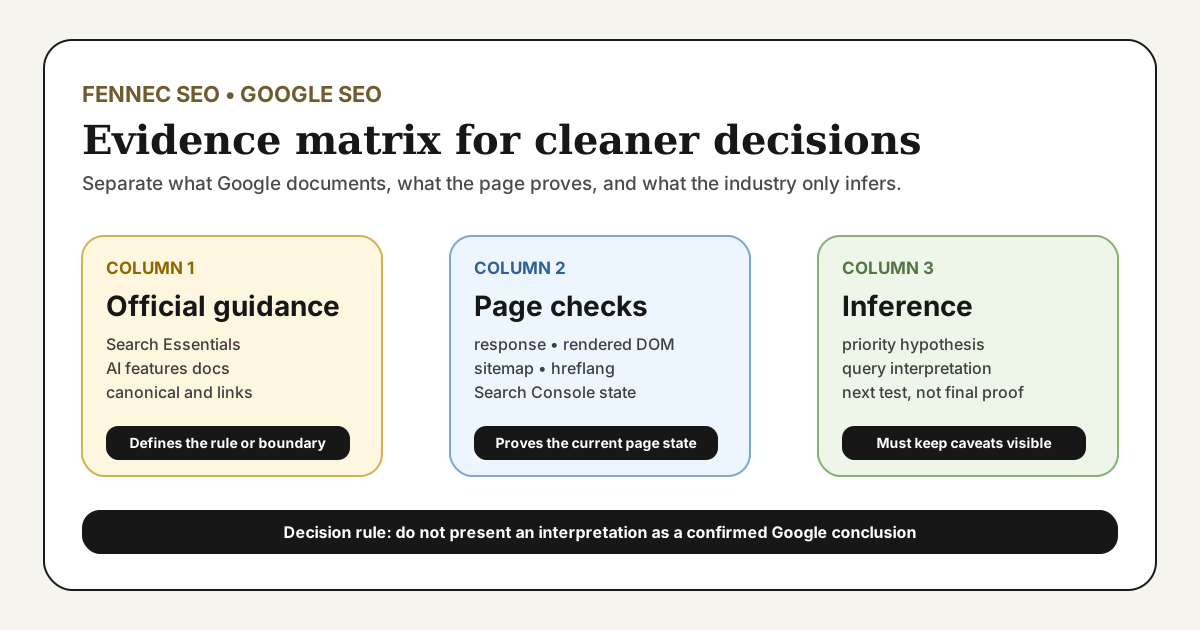
The fastest way to make a Google SEO project noisy is to mix together three different things: what Google has explicitly documented, what you can reproduce on a page right now, and what the industry only infers from patterns or tests. A practical evidence matrix keeps those layers separate before you change a title, push a canonical fix, rewrite a guide, or explain a traffic drop.
Google’s SEO Starter Guide, Search Essentials, AI features and your website, crawlable links guidance, JavaScript SEO basics, canonical documentation, URL Inspection help, Page indexing report help, and Performance report help are the primary sources behind this matrix.
The direct answer: what belongs in each column?
Use official guidance for things Google has publicly documented or required. Use reproducible page checks for what you can verify on a live URL, a response, a rendered DOM, or a Search Console report. Use industry inference only for plausible interpretation that still needs caveats.
If you collapse those three columns into one, teams start treating a tool warning as a ranking law, or an SEO theory as if Google had confirmed it.
The three evidence columns
| Evidence type | What it can support | What it cannot support |
|---|---|---|
| Official guidance | Technical requirements, policy boundaries, documented systems behavior, supported controls | A guarantee that your page will rank or recover traffic |
| Reproducible page check | What is true for a specific URL, template, locale, or report window right now | A universal rule for every site or query |
| Industry inference | A cautious working explanation, prioritization idea, or hypothesis to test | A statement that should be written as confirmed Google behavior |
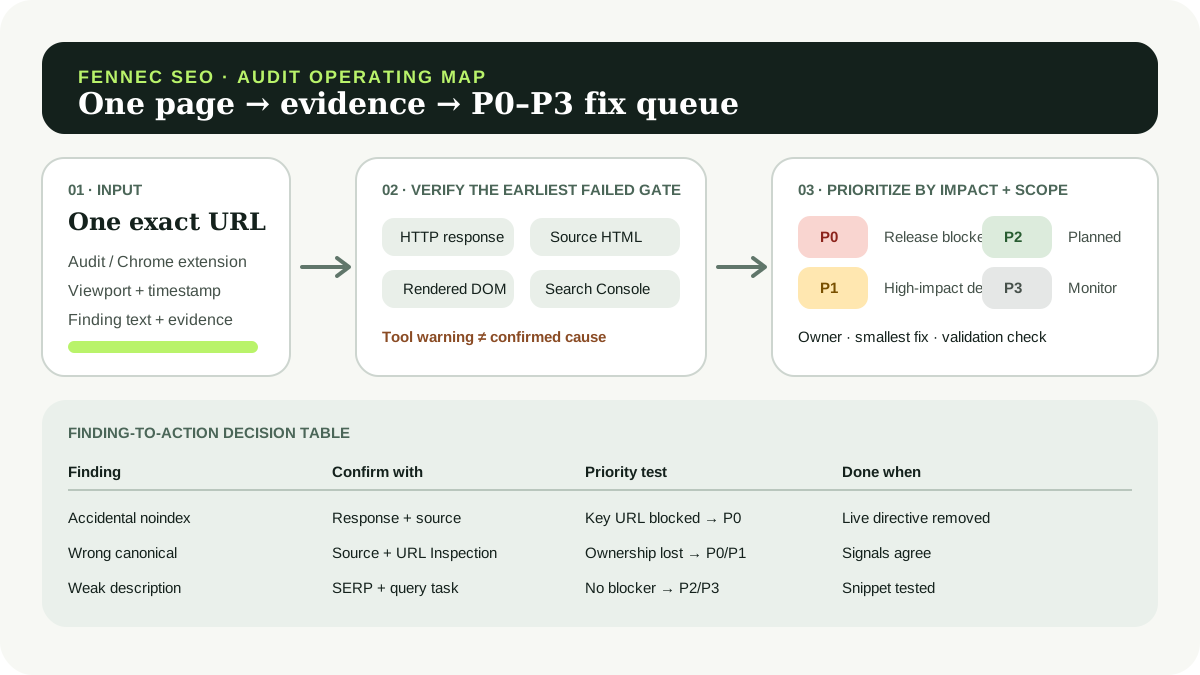
This is why a good cluster needs both the broader Google SEO guide and narrower assets like the diagnostic workflow. One explains the whole operating model; the other helps classify the confidence level of specific claims.
A working Google SEO evidence matrix
The table below uses claim examples, not measured site performance data.
| SEO question | Official guidance | Reproducible Fennec page check | Industry inference |
|---|---|---|---|
| Why does a new page have no impressions? | Google says most pages are found through links and can also be submitted in a sitemap | Confirm crawlable <a href> links, sitemap inclusion, final status, and robots access with link checker, sitemap checker, and the live response | If discovery is weak, broader content publishing probably will not help yet |
| Why is a page crawled but not indexed? | Google documents that not every non-indexed page is an error, and that duplicates, noindex, and blocked pages may be valid | Compare raw HTML, rendered DOM, noindex, canonical, duplicate versions, and Search Console status | Thin value, ambiguous intent, or duplicate clustering may be the real blocker even when the page is technically accessible |
| Why is the wrong language URL showing? | Google documents canonicalization and localized alternates as routing signals | Check self-canonical, reciprocal translations, hreflang, redirects, and internal links on both language pages | The stronger internal-link path or clearer page role may be influencing routing |
| Why do impressions rise but CTR stay weak? | Google documents title links, snippets, and Performance report behavior | Compare query set, page title, first-screen answer, snippet promise, and device/language splits | The page may be matching the wrong task, or the result format may be weaker than competing pages |
| Why is JavaScript causing SEO risk? | Google documents that rendering is separate from crawling and indexing, and uses rendered HTML for indexing | Compare raw HTML and rendered DOM with Bot Simulator and URL Inspection | Fragile rendering may delay or reduce Google’s confidence in the page, even when the page is technically reachable |
| How much do Core Web Vitals matter? | Google and web.dev document Web Vitals as user-experience signals and measurement standards | Check LCP, INP, CLS, loading behavior, and whether the page remains usable during load | A modest CWV improvement is less urgent than a hard indexing blocker, even if both deserve work |
The matrix is not there to remove judgment. It is there to stop unsupported certainty.
How to use the matrix before making changes
1. Write the claim in one sentence
Examples:
- “This page is not indexed because Google cannot see the main content.”
- “CTR is low because the title promises the wrong thing.”
- “The Chinese page is losing to the English page because our routing signals conflict.”
If the claim is too vague to write down, it is too vague to prioritize.
2. Fill all three columns
For each claim, capture:
- the Google document that defines the boundary, if one exists;
- the live page evidence you can reproduce now;
- the interpretation that still needs caveats.
If the middle column is empty, you are still guessing.
3. Choose the earliest fixable layer
Do not jump to a later layer because it is easier to edit copy than to inspect the response. If the page is not discoverable, start there. If the page is discoverable but rendered content is missing, fix rendering before title experiments.
This aligns with the Google SEO diagnostic workflow and makes the Google SEO audit checklist more reliable.
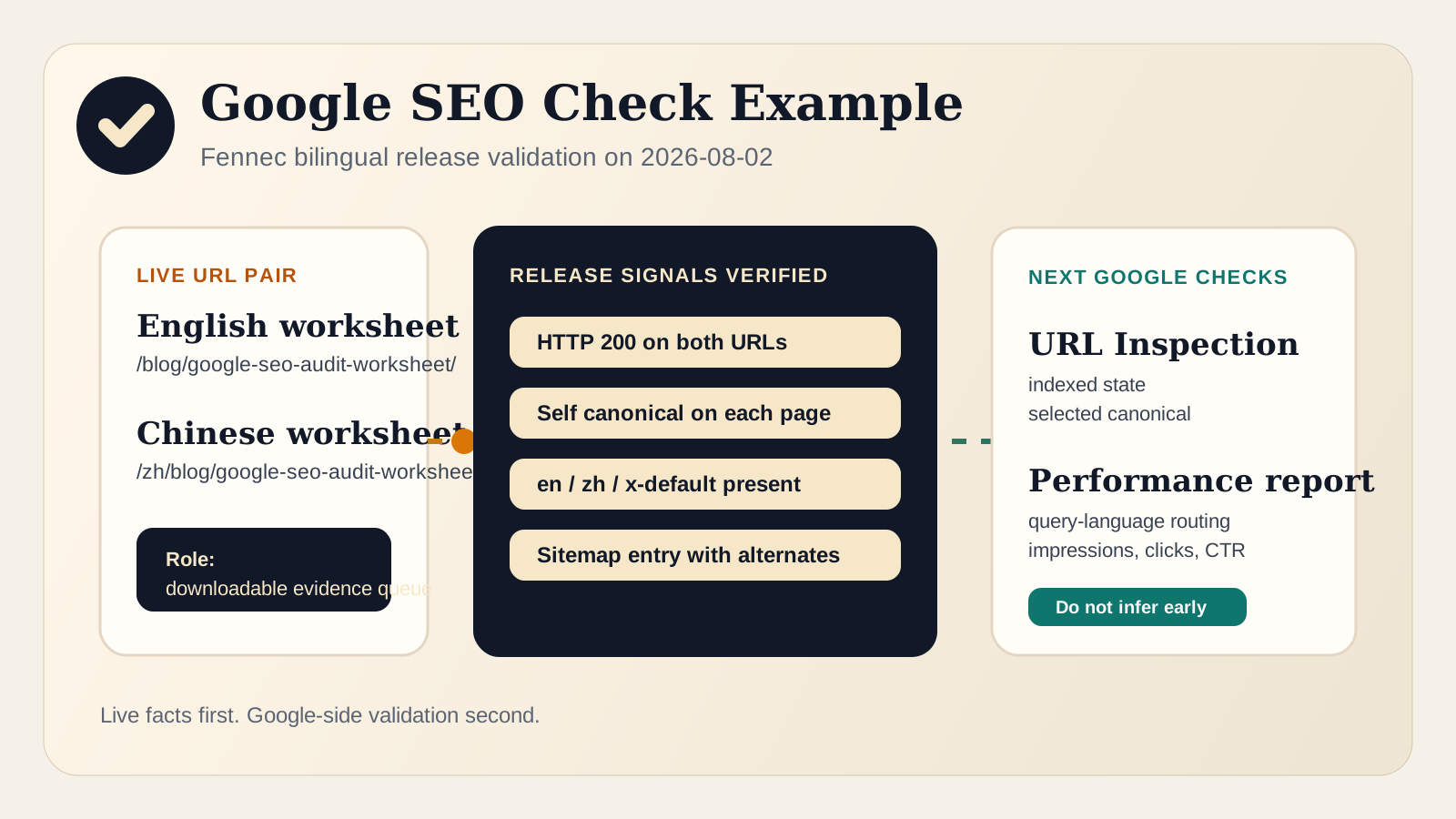
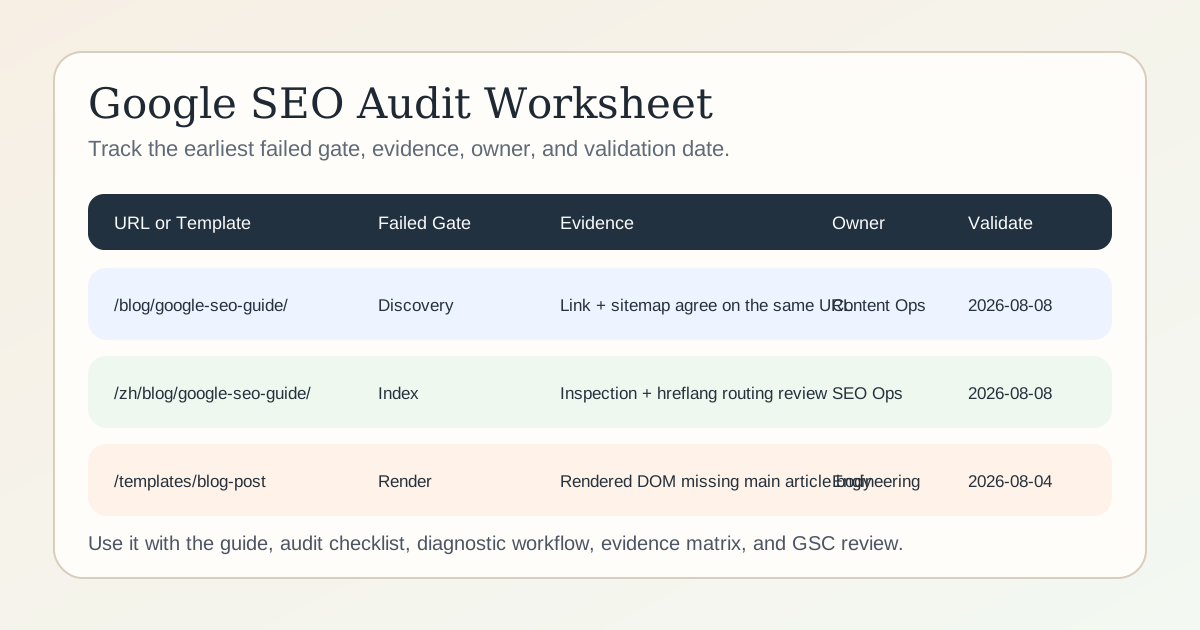
If the team is ready to move from classification to execution, record the final claim in the downloadable Google SEO audit worksheet so the owner, fix, and validation date stay attached to the evidence. If you want to see how live page facts and Google-side follow-up stay separate on a real Fennec-owned bilingual pair, use the Google SEO check example.
Failure modes the matrix is designed to prevent
Writing industry theories as if Google confirmed them
Examples:
- claiming dwell time is a confirmed ranking factor;
- claiming ad spend improves organic trust;
- claiming an E-E-A-T score exists as a public Google metric.
Those statements do not belong in the official-guidance column.
Treating one tool warning as proof
Examples:
- a crawler snapshot says the page is thin, but you did not compare rendered DOM and source HTML;
- a title looks weak, but you did not check the query set or current snippet;
- a canonical warning appears, but the live page and Search Console agree on the correct canonical.
Those are not finished findings yet.
Over-explaining a traffic change from one number
Performance report data is useful, but it does not prove causality on its own. A drop in clicks can come from demand shift, result-format change, query mix, wrong-language routing, snippet mismatch, or a page-quality issue. The matrix forces you to write down which parts are measured and which parts are inference.
A practical Fennec workflow
For a Google SEO cluster page, a realistic sequence looks like this:
- Use Audit to collect candidate technical and content issues.
- Validate crawl, canonical, sitemap, and rendered-page questions with robots.txt checker, canonical checker, sitemap checker, and Bot Simulator.
- Use GSC Management or Search Console to confirm indexing and performance state.
- Record the finding in the matrix before you rewrite the page or explain the result to stakeholders.
That is the difference between “we saw a warning” and “we have evidence for a fix.”
Example matrix rows for common cluster decisions
These are sample classification rows, not production performance records.
| Decision | What makes it evidence-backed | What would still be too weak |
|---|---|---|
| Update a title | Query-level impressions exist, CTR is weak, page intent is correct, and the title overpromises or buries the answer | Low clicks without checking impressions, device, language, or competing page role |
| Fix a canonical | Live HTML, redirect target, internal links, sitemap, and Search Console disagree on the preferred URL | A generic “duplicate content” warning with no URL-level review |
| Merge two pages | Both pages repeatedly overlap on the same visible query set and do not serve distinct tasks | One screenshot showing two pages ranking once |
| Escalate rendering work | The rendered DOM loses important copy, links, or tags compared with the source or intended user view | A theory that JavaScript “must be the problem” without comparing outputs |
Limitations
The matrix improves decisions, but it does not make SEO deterministic.
- Google does not expose every internal system detail.
- Search Console omits some low-volume queries and can delay visibility.
- URL Inspection can show current access and indexed state, but not future ranking.
- A correct interpretation can still fail if the page does not add enough value for the query.
Use the matrix to improve the quality of your next action, not to pretend uncertainty has disappeared.
When this asset should be used
Use this page when the team is debating a cause, prioritizing a fix, or explaining results to stakeholders. If the task is broader site diagnosis, continue with the Google SEO audit checklist. If the task is routing a symptom to the earliest failed layer, continue with the Google SEO diagnostic workflow. If the task is deciding what to do over the next quarter, continue with the Google SEO 30/60/90-day plan.
Sources
- Google Search Central: SEO Starter Guide
- Google Search Central: Search Essentials
- Google Search Central: AI features and your website
- Google Search Central: Make your links crawlable
- Google Search Central: JavaScript SEO basics
- Google Search Central: How to specify a canonical URL
- Google Search Console Help: URL Inspection tool
- Google Search Console Help: Page indexing report
- Google Search Console Help: Performance report
- web.dev: Web Vitals
Q&A
What is a Google SEO evidence matrix?
It is a working table that separates Google's documented guidance, reproducible page-level checks, and industry interpretation so a team knows which claims are confirmed, testable, or still uncertain.
Can a tool output count as proof?
No. A tool output is only useful when it ties back to the live page, response, rendered DOM, Search Console state, or another check that someone else can reproduce.
Why does this matter before editing a page?
Because many SEO mistakes come from acting on an interpretation as if it were a Google rule. The matrix reduces bad priorities, weak explanations, and avoidable rewrites.