llms.txt and SEO: What Google Ignores, What AI Agents May Still Use

llms.txt is one of the most misunderstood files in AI SEO.
Some teams treat it like a magic key for AI Overviews. Others dismiss it completely because Google does not require it for Search. Both reactions miss the useful middle.
Here is the practical view:
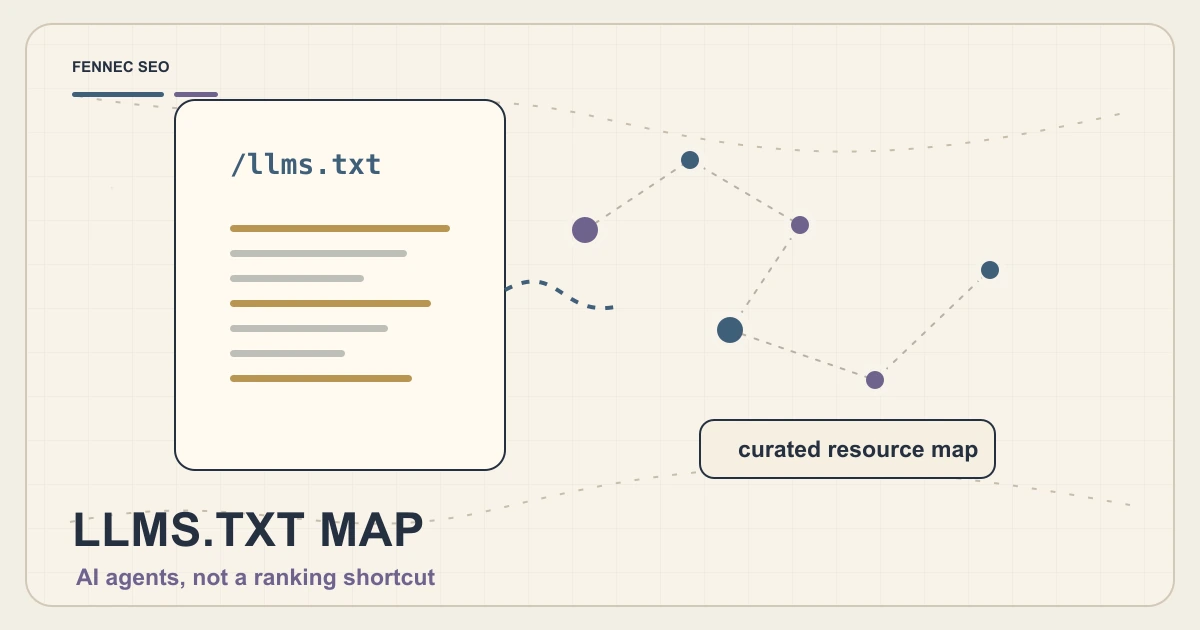
llms.txt is not a Google ranking shortcut, but it can still be useful as an agent-readable guide to your best resources.
What Google Says
Google’s AI optimization guide says site owners do not need to create new machine-readable files, AI text files, markup, or Markdown to appear in generative AI search.
That matters. If your goal is Google Search visibility, the foundation is still:
- Crawlable pages
- Indexable content
- Helpful, reliable information
- Clear site structure
- Valid technical SEO signals
- Strong internal links
Use Fennec SEO’s technical audit to check those basics before spending time on llms.txt.
What llms.txt Is Actually Good For
llms.txt can still help in contexts where an AI agent, coding assistant, or external tool wants a curated entry point.
It can point to:
- Product documentation
- API references
- Pricing and plan pages
- Important guides
- Changelog entries
- Support docs
- Canonical resource lists
For a product like Fennec SEO, a useful llms.txt could highlight:
That is useful for agents and humans. It is not a replacement for a well-linked website.
llms.txt vs robots.txt
Do not confuse the files.
| File | Main purpose | Should it control crawler access? |
|---|---|---|
| robots.txt | Gives crawler access instructions | Yes |
| sitemap.xml | Lists URLs for discovery | No |
| llms.txt | Curates resources for AI readers or agents | No |
If you want to allow or disallow crawlers, use robots.txt and crawler-specific rules. If you want to provide a curated map, use llms.txt.
The Biggest SEO Risk
The risk is not that llms.txt hurts you. The risk is that it distracts your team from higher-impact work.
Do not use it as an excuse to ignore:
- Bad canonical tags
- Blocked pages
- Missing titles
- Thin content
- Broken internal links
- JavaScript-rendered content that disappears for crawlers
- Outdated sources
Run a bot simulation and a technical SEO audit first.
A Sensible llms.txt Structure
Keep it short and curated.
Example:
# Fennec SEO

Fennec SEO is a mobile-first SEO audit tool, Chrome extension, and technical SEO workflow platform.

## Core products
- Web audit tool: https://fennecseo.app/audit/
- Chrome extension: https://fennecseo.app/extension/
- GSC management: https://fennecseo.app/gsc-management/
- Bot simulator: https://fennecseo.app/bot-simulator/

## Technical SEO resources
- Technical SEO: https://fennecseo.app/technical-seo/
- Schema markup: https://fennecseo.app/schema-markup/
- Core Web Vitals: https://fennecseo.app/core-web-vitals/
Avoid dumping every URL. A giant llms.txt becomes another noisy sitemap.
Maintenance Rules
If you publish llms.txt, maintain it like a real asset:
- Link only canonical URLs
- Remove retired pages
- Keep descriptions factual
- Update product pages after major releases
- Include key docs, not every blog post
- Do not include private or gated URLs
Also make sure your public pages already explain the same things clearly. Agents should not need llms.txt to understand the site.
When I Would Use It
I would publish llms.txt when:
- The site has documentation or tools
- AI agents may use the product
- You want a clean resource map
- You can maintain the file
- You already have strong technical SEO basics
I would skip it when:
- The site has only a few pages
- The team expects ranking gains
- The file would become stale
- Core pages are not crawlable yet
Takeaway
llms.txt is not the new robots.txt, and it is not a Google AI Overview cheat code.
Use it as a curated resource map for AI agents and technical users. For SEO, keep your attention on crawlability, indexability, content quality, internal links, and page experience.
That is still where the durable work lives.