Domain Authority vs PageRank: Choose Link Actions from Evidence
Separate third-party authority scores from Google's PageRank, inspect actual links, and choose repairs without treating a score change as a ranking diagnosis.

Your authority score fell, but the pages and links you can see have not changed. Should you buy more links, rewrite the page, or investigate first? Start by identifying what the score measures and which observation supports an action.
Domain Authority and PageRank answer different questions
Domain Authority (DA) is Moz’s comparative metric for estimating ranking potential. Moz’s historical DA 2.0 guide distinguishes it from PageRank and says Google does not use that score. The guide explains the distinction; it is not a specification of today’s Moz model.
Google’s ranking systems guide describes link analysis as helping interpret relationships between pages. PageRank remains part of Google’s core systems and has evolved since its original implementation. The original formula does not let an audit tool reconstruct Google’s current calculations.
A vendor score is therefore not a Google PageRank reading. Do not convert DA, DR, or another authority score into a required number of backlinks or a prediction that one page must outrank another. For the broader context, see the Google ranking systems guide.
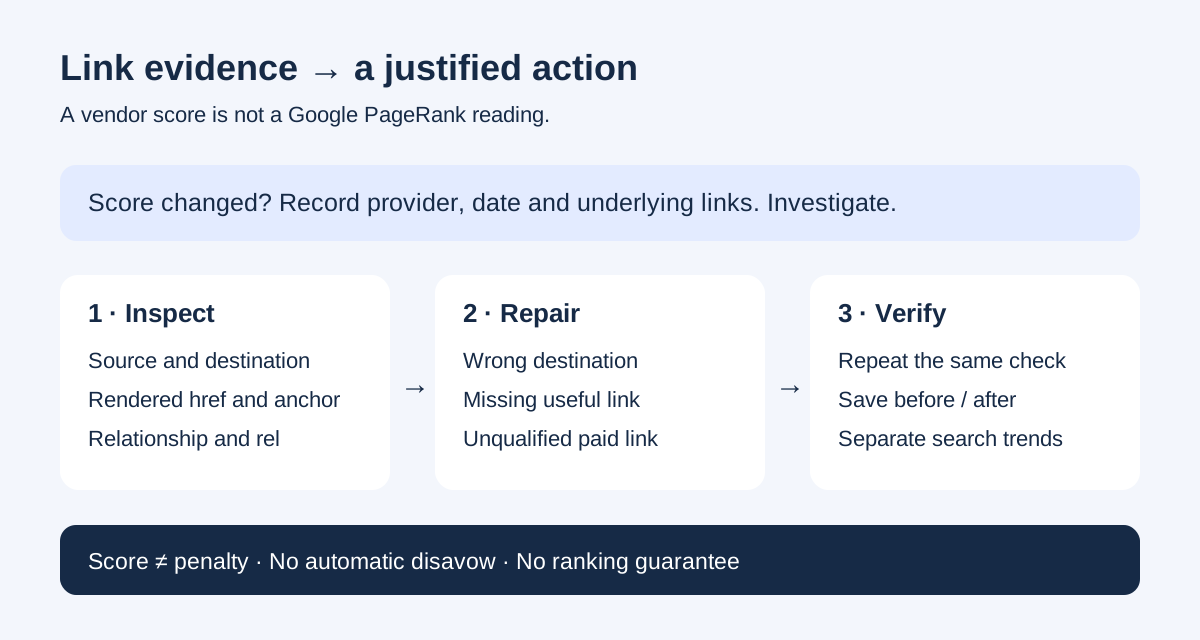
Match the observation to the next check
The following is a practical decision aid, not a Google scoring formula.
| Observation | Evidence to collect | Proportionate action |
|---|---|---|
| A vendor score changes | Provider, date, affected URLs, underlying link records | Investigate; the score alone justifies no page change |
| An important internal destination is hard to reach | Source page, rendered anchor, actual destination | Add a useful contextual link or repair the wrong destination |
| A backlink appears in Search Console | Linking page, current link, destination, relationship | Inspect the source before deciding whether anything needs fixing |
| A paid placement lacks qualification | Commercial relationship and rendered rel value | Correct the qualification on links you control |
| An unfamiliar link looks suspicious | Link pattern, provenance, manual-action evidence | Assess against policy; do not automatically disavow |
The Search Console Links report is a sample. Its tables can be limited to 1,000 rows; larger export options have separate limits. Links may have disappeared since discovery, and the report does not show nofollow status. Neither absence nor presence proves Google’s current ranking treatment of a link.
Inspect one link before changing a template
- Record the source URL, intended destination, inspection date, and reason the link helps a reader.
- Inspect the rendered HTML. Google’s link guidance recommends an
<a>element with anhrefand meaningful anchor text. - Follow the link. Check the final destination, response, language, and whether it fulfils the anchor’s promise.
- Check the relationship. For paid placements, Google prefers
rel="sponsored";nofollowremains acceptable. Useugcfor user-generated links as described in the qualification guidance. - Repair only the demonstrated defect, then repeat the same inspection. Save before/after evidence separately from search-performance observations.
For example, imagine a category page whose “installation instructions” link opens a discontinued product. Correcting it to the relevant instructions fixes navigation. This is an illustrative scenario, not a measured customer result, and it does not establish a PageRank increase.
Use anchor text to set expectations, backlink checks to examine external references, and link-building guidance when planning acquisition. A nofollow link is not a precise PageRank control.
Keep risk decisions separate from score changes
Google’s link spam policy addresses manipulative activity such as paid ranking links, excessive exchanges, and automated link creation. A low score is not that evidence.
The disavow tool is for a considerable number of spammy or artificial links that caused, or are likely to cause, a manual action. Most sites do not need it; misuse can harm search performance.
Judge the repair first by its observable result: the right destination, a usable link, accurate wording, and appropriate qualification. Later traffic changes need their own comparison and cannot reveal how much PageRank an individual link contributed.
Q&A
Is Domain Authority the same as PageRank?
No. DA is Moz's comparative metric. Google documents PageRank as part of its core ranking systems; a DA score is not a measurement of Google's PageRank.
Does a falling authority score prove a Google penalty?
No. Inspect the underlying links and relevant Search Console reports. A tool score alone cannot establish a manual action or explain a ranking change.
Should a low score trigger disavowal?
No. Google's disavow guidance requires a considerable number of spammy or artificial links and a manual action caused by them, or a likely manual action. Most sites do not need the tool.