Google Search Ranking Systems: Algorithms, Updates, and Spam Explained

A site’s organic traffic drops. One person calls it an HCU hit, another blames the latest core update, and a third says BERT no longer understands the content. Which claim can you actually test?
Start by separating four things that are often collapsed into the phrase Google algorithm:
- systems that understand queries, pages, links, and result needs;
- broad updates that improve several systems;
- spam-detection systems and published policies;
- product names such as Bard or Gemini that are not documented Search ranking systems.
Google’s own ranking systems guide says automated systems use many factors and signals, mostly at page level, while site-wide signals and classifiers can also contribute. It does not publish a complete factor list, fixed weights, or a score that publishers can tune.
The short answer: system, update, policy, and product are different
| Term | What Google documents | What a site owner can observe | What not to claim |
|---|---|---|---|
| BERT | Helps understand how combinations of words express meaning and intent | The queries and pages Google matches; changes in page/query visibility | A public BERT score or exact optimization weight |
| RankBrain | Helps understand how words relate to concepts | Whether conceptually relevant pages surface without exact wording | That repeating a keyword “feeds RankBrain” |
| Neural matching | Connects concept representations in queries and pages | Broader query-to-page matching patterns | A separate neural-matching checklist |
| Helpful content | A former standalone system incorporated into core ranking systems in March 2024 | Page and query changes, content quality, originality, evidence, production patterns | That every decline is an HCU penalty |
| SpamBrain | Google’s AI-based spam-prevention system | Announced spam-update windows, policy violations, manual-action messages | That an analytics chart proves SpamBrain targeted a site |
| Core update | A broad change to Search algorithms and systems | Timing, affected pages, queries, countries, devices, and search types | That it targets one site or one isolated “factor” |
| Spam policy | A published boundary for manipulative or deceptive practices | Page patterns, implementation evidence, and Search Console notices | That low traffic alone proves a violation |
| Bard / Gemini | A Google AI product lineage | Product behavior and referrals where measurable | That Bard is a documented ranking algorithm |
A four-layer model for understanding Google Search
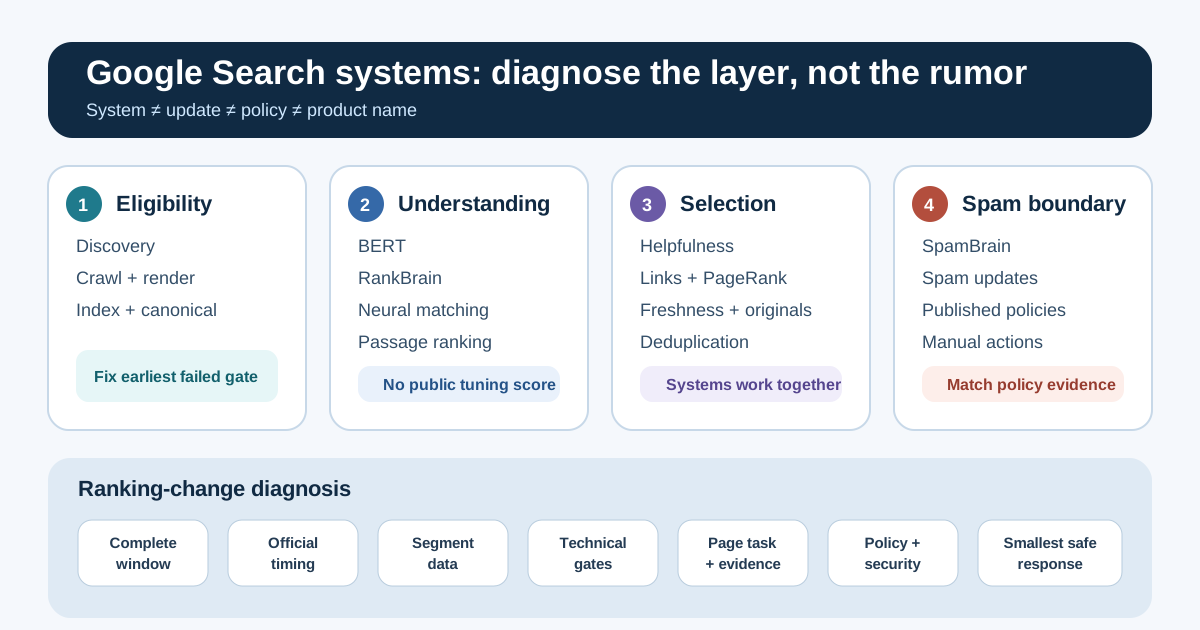
This four-layer model is a practical diagnostic aid, not Google’s internal architecture diagram. It keeps evidence at the right layer.
Layer 1: eligibility, discovery, and indexing
Before ranking systems can select a page, Google must be able to discover, crawl, render, and index an eligible version. Check the live response, robots directives, canonical signals, sitemap and crawlable internal links. Use the Google SEO audit worksheet and indexing troubleshooting workflow to record those states.
An indexing fault is not evidence of a BERT, helpful-content, or core-update problem. Fix the earliest failed gate first.
Layer 2: query and page understanding
Google documents several AI systems with different jobs:
- BERT helps interpret how combinations of words express meanings and intent.
- RankBrain helps understand relationships between words and concepts.
- Neural matching helps match concept representations in queries and pages.
- Passage ranking helps identify individual sections of a page to understand their relevance.
The practical content lesson is not “write for BERT.” It is to give a real task a clear, complete answer; use terms naturally; make relationships explicit; and structure long pages so important sections remain understandable. Google’s SEO Starter Guide also says language-matching systems can understand many query variations without exact wording.
Creating a near-duplicate page for every phrasing can create cannibalization and, when done at scale to manipulate ranking, can cross the scaled content abuse boundary.
Layer 3: relevance, usefulness, and result selection
Google’s documented systems also include link analysis and PageRank, freshness systems, deduplication, original-content systems, and systems for specific needs such as crisis information. They work together rather than as a single ordered checklist.
The people-first content guidance asks whether a page offers original information or analysis, demonstrates real expertise, serves an intended audience, and leaves readers able to achieve their goal. Google says the former helpful content system became part of its core ranking systems in March 2024.
That changes the operational language:
- do not ask, “How do I remove an HCU penalty?” before you have evidence;
- ask which pages and queries changed, whether the change was sustained, and what those pages fail to deliver;
- compare your page with the task users are trying to complete, not with a rumored word count or factor score;
- improve content substantially when evidence supports it; do not merely change the date.
For the historical term and its current meaning, see our Helpful Content guidance. The E-E-A-T guide also separates quality concepts from a fictional single ranking score.
Layer 4: spam prevention and enforcement
Google’s spam update guidance says automated spam-detection systems operate continuously. A notable improvement may be announced as a spam update. Google names SpamBrain as an AI-based spam-prevention system.
The system is not the policy. The spam policies define practices such as cloaking, doorway abuse, hidden text and link abuse, link spam, scaled content abuse, site reputation abuse, and other manipulative or deceptive patterns. Automated systems and human review can both be involved; human review may result in a manual action.
For a step-by-step evidence route, use SpamBrain, spam updates, and manual actions. It separates update timing, policy evidence, Search Console notices, and page/query analysis before a remedy is chosen.
Keep four evidence states separate:
| Evidence state | What it supports | First action |
|---|---|---|
| Announced spam update overlaps a traffic change | Timing correlation only | Wait for rollout completion; segment affected pages and queries |
| Page or template matches a policy definition | A concrete compliance risk | Stop the pattern, preserve evidence, and remediate the root cause |
| Search Console reports a manual action | Confirmed manual enforcement | Read the exact action, fix its scope, document changes, request reconsideration when eligible |
| Traffic declined with no policy evidence | A performance symptom | Continue technical, query, page, competitor, seasonality, and update analysis |
Calling every decline a “spam penalty” skips the work needed to find the actual failure.
Core updates are broad reassessments, not a named-site penalty
Google says core updates are broad changes intended to improve the overall usefulness and reliability of results. They do not target specific sites or pages. The official core update guidance recommends:
- confirm the update has finished on the Search Status Dashboard;
- wait at least a full week after completion before analysis;
- compare equivalent periods before and after the rollout;
- review affected pages and queries, not only the site total;
- separate Web, Image, Video, and News performance;
- avoid drastic action for a small movement on an otherwise successful page.
This is a measurement discipline. It prevents a normal seasonal drop, indexing incident, migration problem, competitor improvement, or snippet change from being mislabeled as an algorithm hit.
A reproducible ranking-change diagnosis
Use this sequence when visibility changes:
1. Confirm the data window
Exclude incomplete Search Console dates. Note timezone, search type, country, device, and whether the change is clicks, impressions, CTR, or position. Compare equal-length periods.
2. Check official event timing
Record the start and end of any core or spam update from the Google Search Status Dashboard. Correlation creates a hypothesis, not a diagnosis.
3. Segment before interpreting
Move from site → directory → page → query → country → device → search appearance. A site-wide total can hide one lost page, a language-routing shift, or a mobile-only problem. GSC Management and the query clustering workflow can structure this evidence.
4. Test the earliest technical gate
Check HTTP status, redirects, robots, rendering, canonical, hreflang, sitemap and internal discovery. Use Fennec Audit, Bot Simulator, Canonical Checker, and Sitemap Checker as diagnostic inputs—not as proof of Google’s selected state.
5. Review the page task and evidence quality
Ask whether the page still completes the query’s task, provides original information, cites current primary sources, exposes accountable authorship, and avoids unsupported promises. Compare impacted pages with stable pages and with better current results.
6. Check policy and security separately
Inspect Manual Actions and Security Issues in Search Console. Match any suspected pattern to the actual policy wording. Do not infer a manual action from ranking data.
7. Choose the smallest justified response
- Technical fault: repair and validate the affected layer.
- Intent mismatch: adjust the page role, content, title, or internal links without creating a duplicate URL.
- Weak information gain: add real evidence, analysis, or task completion—not filler.
- Policy violation: stop and remediate the violating pattern across its true scope.
- Insufficient evidence: record a review date and wait for a complete window.
What publishers can control
You cannot tune Google’s model weights. You can control whether your pages are accessible, internally discoverable, technically coherent, original, well sourced, accurately titled, and useful for a defined audience.
You can also keep your evidence honest:
- a crawler test describes what that request received, not Google’s final ranking decision;
- URL Inspection describes Google’s indexed view or a live eligibility test, not a ranking guarantee;
- Search Analytics returns top rows and can hide low-volume queries;
- a timing match with an update does not establish causation;
- a content improvement needs a release record and later observation window before you attribute an outcome.
That is the useful way to study Google algorithms: not as secret levers, but as a map for asking better diagnostic questions.
Sources
- Google Search Central: A guide to Google Search ranking systems
- Google Search Central: Creating helpful, reliable, people-first content
- Google Search Central: Google Search core updates
- Google Search Central: Spam updates and your site
- Google Search Central: Spam policies for Google web search
- Google Search: How AI powers great search results
Q&A
Is Google's Helpful Content Update still a separate ranking system?
Not as a standalone system. Google says the helpful content system became part of its core ranking systems in March 2024. Diagnose affected pages and queries instead of assigning every decline to an HCU penalty.
Are BERT, RankBrain, and SpamBrain the same kind of Google algorithm?
No. BERT and RankBrain help Search understand language and concepts, while SpamBrain is an AI-based spam-prevention system. None gives site owners a public score or tuning control.
Is Google Bard or Gemini a ranking algorithm?
No. Bard was a Google AI product name and is now Gemini; neither is listed in Google's Search ranking systems guide.