SpamBrain, Spam Updates, and Manual Actions: An Evidence-Led Diagnosis

Direct answer
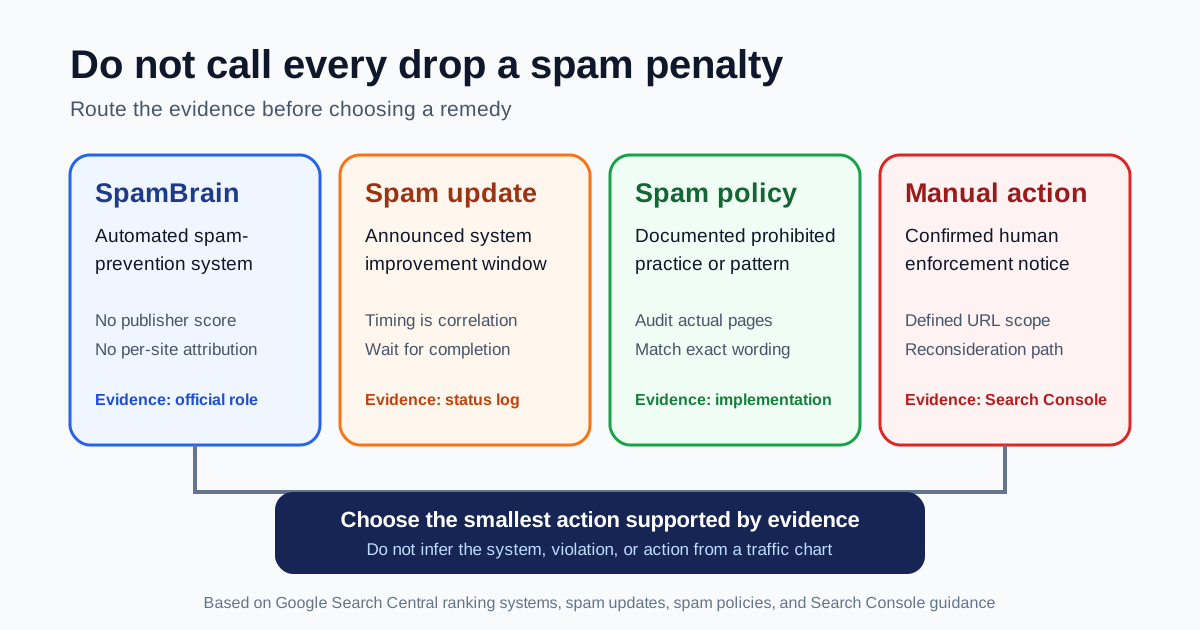
SpamBrain, a spam update, a spam-policy violation, and a manual action are four different things. Google describes SpamBrain as an AI-based spam-prevention system. Its automated spam-detection systems operate continuously. When Google makes a notable improvement and announces it, that event is called a spam update. The spam policies describe prohibited practices. A manual action is human enforcement confirmed in Google Search Console.
Use those distinctions before changing a site:
| Term | What it is | Evidence you can verify | What it does not prove |
|---|---|---|---|
| SpamBrain | One of Google’s automated spam-detection systems | Google’s documented description of its role | That SpamBrain caused a specific site’s traffic change |
| Spam update | An announced improvement to automated spam detection | Start and completion dates in the Search Status Dashboard | That every site moving during the window violated policy |
| Spam policy | A documented boundary for manipulative or deceptive practices | Page, link, hosting, ownership, and implementation evidence | That low traffic by itself is a violation |
| Manual action | Human enforcement recorded for a site or section | The exact notice and affected scope in Search Console | That an unnotified ranking drop is a manual action |
Start with the evidence source, not the suspected algorithm
A useful diagnosis routes each signal to the system that can actually confirm it.
| Signal | Confirm it here | First action |
|---|---|---|
| Google announced a spam update | Search Status Dashboard | Record the rollout window and wait until it completes before comparing stable periods |
| Search Console shows a manual action | Manual Actions report | Preserve the exact wording and URL pattern; fix every affected instance |
| Pages appear to use a prohibited pattern | Google spam policies | Match the implementation to a named policy and collect page-level evidence |
| Rankings changed with no notice | Search Console page and query data, crawl/index checks, change log | Segment the change and test technical, content, competition, and update hypotheses |
| Security warning or hacked content appears | Search Console Security Issues and server evidence | Treat it as a security incident, not an algorithm theory |
This order prevents a common failure: seeing one line fall in analytics, naming an invisible system, and rewriting unrelated content.
What Google says about SpamBrain
Google’s ranking systems guide says it uses multiple spam-detection systems, including SpamBrain, to address content and behaviors that violate its spam policies. The guide does not expose a SpamBrain score, site-level classification, tuning switch, or per-query debugger.
Google’s spam update guidance adds two operational facts:
- automated spam detection runs continuously, while only notable improvements are announced as spam updates;
- after fixing policy problems, improvement may take months while automated systems learn that a site complies.
For a link spam update, Google warns that neutralizing spammy links can remove the ranking benefit those links previously created. Removing or disavowing the links does not restore an illegitimate benefit.
The practical boundary is simple: you can audit a site’s behavior against published policies, but you cannot prove from an analytics chart that SpamBrain classified a particular URL.
How to compare a spam-update window
An announced update gives you a time boundary, not a diagnosis.
- Record the official start and completion timestamps from the Search Status Dashboard.
- Avoid judging the rollout from partial days. Use complete, equal-length periods before and after the finished window.
- Compare pages and queries together. A sitewide total can hide one template losing visibility while another grows.
- Segment by country, device, and search type when the change is large enough to support that split.
- Overlay releases, migrations, robots changes, outages, redirects, canonical changes, and major content edits.
- Inspect the affected pages against current spam policies and ordinary quality or technical requirements.
Correlation can justify an audit. It cannot identify SpamBrain, a violation category, or a manual action.
Audit the policy pattern, not a vague “penalty”
Google’s spam policies cover distinct behaviors. The remedy depends on which implementation exists:
| Pattern to investigate | Evidence to collect | Useful Fennec reference |
|---|---|---|
| Scaled pages created mainly to manipulate rankings | Generation rules, page inventory, uniqueness, reader value, publishing controls | Scaled content abuse |
| Third-party sections exploiting host-site signals | Ownership, editorial responsibility, distribution copies, URL patterns, audience path | Site reputation abuse |
| Doorway pages funnelling similar searches to one destination | Location/keyword templates, redirects, navigation role, unique utility | Doorway pages |
| Hidden text or links intended to manipulate Search | Rendered state, CSS, accessibility purpose, crawler/user parity | Hidden content audit |
| Link schemes or artificial link patterns | Source pages, placement, anchors, commercial relationship, qualification attributes | Link building |
| Keyword stuffing | Repeated blocks, city/phone lists, unnatural repetition, reader task | Keyword stuffing |
Do not collapse these into “thin content” or “AI content.” Google’s policies focus on purpose, behavior, deception, and manipulation. The writing tool alone does not determine whether a page violates policy.
Manual action workflow
If the Manual Actions report contains a notice, the evidence is no longer hypothetical.
- Save the notice, date, policy name, examples, and affected URL pattern.
- Determine whether the scope is a page set, section, or the whole site; do not broaden it without evidence.
- Fix the underlying pattern everywhere it occurs, not just the sample URLs.
- Document what was wrong, what changed, and how you verified the final state.
- Submit a reconsideration request only after the remediation is complete.
- Wait for the decision instead of repeatedly submitting new requests.
For site reputation abuse, regional treatment can differ. Use the dedicated EEA and non-EEA enforcement guide rather than generalizing that one policy’s scope to every manual action.
What to record in an incident log
Keep the log factual enough that another reviewer can reproduce the diagnosis:
| Field | Record |
|---|---|
| Official event | Update name, source URL, start time, completion time |
| Site change | Commit or release, affected templates, exact timestamp |
| Search evidence | Equal windows, filters, page/query rows, data finality |
| Policy evidence | Named policy, representative URLs, implementation pattern |
| Search Console state | Manual Actions and Security Issues result, inspection date |
| Decision | Keep, fix, remove, consolidate, or monitor—with the evidence for that action |
This record keeps an update hypothesis separate from a confirmed violation and prevents later reviewers from treating a guess as history.
Mistakes to avoid
- Calling every post-update decline a SpamBrain hit.
- Treating a third-party “spam score” as Google’s classification.
- Assuming no manual action means no automated ranking effect.
- Assuming a manual action always affects the entire domain.
- Rewriting strong pages before checking crawling, indexing, canonicalization, and internal competition.
- Expecting a fixed recovery date after policy remediation.
- Trying to regain benefits from links that Google has neutralized.
Bottom line
Name only what the evidence can support. SpamBrain is a documented automated system; a spam update is a published rollout window; spam policies define prohibited practices; and a manual action is confirmed in Search Console.
When traffic changes, start with the Google Search ranking systems map, then route each signal to status history, Search Console, page-level evidence, or a named policy. The goal is not to identify a hidden algorithm. It is to find the smallest verified problem and correct it without damaging unrelated pages.
Official sources
- Google Search Central: A guide to Google Search ranking systems
- Google Search Central: Spam updates and your site
- Google Search Central: Spam policies for Google web search
- Google Search Status Dashboard: Ranking history
- Google Search Console Help: Manual Actions report
Q&A
Is SpamBrain the same thing as a Google spam update?
No. SpamBrain is an AI-based spam-prevention system. A spam update is Google's announcement that it made a notable improvement to automated spam detection.
Does a traffic drop prove that Google found a spam-policy violation?
No. Timing and traffic data can identify affected pages and queries, but they do not prove which system acted or whether a policy violation exists. Audit the implementation against the current policy.
How do I know whether Google issued a manual action?
A manual action is confirmed in the Search Console Manual Actions report. Do not infer one from rankings, traffic, or a third-party tool.