Google Site Reputation Policy: EEA vs Non-EEA Enforcement from August 30, 2026

Direct answer
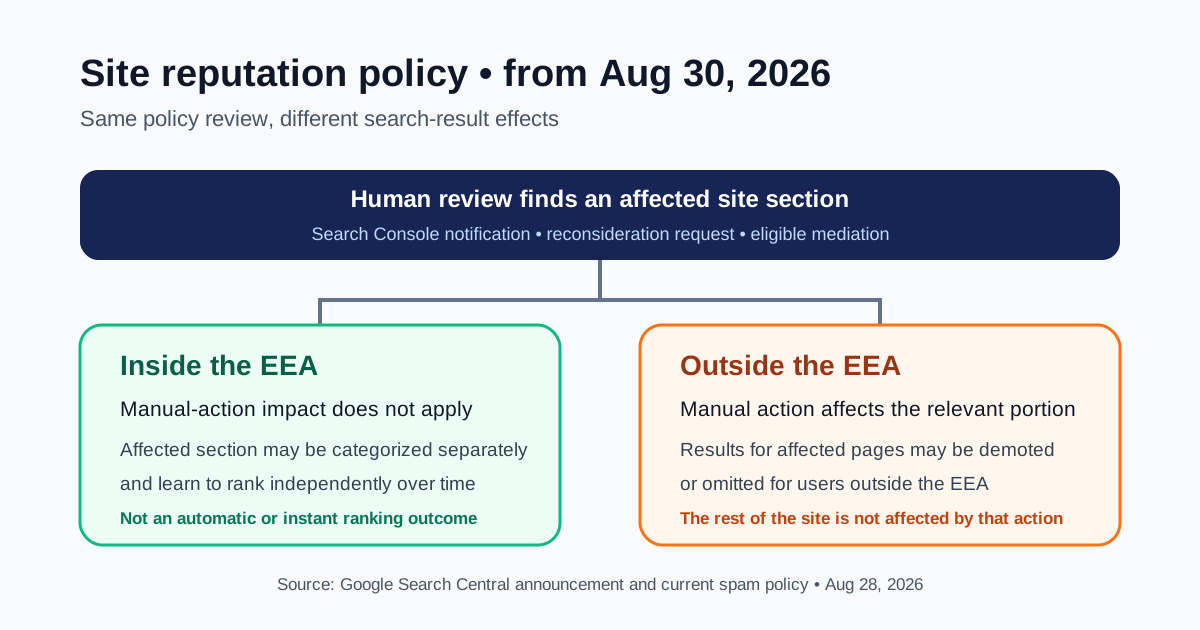
On August 28, 2026, Google announced a regional change to enforcement of its site reputation abuse policy, effective August 30, 2026. The policy itself still applies globally, and Google still uses human review. What changes is the effect on search results:
| Searcher location | Effect from August 30, 2026 |
|---|---|
| Outside the European Economic Area (EEA) | A manual action may affect the relevant pages or portion of the site. Google says the rest of the site is not affected by that action. |
| Inside the EEA | The impact of the manual action does not apply. The relevant section may instead be categorized separately from the main domain and, over time, ranked independently on its own merits. |
This is not a simple “EEA exemption.” Google can still review the same content, notify the owner in Search Console, and separate a section from the main domain in its systems. It is also not an automatic domain-wide penalty outside the EEA.
What Google changed—and what it did not
Google’s August 28 announcement says the adjustment follows discussions with the European Commission. It changes the consequences of a site reputation policy manual action according to the location of the person seeing the search results.
Three distinctions matter:
- The rule is about the searcher’s location, not simply the publisher’s headquarters. A page can serve a global audience. Google says a manual action on that page can affect results shown outside the EEA while not affecting results shown inside it.
- The EEA alternative is independent evaluation, not a guaranteed ranking outcome. Google may categorize the relevant section separately. Its systems can then learn to rank that part independently over time.
- The non-EEA action is scoped to the affected portion. Google’s announcement says the rest of the site will not be affected by that manual action.
The current Google spam policy retains the core definition: site reputation abuse concerns third-party pages published mainly to exploit the host site’s existing ranking signals. The update adds regional enforcement detail and more guidance on the factors used during human review; it does not turn all third-party, freelance, affiliate, sponsored, or white-label content into a violation.
How the EEA treatment works
For results shown to users inside the EEA, Google says the manual action’s impact will not apply. Previous actions under this policy will also be lifted for pages appearing in EEA search results.
The affected portion may still be treated as separate from the main domain. Google’s FAQ explains that this removes the normal presumption that a page shares the overall quality of other pages on the domain. It does not mean that the section instantly loses every domain-level signal, and the categorization itself is not used as a ranking signal. Instead, ranking systems may learn over time to assess the section independently.
That distinction matters operationally. A publisher should not describe the EEA outcome as either “no consequences” or “an immediate subdomain-style demotion.” The documented outcome is a different evaluation path whose ranking effect may evolve.
Google also says a non-EEA manual action is not used as a ranking signal for that content inside the EEA. There is no obligation to apply noindex merely because the content is subject to this action outside the EEA, and failure to do so is not itself treated as circumvention or a repeated violation in the EEA.
What happens outside the EEA
For results shown to users outside the EEA, the relevant pages may be subject to a manual action. The announcement is explicit that the action directly affects the portion of the site affected, while the rest of the site is not affected by that action.
This corrects a common overstatement: site reputation abuse enforcement is not automatically a whole-domain suppression. Search Console can identify URL patterns representing a subset of a site. Google also warns in its Manual Actions report documentation that repeated violations may lead to further actions or affect overall ranking, but that is a separate escalation risk—not the default scope of every site reputation action.
What Google considers during human review
The updated spam policy describes a global human-review framework. Google looks for sufficient host-site input, editorial oversight, or contribution to determine whether a section is genuinely integrated with the main site. Its non-exhaustive factors include:
- whether design, formatting, typography, and user experience are consistent with the host;
- whether the section has quality problems not seen on the main site;
- whether authorship, ownership, editorial responsibility, and commercial character are clear;
- whether identical or near-identical content appears on other sites;
- whether other evidence indicates the pages are third-party marketing material created to manipulate rankings.
No single factor is necessary or sufficient on its own. A disclosure, matching design, staff edit, affiliate link, or freelancer byline cannot act as a safe harbor by itself.
Google’s examples reinforce that point. A well-integrated coupon section with publisher curation and accountability may be unlikely to trigger action. An unauthored, commercially undisclosed affiliate article copied from a marketplace and disconnected from the publication may be likely to trigger action outside the EEA. Original freelancer work with clear editorial responsibility and genuine integration may be unlikely to trigger action.
Search Console, reconsideration, and mediation
The owner workflow remains centered on Search Console:
- Review the notice in the Manual Actions report, Search Console message center, or email.
- Expand the action and record the affected URL patterns. Do not infer that every page or the whole domain is affected unless the notice says so.
- Compare the section with the current policy and fix all affected pages. Document the issue, the remediation, and the resulting state.
- Select Request Review in the Manual Actions report and submit a reconsideration request.
- Watch Search Console and email for the review result; do not repeatedly resubmit while a request is pending.
All sites can use reconsideration. Google says eligible sites can, after the reconsideration request, also bring a dispute to mediation. Its policy FAQ further says that EEA websites receive a reconsideration process with a short response commitment and more reasoning, and may use alternative dispute resolution. Mediation is therefore an eligibility-dependent escalation path, not a substitute for the first reconsideration request.
Publisher audit: what to record now
Use the change to improve evidence, not to design geographic loopholes. For each third-party or commercial section, record:
- the commissioning party, original producer, editor, accountable publisher, and update owner;
- the audience need and how the section fits the site’s primary purpose;
- where the section appears in navigation, articles, newsletters, and other non-search journeys;
- whether materially identical pages are distributed on other domains;
- how authorship, commercial relationships, affiliate links, and editorial responsibility are disclosed;
- which URL patterns belong to the section and whether controls apply consistently;
- whether the content would still be published without inherited ranking benefit.
If a notice arrives, preserve the exact Search Console wording and affected patterns before changing anything. That evidence determines scope and supports a credible reconsideration request.
Mistakes to avoid
- Calling the EEA approach a complete policy exemption.
- Saying the affected section is automatically or immediately stripped of all host-domain signals.
- Saying every non-EEA action suppresses the whole site.
- Treating disclosure, first-party editing, or a subdirectory as an automatic safe harbor.
- Filing reconsideration before fixing every affected page and documenting the result.
- Promising mediation to every site without checking eligibility.
Bottom line
From August 30, 2026, Google applies two different consequences to the same site reputation policy review. Outside the EEA, the affected portion may be hit by a manual action while the rest of the site remains unaffected by that action. Inside the EEA, that manual-action impact does not apply, but the section may be separated and learned as an independent ranking unit over time.
Keep one global editorial standard, map the exact affected section, retain evidence, and follow the Search Console reconsideration path. For the underlying definition, examples, and publisher audit questions, continue with Site reputation abuse and Parasite SEO.
Official sources
- Google Search Central: Update to the Site Reputation Policy (August 28, 2026)
- Google Search spam policies: Site reputation abuse
- Google Search Console Help: Manual actions report
Q&A
Does a site reputation abuse manual action affect EEA search results?
From August 30, 2026, Google says the impact of this manual action does not apply to results shown to users inside the EEA. The affected section may instead be categorized separately and learn to rank independently over time.
Does the policy create an automatic sitewide penalty outside the EEA?
No. Google says the manual action directly affects the affected portion of the site in results shown outside the EEA; the rest of the site is not affected by that action.
Can a publisher appeal the decision?
Yes. Google continues to notify owners in Search Console and allows reconsideration requests. Eligible sites may also take a dispute to mediation after the reconsideration request.