Gemini Small Business Tools: Shopify Limits Sellers Should Check First
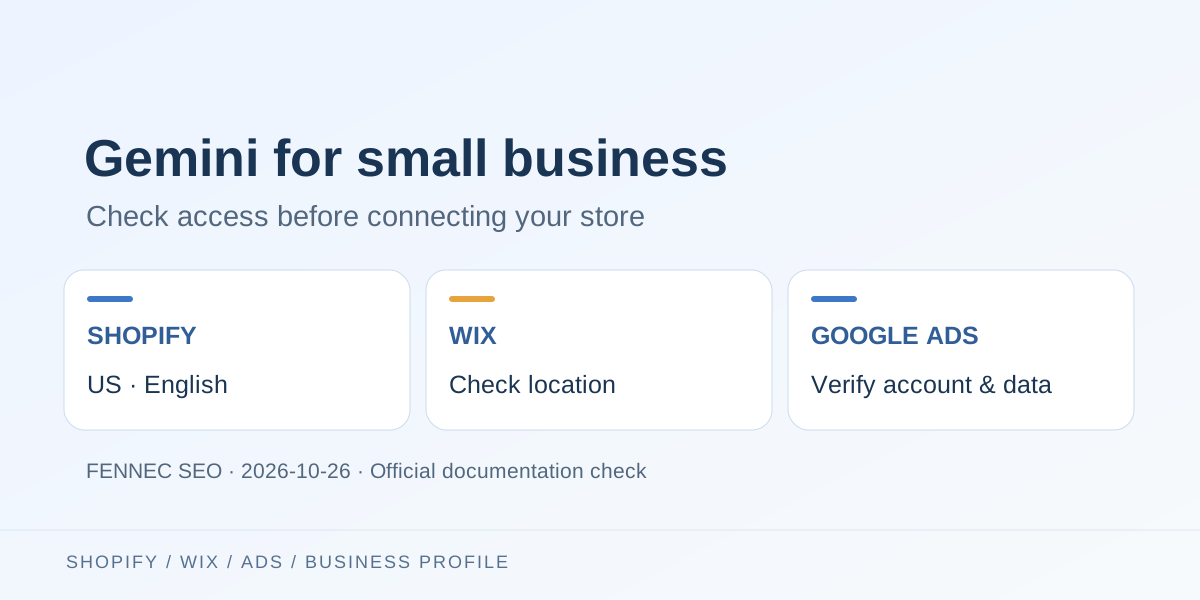
Can a Shopify seller serving US customers connect a store from Hong Kong while using Gemini in Chinese? The global rollout announcement does not establish that eligibility. On October 26, 2026, Google’s connected-apps table lists Shopify for US users, English, personal Google Accounts and ages 18+. Selling into the US does not establish the operator’s location eligibility. Check Google’s connection requirements.
For merchants and SEO teams, access and permissions come before image quality. This article cross-checks primary announcements and help documentation. It does not report a signed-in account trial, store authorization, generated-image comparison or advertising experiment. There are no measured time savings or conversion gains here.
What changed on October 20?
Google’s small-business announcement introduces a business landing page inside Gemini, brand visuals and financial analysis. It names Business Profile, Ads, Workspace, Adobe, Canva, Dropbox, Shopify, Wix, Zoho and Xero connections. Saved brand inputs can guide Nano Banana 2.1 visuals; financial records can become charts and interactive models.
Google describes a global rollout starting in the following days, without a completion date per account or a standalone price for the new tools. Its owner stories are Google-selected examples rather than our tests of this launch. The Indonesian example is Barelz Arena, a Jakarta sports and entertainment space that also designed merchandise.
Primary-source checks: a global hub has app-specific limits
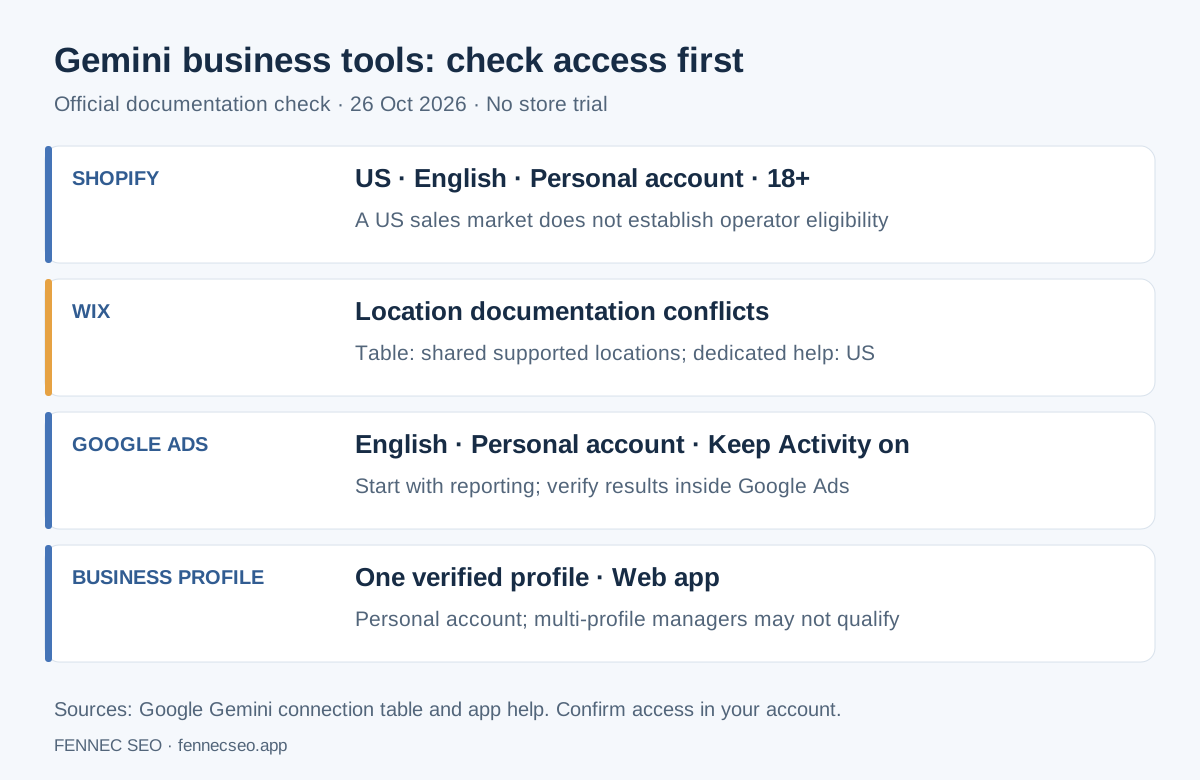
These are the official pages read on October 26, 2026; requirements can change.
| Connection | Verified documentation | Merchant implication |
|---|---|---|
| Shopify | Table: US, English, personal account, 18+ | Do not promise access to an overseas operator; the table describes product-creation actions, so inspect permissions |
| Wix | Table: locations supporting both services; dedicated help: US. Both require English and a personal account | Location documentation conflicts; confirm eligibility in the actual account |
| Google Ads | Dedicated help: personal account, 18+, English, Keep Activity on, both services supported locally | A Workspace work account has different eligibility; begin with reporting questions |
| Business Profile | Dedicated help: personal account, 18+, Keep Activity on, only one verified profile, web app | Multi-location owners and agencies managing multiple profiles may not qualify |
Sources: connection table, Wix and Canva help, Ads help, Business Profile help. General Chinese-language chat support does not override a connection’s language rules. Entering a US store address is not an eligibility test.
Wix’s dedicated help also routes some editing, publishing and account actions back to Wix. A connection is therefore insufficient evidence of automatic website publishing. Similarly, an unpriced announcement does not promise free, unlimited workflows. Check model allowances, Google AI subscriptions and third-party service charges separately. Google’s limits documentation distinguishes ordinary access from paid expanded access.
What merchant question remains after the news coverage?
In our sample, BUDEFA offers a short news summary. Digital Applied already discusses account, permission and privacy constraints. These checks help establish whether an account should be connected.
The useful next step is connecting eligibility to product-image acceptance, including the conflicting Wix documentation. Does a generated asset preserve the actual SKU’s colour, material and packaging? Does rework cancel out production savings? Can the file be used as a Shopping product image? Attractive announcement examples cannot answer those questions.
AI brand images versus real photography: a repeatable test
This is a proposed method, not a completed benchmark. Start with one SKU for which you have clear real photos and reliable specifications.
- Fix the reference. Keep the original photo, dimensions, colour, materials, packaging contents, brand palette and licensed fonts. Record account location, language, plan, model shown in the interface and test date. Do not assume every account has the model named in the announcement.
- Keep three asset groups. A is the original photograph; B changes only its background; C generates a marketing scene using the brand style. Keep format and intended placement consistent. Save prompts, original outputs and revision counts, including failures.
- Inspect product fidelity. Compare logo spelling, colour, texture, proportions, accessory counts and packaging text. Reject a material product error even if the overall image looks polished.
- Calculate usable-asset cost. Include generation, selection, editing and review time. Allocate subscriptions and photography costs on comparable terms. Divide total input by accepted assets, counting rejected outputs and rework.
- Then test commercial performance. Use a small controlled comparison with audience, copy, placement, landing page and reporting window held consistent. Track spend, clicks, carts, purchases and return feedback. An inadequate sample does not establish a winner.
A starting prompt:
Use the attached product photo. Preserve the product shape, colour, logo, material and packaging contents. Generate only a background using the brand palette. Do not add accessories that are not sold with the item. List product details you may have changed so a person can check them.
Instructions cannot guarantee compliance. Compare the output against the reference. Where accurate details establish buyer trust, keep photography as the primary product evidence and use approved generated scenes for marketing.
Advertising, product requirements and data permissions
Advertising advice requires backend verification. Google Ads help documents reporting questions and warns that data in an old chat may be stale. Specify dates, currency and account, then check Ads itself. If budgets, bids or campaigns change, inspect settings and change history; a chat response is insufficient proof of execution. Google’s Ads freshness guidance.
A brand asset still has to meet product-image requirements. Merchant Center requires an accurate view of the item. Promotional overlays and added logos can cause disapproval; generative-AI images must retain metadata identifying their origin. Check the final file after export, compression and CDN processing. See Google’s image requirements and our Product schema and Merchant Listings checklist for related product-data consistency checks.
A finance upload needs a defined data boundary. Start with totals by month or SKU, stripped of personal identifiers. Reconcile currency, taxes, refunds and reporting dates against the source ledger. Google’s Gemini Privacy Hub describes human review of some data and third-party processing under those services’ policies. Check customer commitments, permissions and disconnection options before connecting. Consumer Gemini access and enterprise data governance are different arrangements.
Business Profile permissions can affect public hours and posts. If the first task is analysis, restrict the request to reading and verify changes in the original backend. Online-only merchants should also check Business Profile eligibility before creating a profile simply to access an AI feature.
SEO and bilingual content: add evidence before expanding tutorials
Shopify and Wix being named is a product signal worth monitoring. It is not evidence that search demand for AI product-description tutorials has already grown. We did not obtain new query-demand data for that claim. Observe relevant queries for existing pages in Search Console before expanding investment; our Google SEO evidence matrix explains how to connect observations to a change hypothesis.
Ground product descriptions in verified specifications. Do not let a model invent certifications, origin, compatibility, shipping times or warranties. Review English and Chinese separately for units, sizes, currency and terminology. Translation must not strengthen a claim beyond the source. Use the human review approach to AI content and the prioritized SEO fix list to check the resulting landing page.
Google’s generative-content guidance emphasizes accuracy, quality and relevance. A useful comparison tutorial retains failed outputs, rework logs, tested SKUs and conditions. Disclose affiliate relationships around relevant recommendations; without usage evidence, avoid a “tested best” label. For language-page implementation, continue with our technical SEO guide.
Four useful actions today
- Inspect Connected Apps using the actual account, language and required permissions. Save the dated eligibility message; a missing entry does not automatically mean an account is broken.
- If eligible, start with one report query or a test asset containing no customer data. Verify the result in the source service.
- Run the same-SKU photography comparison: product fidelity first, cost next, performance last.
- Improve real specifications, clear photography and English–Chinese consistency on product pages. Those changes remain useful while a connection is unavailable.