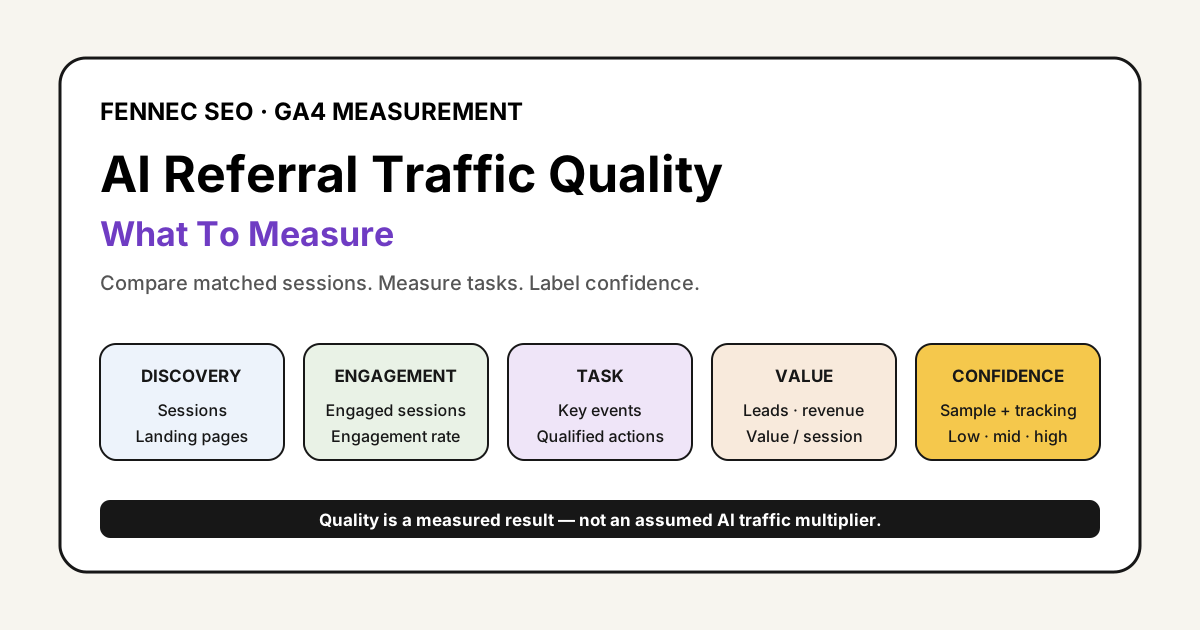

AI referral traffic is often discussed with more confidence than the data supports. A handful of engaged visits can look exciting; a large traffic spike can look important. Neither proves business value.
The right question is not “How much traffic did AI send?” It is:
For identifiable AI referral sessions, did visitors complete useful tasks at a better, similar, or worse rate than a fair comparison group?
That requires a GA4 segment, a matched cohort, a quality scorecard, and clear limits on what the attribution can prove.
Start With Session-Scoped Traffic Acquisition
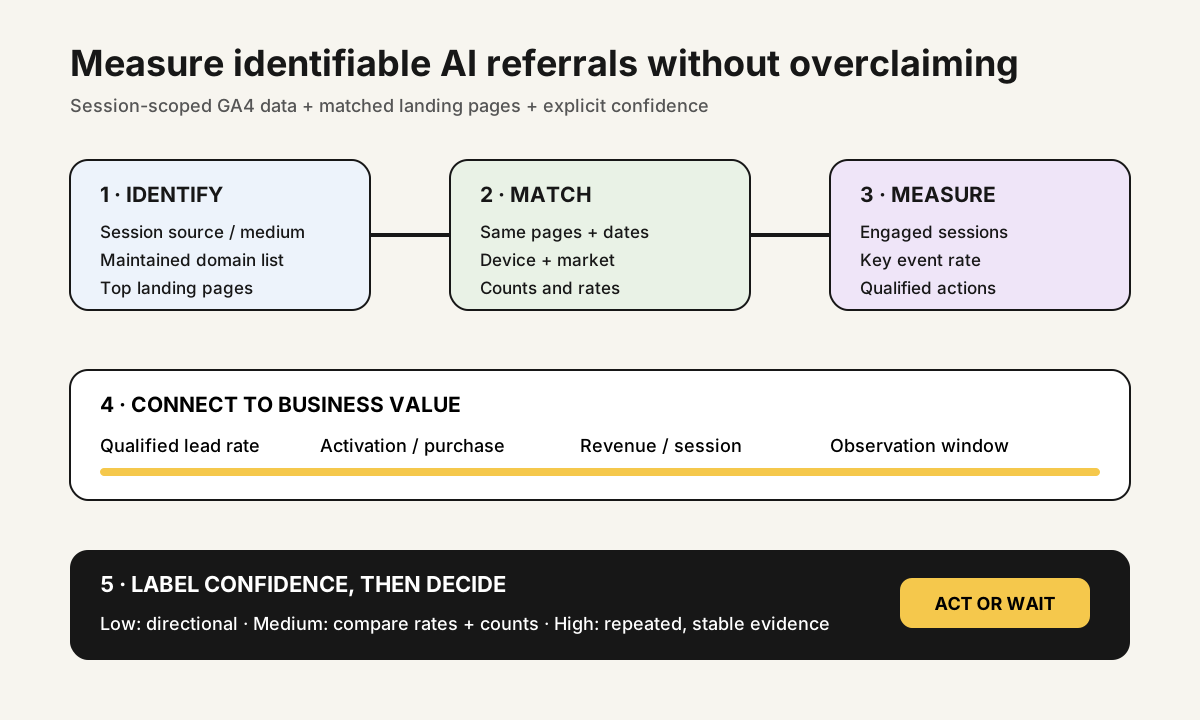
Use GA4’s Traffic acquisition report and session-scoped dimensions such as Session source and Session medium. Google’s acquisition report guide distinguishes this from User acquisition, which focuses on the source that first acquired the user.
Session scope fits the question “What happened during visits attributed to this source?” User scope fits a different question: “Where did these users originally come from?” Do not mix the two in one comparison without labeling them.
Build a comparison or exploration for identifiable domains such as:
chatgpt.comperplexity.aigemini.google.comcopilot.microsoft.comclaude.ai
Treat this as a maintained source list, not a universal standard. Hostnames and referral behavior can change, regional domains may differ, and some products may not pass a usable referrer.
The Five-Layer Quality Scorecard
1. Discovery Volume
Record sessions, active users, new users, and landing pages. Volume is context, not quality. A segment with seven sessions should not drive a strategic conclusion based on one conversion.
Set a minimum reporting threshold appropriate to your business. Below it, label the result “directional” and aggregate a longer period rather than presenting a precise winner.
2. Engagement
Use:
- Engaged sessions
- Engagement rate
- Average engagement time per session
- Views per session when it reflects the site experience
GA4 defines an engaged session using duration, key-event, or multi-view conditions. Engagement helps distinguish accidental visits from sessions where a user stayed or acted, but it is not the final business outcome.
3. Task Completion
Define key events that represent the job the landing page should support:
- Audit started
- Tool completed
- Extension install click
- Documentation step reached
- Contact or demo request
- Newsletter signup
Measure the session key event rate and key events per session. Do not compare a blog reader with a pricing visitor unless their expected tasks are aligned.
For Fennec SEO, an AI referral landing on an AI Overview guide may reasonably continue to a technical SEO audit, GSC management, or the Chrome extension. The measurement plan should capture those meaningful next steps.
4. Business Value
Use the closest available outcome:
- Qualified lead rate
- Trial or account activation rate
- Purchase rate
- Total revenue
- Revenue per session
- Pipeline value per qualified session, when governed consistently
Avoid inventing a monetary multiplier for AI visits. If the segment has low volume or long sales cycles, report counts and ranges with the observation window.
5. Data Confidence
Add a confidence label beside every scorecard:
| Confidence | Conditions | How to report |
|---|---|---|
| Low | Very small sample, incomplete key events, or major referral loss | Directional only |
| Medium | Stable instrumentation and enough sessions, but limited history | Compare rates with counts |
| High | Stable definitions, sufficient volume, and repeated periods | Use for budget or content decisions |
Confidence is not a GA4 metric. It is an operating control that prevents weak attribution from looking definitive.
Build A Fair Comparison Cohort
A source-wide comparison is usually misleading. AI assistants may send users to detailed guides while organic search also sends large volumes to navigation, brand, support, and product pages.
Match the comparison on as many of these as practical:
- Same landing pages or page group
- Same date range
- Same device category
- Same country or market
- Same new/returning-user definition
- Same consent and tracking environment
Then compare AI referral with organic search, other referral, or the landing page’s all-traffic baseline. Show both counts and rates:
| Metric | AI referral | Matched organic | Interpretation |
|---|---|---|---|
| Sessions | 420 | 5,800 | Context only |
| Engagement rate | 68% | 61% | AI cohort engaged more often |
| Key event rate | 4.8% | 4.1% | Small directional difference |
| Qualified leads | 9 | 126 | Volume still matters |
| Revenue / session | $3.10 | $3.35 | No value advantage shown |
These figures are illustrative. The conclusion is deliberately modest: this example does not prove that AI referrals are universally higher intent.
Understand The Attribution Boundary
Google’s traffic-source dimension documentation explains that session source, medium, and campaign are session-scoped and appear in Traffic acquisition. GA4 uses attribution rules to assign the session, but that source is not a full map of the buyer’s research journey.
Known limitations include:
- AI apps or browsers may suppress the referrer
- A copied link may arrive as Direct
- Consent choices and blockers may prevent measurement
- Redirects can remove source information
- A user may discover the brand in an AI answer and return through search later
- Cross-device journeys may not be connected
Therefore, report “identifiable AI referral sessions,” not “all traffic caused by AI.”
UTM parameters help on links you own or distribute, but you cannot retroactively tag a third-party AI citation. Google’s source platform guide explains that manually tagged sources rely on campaign parameters such as source and medium. Never add UTMs to internal links; doing so can overwrite acquisition context.
A Weekly 30-Minute Review
- Refresh the maintained AI-referrer segment.
- Check whether new source values appeared.
- Compare the same landing-page cohort and date range.
- Review engagement, task completion, business value, and counts.
- Inspect the top landing pages for intent mismatch.
- Label data confidence and write one decision.
The decision might be:
- Improve the landing page’s next step
- Add a relevant internal link
- Repair a missing key event
- Preserve the page because quality is healthy
- Wait for more data
“Wait” is a valid decision when the sample is too small.
Connect Referral Data To Search Measurement
Referral reporting covers visits with a detectable source. Search Console covers search visibility and clicks. Neither alone represents the entire AI-assisted journey.
Use referral quality alongside an AI search measurement routine, the generative AI Search Console dashboard, and query clustering. For technical eligibility, use the AI search visibility scorecard.
This combined view separates four questions:
- Can the content be discovered and understood?
- Is it appearing for relevant searches?
- Are detectable AI referrals engaging?
- Do those sessions produce useful outcomes?
Takeaway
AI referral quality is an empirical question, not a marketing claim.
Use session-scoped traffic acquisition, maintain a transparent source list, compare equivalent landing-page cohorts, measure engagement and key events, connect them to business value, and label confidence. The result may show strong traffic, weak traffic, or simply not enough data. All three are useful when reported honestly.
Sources
- Google Analytics Help: User acquisition and Traffic acquisition reports
- Google Analytics Help: Scopes of traffic-source dimensions
- Google Analytics Help: Source platform
Q&A
Is AI referral traffic always more valuable than organic search traffic?
No. Quality varies by assistant, landing page, audience, and task. Compare AI referral sessions with a matched cohort and judge engagement, qualified actions, revenue, and data confidence instead of assuming a universal multiplier.
Which GA4 dimension should I use for AI referrals?
Start with session-scoped source and medium in Traffic acquisition. This matches the visit being evaluated. User acquisition answers a different question about how a user was first acquired.
Why do some AI-assisted visits appear as direct traffic?
Apps, browsers, privacy controls, redirects, and missing referrer information can break the referral signal. GA4 can measure identifiable referrals, not every visit influenced by an AI assistant.