Fennec SEO 1.2.1: Full-Site Batch Audit & AI SEO Citation Report

Fennec SEO 1.2.1 is now available and closes two of the biggest gaps in a modern SEO workflow: auditing an entire site in one pass, and understanding how AI systems actually reach your content.
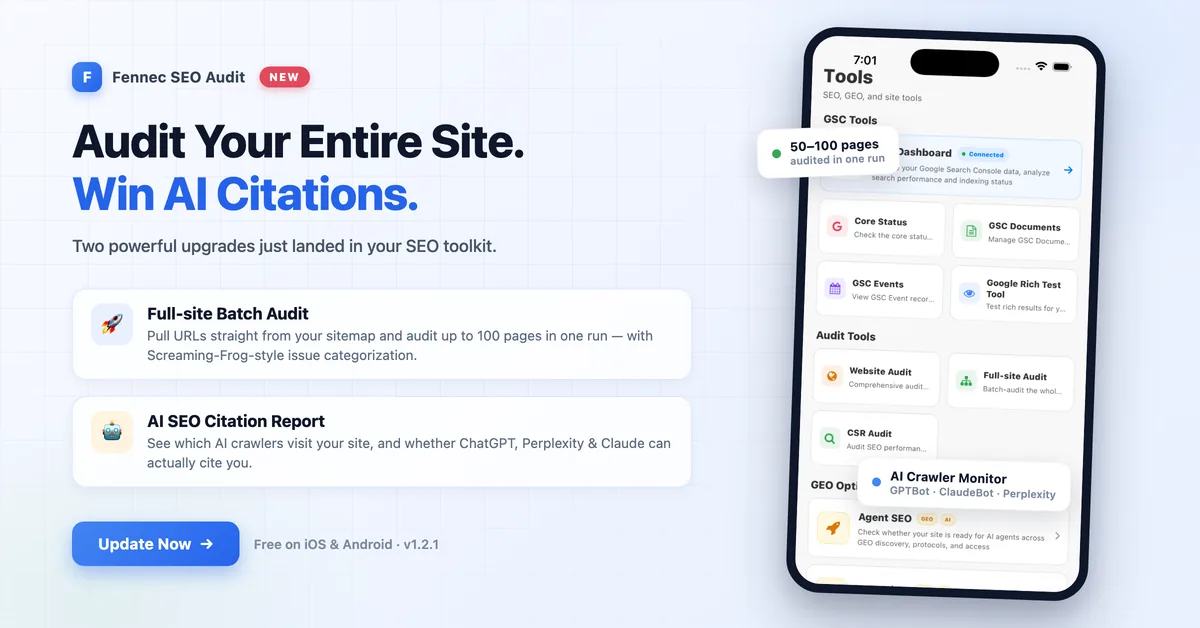
Instead of pasting URLs one at a time, you can now pull a full URL list from your sitemap and audit dozens of pages at once. And instead of guessing whether ChatGPT or Perplexity can see you, you can connect Cloudflare and read the real crawl data behind your AI citations.
What is new in Fennec SEO 1.2.1?
| Update | What it helps you do |
|---|---|
| Full-site Batch Audit | Pull URLs from a sitemap and audit up to 50 pages (100 for Pro) in one run |
| Issue categorization | Review problems the Screaming Frog way — grouped by title/meta, headings, links, images, schema, and more |
| AI SEO Citation Report | Connect Cloudflare to see which AI crawlers reach your site and how much traffic they generate |
| Global Radar | Track worldwide AI crawler trends from public Cloudflare Radar data, no account required |
| Reliability fixes | Resolve a GSC search-analytics crash and unresponsive page links |
Full-site Batch Audit: from one URL to your whole site
Most site audits start the same frustrating way: copying links one at a time. For a site with hundreds of pages, that is not a workflow — it is a chore.
The new Full-site Batch Audit changes that. Paste a sitemap URL (or your domain), and Fennec SEO:
- Extracts every URL from the sitemap, recursively following sub-sitemaps.
- Lets you select, remove, or manually append URLs before you start.
- Flags invalid URLs and cross-domain addresses automatically, so you only audit what belongs to the current site.
- Decodes URLs for clean display and supports one-tap preview and external open.
Free users can audit up to 50 pages per run, and Pro members up to 100 pages. The batch runs concurrently, so a full pass completes far faster than auditing pages one by one.
Results organized like Screaming Frog
The results page groups issues by category instead of dumping a flat list. You see, at a glance:
- Title & description problems
- Heading (H1/H2) structure issues
- Links, images, and schema gaps
- Robots.txt, HTTP status, and LLM/AI signals
Each category shows its issue count and severity (high / medium / low), and each URL carries its own score. Tap any issue to open a full detail view with the recommendation — the same depth as a single-URL audit, but across your entire site.
AI SEO Citation Report: see who is crawling you
Ranking in a search box is no longer the whole story. In 2026, a meaningful share of your traffic and brand mentions comes from AI answers — ChatGPT, Perplexity, Claude, Google AI Overviews, and the agents built on top of them.
The problem is that most tools can’t tell you whether those systems can actually reach you.
The new AI SEO Citation Report (the AI Monitor tool) connects your Cloudflare account to show real crawl data:
- Which AI crawlers access your site — GPTBot, ChatGPT-User, ClaudeBot, PerplexityBot, Googlebot, and more.
- How many requests and how much traffic each generates.
- Which paths they hit, so you can see what gets indexed into AI training and citation pipelines.
- Daily trends, so you can spot when an AI system starts (or stops) paying attention.
A companion Global Radar view shows AI crawler trends across the web at large — no account required — so you can benchmark your own visibility against the wider ecosystem. This matters for GEO: being cited by AI is increasingly how your content earns visibility outside the classic blue links.
A detail that surprises most site owners: ChatGPT-User, Claude-User, and Perplexity-User do not contain the word “bot” in their user agent. In real-world crawls these three families account for roughly a fifth of all AI traffic — tools that filter for
*bot*silently miss them. Fennec SEO reports the full set.
Why this matters for the way SEO is changing
Traditional technical SEO optimizes for a crawler that renders a page, extracts text, and ranks it. AI search adds a second audience: models and agents that decide whether to cite you as a source.
That shift makes two capabilities essential:
- Scale. You cannot reason about a site one URL at a time. Batch audit turns “I checked a few pages” into “I know the state of the whole site.”
- AI visibility. If an AI crawler is blocked, throttled, or never reaches your key pages, your content won’t be cited — no matter how good it is. The citation report makes that invisible layer visible.
Together they give you a clearer loop: audit the whole site, fix the issues that block both search and AI, then verify that AI systems can actually reach and cite you.
How to get started
- Open Fennec SEO and start a full-site audit by pasting your sitemap URL.
- Review the auto-extracted URL list — remove or append as needed, then run the batch.
- Explore the categorized issues and drill into individual URLs.
- Open AI Monitor, connect Cloudflare, and review your AI crawler traffic.
You can install Fennec SEO 1.2.1 from the official store pages:
For the full list of changes, see the changelog. If you are weighing the app against other tools, Fennec SEO vs traditional SEO tools breaks down the differences, and how generative search chooses sources explains the AI citation mechanics behind the new report.
Frequently asked questions
What is the difference between a single audit and a batch audit?
A single audit checks one URL in depth. A batch audit extracts many URLs from your sitemap and runs the same analysis across all of them at once, then groups the results by category so you can spot site-wide patterns. It is the same engine — just scaled to your whole site.
Do I need a Cloudflare account to use the AI SEO citation report?
Yes, for your own site’s crawl data you connect a read-only Cloudflare API token. The Global Radar view, which shows worldwide AI crawler trends, works without any account.
How many pages can I audit for free?
Free accounts can audit up to 50 pages per batch, and Pro members up to 100 pages. See pricing for the full plan comparison.
Which AI crawlers does the report detect?
The report detects all major AI crawlers, including GPTBot, ChatGPT-User, OAI-SearchBot, ClaudeBot, Claude-User, PerplexityBot, Perplexity-User, Googlebot, Google-CloudVertexBot, and many more — including the “User” agents that don’t contain “bot” in their name.