Content Signals and AI Bot Access: Use Preferences for Agent SEO

AI crawler policy used to be a robots.txt footnote. Now it is a core Agent SEO decision.
The reason is simple: crawling is no longer just about classic search indexing. A crawler might build a search index, fetch a page for a user inside an assistant, ground a real-time answer, train a model, render a preview, or inspect a workflow for an agent.
Those are different uses. Treating them as one bucket creates bad decisions.
Content Signals give publishers a more precise vocabulary.
This article is the policy spoke in the broader Agent SEO audit cluster. For user-agent-specific robots examples, use the dedicated GPTBot vs OAI-SearchBot vs Googlebot guide.
For the full product checklist that combines policy with discovery and protocol checks, see the Agent SEO audit page.
Access Rules vs Use Preferences
Start by separating two questions.
| Question | Best place to express it |
|---|---|
| Should this compliant crawler crawl this URL? | robots.txt user-agent and path rules |
| How may this fetched content be used? | Content-Signal directives |
| Is this bot really who it claims to be? | Verification, logs, Web Bot Auth, CDN bot controls |
| Should traffic be enforced technically? | WAF, AI Crawl Control, rate limits, authentication |
This distinction matters because robots.txt is voluntary. It expresses preferences to well-behaved bots, but it does not physically stop requests.
Agent SEO needs both sides: visibility for the agents you want, control for the uses you do not want.
What Content Signals Express
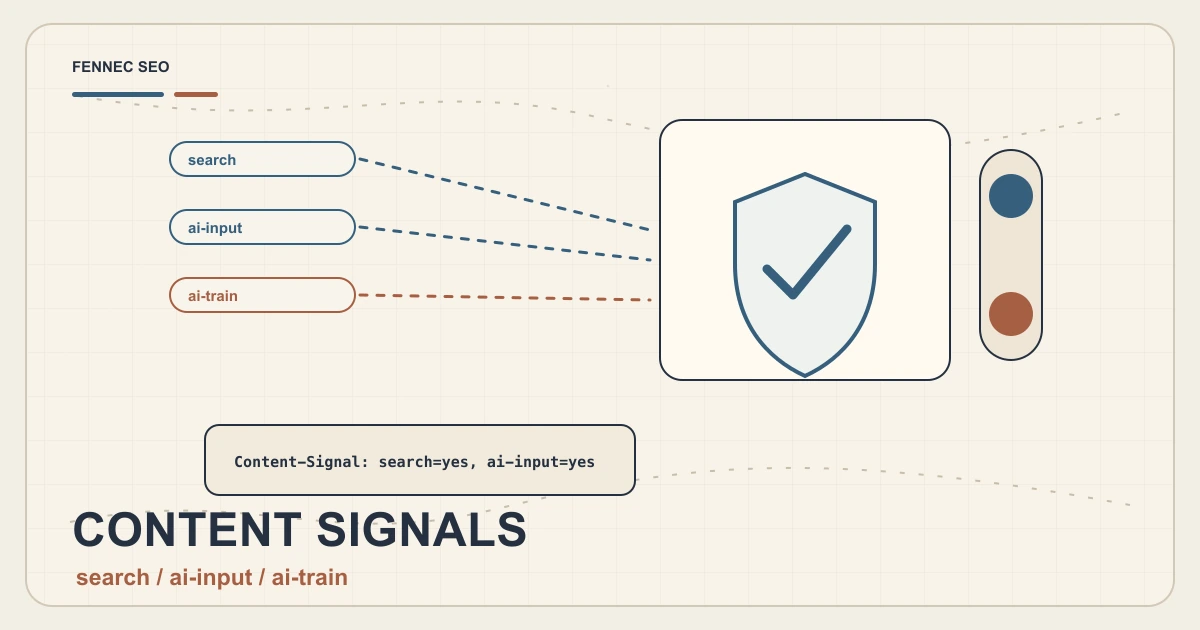
Cloudflare’s Content Signals define three broad categories:
search: building a search index and providing linked search resultsai-input: using content as input for AI models at query time, such as grounding or RAGai-train: training or fine-tuning models
search=yes does not automatically mean AI-generated summaries are allowed. For AI answers, grounding, or retrieval-augmented generation, the relevant signal is ai-input.
A basic policy might look like this:
User-agent: *
Content-Signal: search=yes, ai-input=yes, ai-train=no
Allow: /

Sitemap: https://example.com/sitemap.xml
That says: search is welcome, AI answers may use this content as input, but model training is not allowed.
Whether that exact policy is right depends on the business.
Build A Policy Matrix First
Do not start by editing robots.txt. Start with a matrix.
| Content type | Search | AI input | AI training | Notes |
|---|---|---|---|---|
| Public blog | yes | yes | decide | Good for GEO if citation and attribution matter |
| Product pages | yes | yes | decide | Keep claims accurate and updated |
| Documentation | yes | yes | decide | Often useful for agents and support workflows |
| Pricing | yes | yes | no or decide | Must stay current |
| User account pages | no | no | no | Should be behind auth anyway |
| Checkout | no | no | no | Agent commerce requires explicit design |
| Staging | no | no | no | Block and authenticate |
This makes crawler choices less emotional. It also helps legal, product, SEO, and engineering teams talk about the same policy.
Do Not Block Your Own Visibility
The most expensive mistake is accidental invisibility.
Common problems:
- Blocking
/blog/while trying to block private app paths - Disallowing all AI-related bots without understanding which ones support search discovery
- Blocking CSS or JavaScript required for rendering
- Forgetting multilingual paths such as
/zh/ - Shipping staging robots.txt to production
- Creating conflicting rules for the same user agent
- Assuming a
Content-Signalline will stop hostile traffic
If your goal includes AI search visibility, GEO, or agent-assisted discovery, blocking every AI crawler may work against you.
Use robots.txt validation and bot simulation before shipping policy changes.
A Better Robots.txt Pattern
For many public content sites, a practical starting point is:
User-agent: *
Content-Signal: search=yes, ai-input=yes, ai-train=no
Allow: /

Disallow: /app/
Disallow: /admin/
Disallow: /checkout/

Sitemap: https://example.com/sitemap.xml
Then add crawler-specific rules only when you have a reason.
For example, if you allow search crawlers but block a training crawler:
User-agent: GPTBot
Disallow: /

User-agent: *
Content-Signal: search=yes, ai-input=yes, ai-train=no
Allow: /
The exact user agents and policy should come from current crawler documentation and your own risk tolerance.
OpenAI, for example, documents separate crawlers for training, AI search, and user-triggered browsing. If your policy depends on that distinction, pair this Content Signals layer with crawler-specific rules from the GPTBot, OAI-SearchBot, and Googlebot robots.txt guide.
Where Web Bot Auth Fits
User-agent strings can be spoofed. IP ranges change. Cloudflare’s Web Bot Auth work and related HTTP message signature proposals try to solve a different problem: how a bot can prove its identity cryptographically.
For most SEO teams, the immediate action is not to implement every emerging standard tomorrow. The action is to understand the identity problem:
- A declared user agent is not proof.
- A reverse DNS check is helpful but operationally fragile.
- A signed request can provide a stronger identity signal.
- Access policy is only as good as verification and enforcement.
As agent traffic grows, bot identity will become part of SEO operations, not only security operations.
How This Connects To GEO
GEO is not only about being cited. It is also about being cited under conditions the business accepts.
A publisher may want:
- Search snippets and links
- AI answer citations
- User-triggered assistant access
- No model training
- Clear attribution
- Reasonable crawl rates
- No access to private or paid content
Content Signals cannot guarantee all of that. But they give the site a clear, machine-readable policy starting point.
That policy should be paired with:
- Server log monitoring
- Crawler verification
- CDN bot controls
- Rate limits
- Caching
- Clear content licensing
- Ongoing policy reviews
Audit Workflow
Run this checklist before publishing a new AI bot policy.
- Fetch
robots.txtand confirm it returns 200. - Confirm sitemap directives are present.
- Validate syntax with a robots checker.
- Check if
Content-Signaldirectives match the policy matrix. - Test important public URLs with crawler user agents.
- Confirm private app paths are blocked or authenticated.
- Review server logs after launch.
- Re-scan with IsItAgentReady and compare it with the Agent SEO audit framework.
- Revisit the policy after major product or content changes.
This is not a one-time file. It is a living access policy.
Takeaway
Agent SEO needs visibility and control.
Use robots.txt to express crawl preferences for compliant bots. Use Content Signals to express allowed content uses. Use logs and bot controls to enforce what matters. Then measure whether agents can still discover and read the public content that supports SEO, AI search visibility, and GEO.
Good policy is not “allow everything” or “block everything.” It is clear enough for friendly bots, restrictive enough for business needs, and testable enough for operators.
Sources
- Cloudflare Docs: managed robots.txt and Content Signals
- Cloudflare: Introducing the Agent Readiness score
- Cloudflare: Web Bot Auth
- OpenAI: Crawlers and user agents
- Google Search Central: robots.txt introduction
Q&A
Are Content Signals the same as robots.txt disallow rules?
No. Robots.txt expresses which paths compliant crawlers should or should not crawl. Content Signals express preferences about how fetched content may be used, such as search, AI input, or AI training.
Do Content Signals technically block bad bots?
No. Like robots.txt, Content Signals are preference signals. Enforcement requires logs, CDN controls, bot management, rate limits, or other access controls.
What is the difference between Content-Signal search, ai-input, and ai-train?
search covers search indexing and linked results, ai-input covers using content for AI answers or grounding at request time, and ai-train covers model training or fine-tuning.
Should I block GPTBot but allow OAI-SearchBot?
That can be a reasonable policy when you want AI search discovery but do not want training use, but the final rule should follow current crawler documentation and your business policy.