Google Connected Apps preview: does your store need a native app?

Can an independent store submit its URL and let customers check stock or buy directly inside Google Search? As of October 30, 2026, a website alone is insufficient, and there is no basis for promising every small merchant immediate admission. Google has opened a Connected Apps Platform preview requiring working capabilities, testing and review. A native mobile app is not necessarily the first thing to build.
The opportunity is to make a service callable during a conversation. Eligibility, user permission and business completion still need separate checks. This article reports first-hand checks of public official documentation. We have not completed authenticated onboarding, connected a real store or tested transactions.
What Google announced on October 28
Google’s announcement introduces a shared platform with Search, Gemini app or both as publishing targets. Access is expanding in phases.
Google reports more than 50 Connected Apps across the two products combined, not 50 on each. Adobe, Experian, Localiza and Peloton integrations are live in Gemini; their Search rollout is planned for the coming weeks. Calm is also planned for both. Planned availability should not be reported as universal availability today.
This is a distribution and integration announcement. Google has not announced a web ranking change or guaranteed traffic or sales gains from participation.
Official-document checks: the surface and the handoff matter
The following reflects public documentation checked on October 30, rather than account-level product testing.
| Merchant question | Finding | Practical implication |
|---|---|---|
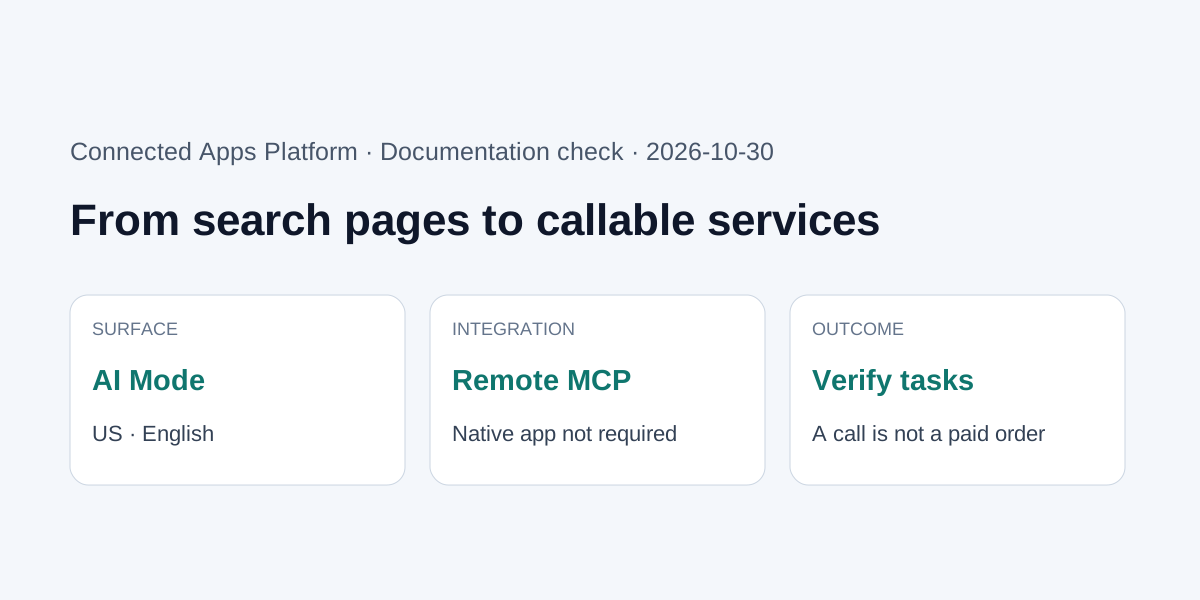
| Does this work throughout ordinary Search results? | Search help specifies AI Mode in the US, in English | Web ranking coverage does not establish app coverage |
| Is everything completed inside Google? | Help describes handoffs for Instacart checkout and order management, YouTube Music playback, and Canva downloads or edits | Measure initiation, handoff and completion separately |
| Is Gemini availability uniform? | Requirements vary by connection, location, language, account, device and subscription; Adobe supports English in mutually supported markets, while Experian and Peloton list US English | Check each connection rather than general Gemini language support |
| Can any small business launch now? | Application and implementation instructions exist; admission and a launch date are not guaranteed | Confirm access before committing a delivery schedule |
| What does it cost, and how long does approval take? | The reviewed announcement and onboarding pages give neither a unified platform price nor a fixed review deadline | Undisclosed pricing does not establish free access |
Sources: Search availability and usage, Gemini connection requirements, Console prerequisites.
Search currently lists services including Instacart, Canva and YouTube Music. Its list differs from Gemini’s. Using Shopify’s existing Gemini connection to manage a store also does not automatically turn that store into a new buyer-facing connected app. See our Gemini small-business eligibility checks.
Our first browser attempt timed out. A second browser reached the official preview entry, which requested Google Account sign-in to access developer support. We did not sign in or submit an application, so authenticated eligibility remains unverified. The official pages reviewed do not provide a complete developer-country admission list, so we cannot confirm self-service access for a developer in Hong Kong or mainland China. Developer admission and consumer availability are separate questions.
A web service can use remote MCP
The MCP developer guide recommends remote MCP for foundational cross-platform capabilities and allows reuse of existing Web APIs. Android MCP through AppFunctions serves on-device app capabilities. Assess the service before deciding to build a native app.
Stock availability, delivery eligibility and authenticated order status are possible evaluation tasks, not approved integrations or guaranteed review passes. A product-description page alone is not an executable capability.
The remote route requires a public HTTPS Streamable HTTP MCP endpoint, domain verification, developer-account permissions and public terms and privacy documentation. The prerequisites also request at least three high-value capabilities and example prompts. Publishing an API Catalog or Link Headers does not replace Google’s registration and review.
The Console workflow separates configuration, testing, review, approval and publication. Added testers currently need Gmail accounts; visibility can take up to about ten minutes. That is a tester-visibility interval, not an approval SLA. Geographic and language targeting controls do not override consumer-surface restrictions. For user-account access, implement the appropriate authorization flow; the OAuth guide is a starting point. An order-number lookup must not expose another customer’s data.
What coverage leaves merchants needing to verify
Our sample included 9to5Google, which explains the platform and partner expansion; TechWyse, which covers infrastructure requirements; and The SEO Handbook, which already identifies US English AI Mode limits. Those restrictions are not an exclusive discovery.
The useful next layer is task acceptance: a successful API response need not mean correct stock, and a cart need not mean a paid order. This is a proposed test plan after admission, not a completed experiment.
| Task | Fixed conditions | Evidence to collect |
|---|---|---|
| Stock and delivery lookup | SKU, destination, currency and timestamp | Compare with the source system; unavailable stock or destinations must not produce purchase promises |
| My order status | Test users A and B, plus expired authorization | A sees only A’s orders; invalid access stops safely |
| Change or cancellation | Test order and explicit confirmation | Correct object and consequences; retries do not duplicate changes; backend and response agree |
| Checkout handoff | Same cart, price, tax and delivery terms | Correct cart survives the handoff; distinguish initiation, payment and refund |
Record account country, language, device, version, prompt, tool payload, confirmation, duration and backend result. Use test data. Compare explicit brand requests with natural-language requests and retain failures. Isolation, idempotency and accounting checks are our recommended acceptance criteria, not claims of completed tests.
SEO, advertising and content decisions
Treat app integration as an additional distribution option. Pages still explain products, pricing, delivery and support; tools perform bounded actions. An agent-friendly website audit helps with the web experience but does not register an app. Teams without dependable services should generally improve product data and task paths before funding a new integration. That is a prioritization recommendation, not a measured ROI result.
The announced traffic, latency and error-rate metrics describe integration operations. Do not equate them with Search Console clicks, ad conversions or revenue. After admission, reconcile call logs, handoff events and order outcomes separately, using permitted identifiers without exposing personal information. Evaluate incremental customers before moving advertising budgets.
For content, describe each real task’s inputs, markets, currencies, freshness, authorization and failure recovery. Keep page explanations, tool schemas and actual behavior aligned. “Ships to the US” must not become a promise of same-day delivery to every US ZIP code. Product structured data is also distinct from app registration.
Policy boundaries affect the business model
Platform policy restricts third-party advertising, misleading capabilities, excessive data requests and apps primarily passing through third-party APIs without the required ownership or proprietary rights. Own-brand elements are allowed. Prepare privacy and data-management documentation.
Permission to call a commerce platform API does not by itself establish Connected Apps eligibility. If the product mainly wraps someone else’s APIs, clarify applicability with Google before substantial development. Do not inflate capability descriptions to attract calls.
What to do now
- Store operators: check the Search and Gemini lists for the target market. Record date, language, device, task and handoff. Absence from a list is not evidence of rejection.
- Teams with proprietary services: identify three useful tasks and assess remote MCP, authorization, reliability and maintenance. Apply through the official preview entry and confirm eligibility.
- SEO and advertising teams: track competitor stages separately: announced, officially listed, visible in an account, and successfully tested. Fill the last stages only with observed evidence.
- Pilot teams: use the acceptance table before expanding. Budget separately for any platform charges, hosting, engineering and third-party subscriptions; do not enter an unconfirmed zero price.
The investment question is whether an eligible customer can safely and accurately complete a useful task that requires your service. That is a stronger foundation than counting a brand mention as a business outcome.