Google AI updates in September 2026 for ecommerce and SEO

A shopper looks at a product and asks whether it works with their device, whether an adapter would help, and whether it can arrive before Friday. What should an independent store prepare? Google’s September AI updates make those follow-up journeys worth examining. Start with compatibility conditions, accurate product details and fulfilment evidence, then check whether both language versions answer the same questions.
Google published its September AI roundup on October 2, 2026. It reviews model, voice, application and scientific announcements, rather than establishing one launch date for every feature. Availability and prices below were checked against official pages on October 28, 2026. Documentation checks and budget calculations are distinct from a mobile trial, store integration or advertising experiment.
September announcements and October availability
| Update | September announcement | What to check now |
|---|---|---|
| Gemini 4 Argon | Complex reasoning and defensive work, initially through Fairwind for trusted defenders | October announcements describe public paid API access; it is no longer accurate to describe all access as invitation-only |
| Gemini 3.8 Flash and Flash Cyber | General coding and agent workflows; a separate defensive variant | Verify ordinary Flash and controlled Cyber access separately |
| Gemini 3.8 Live and Live Extended Thinking | Real-time voice, with the latter aimed at more complex tasks | Search Live, Gemini Live, Workspace and API are separate surfaces |
| Gemini 3.8 Flash TTS and Flash-Lite TTS | More expressive text-to-speech | Speech generation is separate from search eligibility or product indexing |
| WeatherNext 3 | More detailed forecasts integrated across Search, Gemini, Maps and Cloud products | Improve relevant outdoor-use guidance; delivery promises still need logistics evidence |
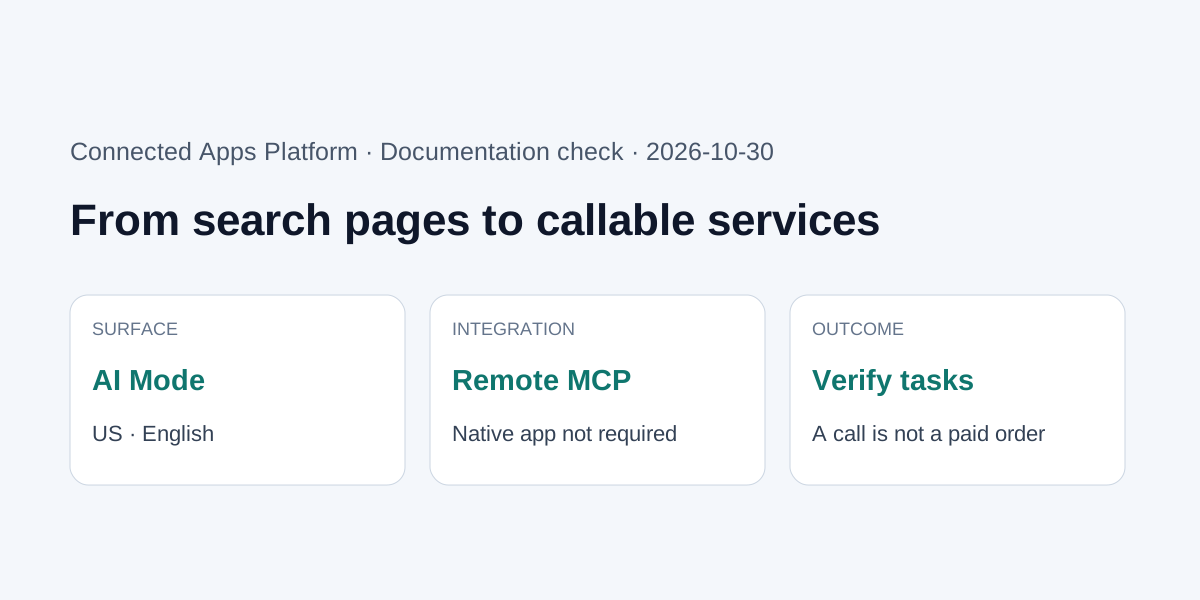
| Gemini apps and desktop tools | Connected Apps, Lyria 3.5, Notebook learning tools and Windows Alt+Space access | Check each connection, subscription and device rather than reuse one global eligibility claim |
See the Flash announcement, TTS section in the roundup, WeatherNext 3 announcement, Connected Apps roundup, Lyria 3.5 and Windows announcement.
Argon illustrates why dates matter. Its September announcement described phased access. The October availability announcement lists paid API access and Pro or Ultra access in the Gemini app and AI Mode. The public model and the access arrangement for trusted Fairwind defenders should be distinguished.
The million-token output claim also needs implementation context. The current model specification lists a default synchronous maximum output of 65,536 tokens. Longer generation uses long decode and background execution. Input, thinking and output share a 1,048,576-token window; it is not a million input tokens plus an additional million output tokens. For product descriptions, factual accuracy and review cost usually matter more than maximum output volume.
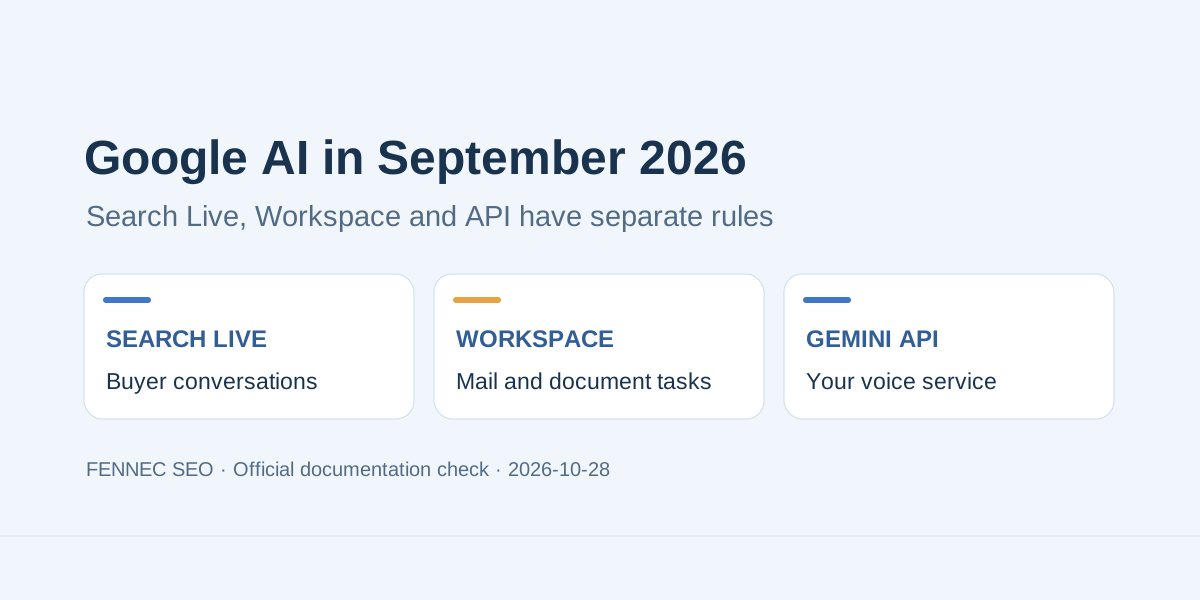
Search Live and Workspace voice tasks have separate access rules
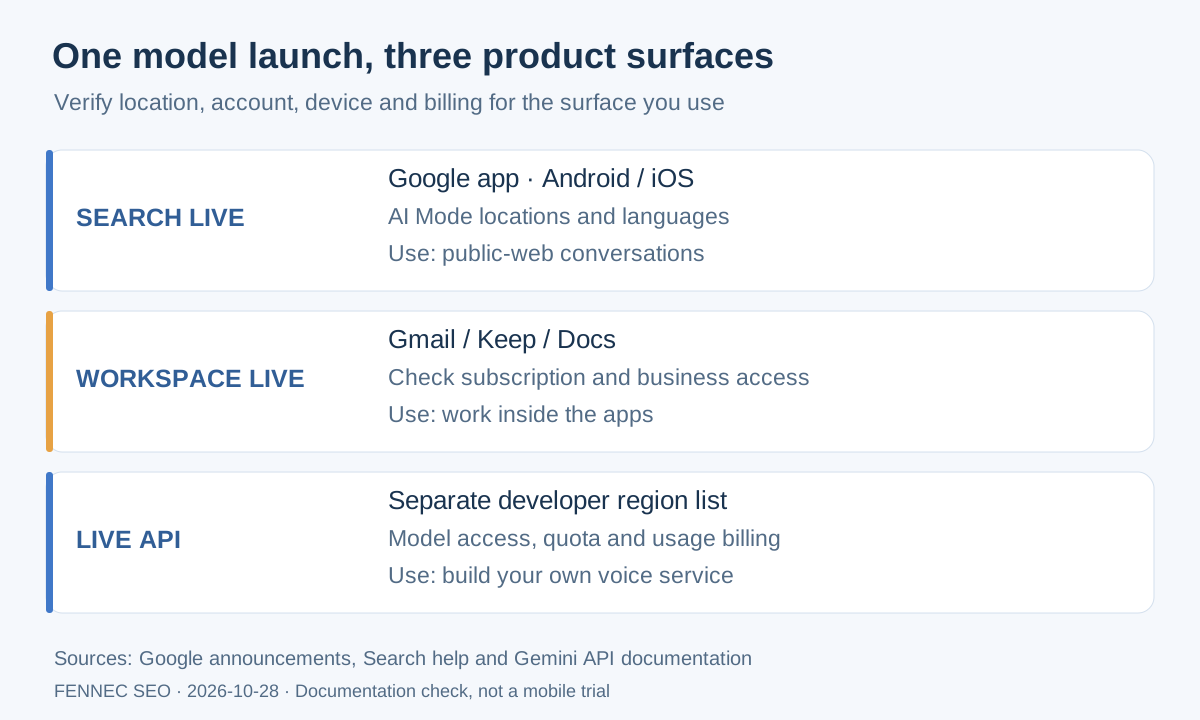
The September 15 audio-model announcement places Gemini 3.8 Live in Search Live. Its rollout section lists Gemini Live and Workspace separately for Extended Thinking. The combined wording in a monthly summary does not establish that Search Live directly edits Gmail, Docs or Keep.
For merchants, Search Live concerns how buyers find and understand public pages. Workspace voice concerns the team’s work data. An API integration requires a service you develop, pay for and maintain. Each has different permissions and costs.
- Search Live: Current help specifies the Google app on Android or iOS, with microphone permission. Availability follows AI Mode’s region and language list. The iOS page explicitly excludes iPad for now. Seeing AI Mode on a desktop does not establish the same voice interface there. Android help, iOS help.
- Location and Chinese: The current AI Mode list includes Hong Kong, Taiwan, Simplified Chinese and Traditional Chinese. This does not measure recognition quality for every account, app version or dialect. Test Mandarin, Cantonese and mixed-language speech separately.
- Workspace Live: The dedicated announcement lists Gmail and Keep for Google AI Plus, Pro and Ultra subscribers, and Docs for Pro and Ultra. It describes Workspace business-customer access as coming later. Check current admin settings and account eligibility rather than treating that announcement as proof of a business account’s access. Workspace announcement.
- Live API: The developer service has its own region list and quotas. That list currently includes Taiwan and does not list Hong Kong. Search availability in Hong Kong therefore cannot establish API eligibility. Record the model ID, project region, quota and billing status before integration.
What merchants still need after the news coverage
Search Engine Land explains the Search Live model upgrade, web links and transcript flow. AI Agent Navi identifies the October post as a monthly recap. The next merchant questions are account eligibility, current cost and whether follow-up answers reach the correct product and policy pages.
The AI Times’ October 2 summary describes Argon’s million-token limit as a context window. Current official specifications additionally distinguish default output from long decode. Procurement and implementation decisions need that distinction. A dated table of access rules is more useful here than another list of benchmark scores.
Verified prices and a reproducible budget example
These are Gemini Developer API Standard paid-tier prices read on October 28, 2026, in USD. They are neither Gemini subscription prices nor a measured invoice. API usage has separate billing; do not infer included API usage from a personal subscription.
| Model or audio direction | Current price | Announced change |
|---|---|---|
| Gemini 3.8 Flash | $0.75 per million input tokens; $3.75 output including thinking | $1.50 and $7.50 from January 1, 2027 |
| Public Gemini 4 Argon | $2 per million input tokens; $10 output including thinking | $4 and $20 from December 1, 2026; no free tier |
| 3.8 Live and Live Extended Thinking audio | $0.005 per input minute; $0.018 per output minute | Estimate against the current price table, then check actual usage |
Source: official API pricing. Other service tiers, caching and tools can change total cost.
Assume a development trial processes 10 input-audio minutes and 10 output-audio minutes. Its audio-only estimate is:
10 × $0.005 + 10 × $0.018 = $0.23
This does not mean every ten-minute call costs $0.23. Text, thinking, images, search tools, retries and infrastructure may add costs. Low audio prices also do not establish a low cost per resolved customer problem: track failures, human escalation and rework.
Build content around successive buying decisions
Choose one real SKU and inspect its pages in the order a buyer makes decisions. These are suggested acceptance questions, not a captured Search Live conversation or Google’s internal retrieval queries.
| Buyer’s follow-up | Evidence the page should provide | Acceptance question |
|---|---|---|
| Does it work with my device | Models, ports, protocols and exclusions | Would an answer have to guess an unspecified device |
| Would an adapter solve the problem | Accessory requirements and whether it is sold separately | Is an optional item being described as included |
| Can I use it in this situation | Real photos, setup steps and observable limitations | Can the text and images explain the conditions and risks |
| Can it arrive before Friday | Delivery area, cutoff, inventory and carrier information | Is a general estimate being presented as a promise |
| Can I return it if unsuitable | Market-specific return conditions, deadlines and exceptions | Do English and Chinese express the same conditions |
Link each answer to the relevant specification, installation guide, accessory or delivery policy. Keep important facts in readable HTML and give images accurate surrounding explanation. Conversational questions help organize content; they do not require a separate URL for every long-tail phrase. See AI Mode follow-up questions and query fan-out, product price and stock consistency and multimodal search.
Google’s website guidance for AI features retains foundational SEO requirements. AI Overviews and AI Mode have no additional technical requirements and do not require special AI schema. Adding FAQs or transcripts does not guarantee Search Live citations. Establish indexability, understandable content and correct answers, then record actual appearances and visits.
Verify advertising and creative uses separately
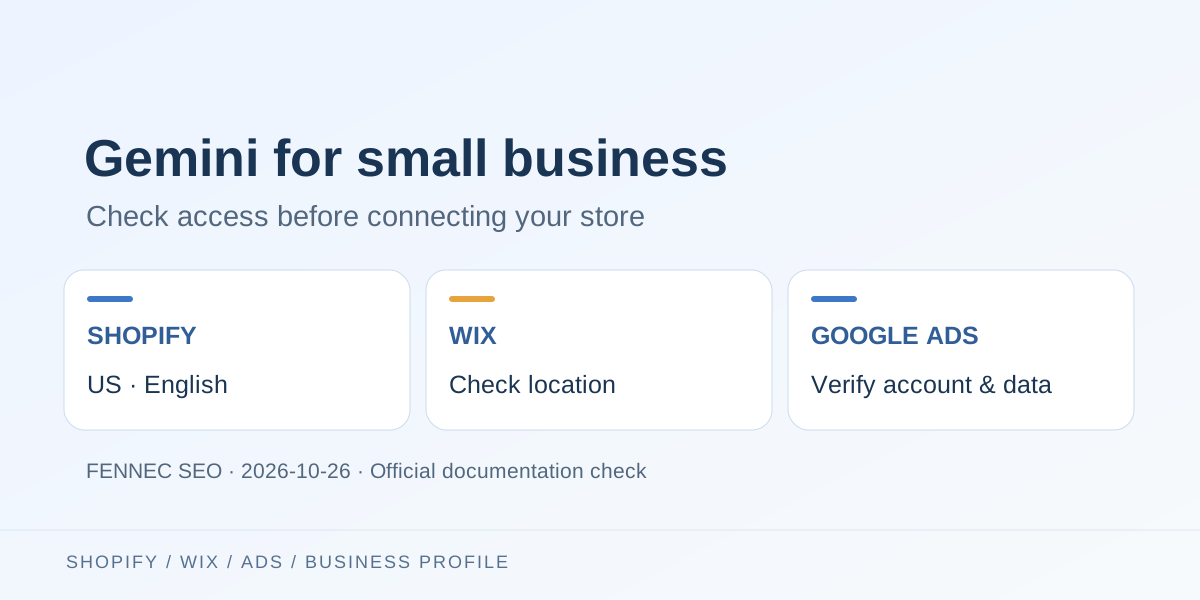
The September roundup supplies no specific new Google Ads bidding, placement or Shopping Feed rule on which to base a campaign change. Better conversational interfaces can motivate content acceptance tests; they do not establish lower costs, higher ROAS or greater product exposure. October’s Shopify and Wix connections also need a separate eligibility check, covered in our published Gemini small-business tools verification.
For an AI-versus-photography comparison, fix the SKU, format, placement and factual specifications. Compare product fidelity, accepted-asset rate and rework time before testing traffic performance. Do not attribute a win to a model while changing products, offers and audiences. Check asset discovery separately with the image discoverability audit.
TTS and Lyria can support trials of narration and background music. Retain source records, font permissions and the basis for using a voice, and check applicable disclosure requirements. The ability to generate an asset does not settle commercial-use rights. For content quality, continue with our Google AI SEO guidance explainer.
Check terms before connecting customer data
Speech may contain names, addresses and order numbers; camera frames can include other people or confidential information. Start with fictional orders and anonymous inputs. Verify retention, logs, deletion and human escalation before using live business data.
The Gemini API additional terms specify an age requirement of 18+, restrictions on API clients directed toward or likely to be accessed by under-18s, and paid-service requirements for API clients offered in the EEA, Switzerland or UK. Check those conditions against the intended audience before launching a consumer-facing voice assistant. Free and paid API services also have different data-handling arrangements. Review Gemini app use separately under its Privacy Hub.
Checks an English and Chinese team can make now
Confirm Search Live using a real phone and account in the target market. Record date, region, Google app version, language and subscription. If the entry point is missing, leave that check incomplete rather than substituting a desktop screenshot. Verify API model access, region and quota independently instead of buying a subscription to guess at access.
Use the five follow-up questions above to inspect one product’s English and Chinese pages. Preserve actual links, incorrect answers, missing conditions and invented details. When a real voice trial is possible, retain its returned web links and transcript and compare them with the pages at that time. This evaluates a specific experience; it does not establish stable rankings or identical answers for all buyers.
There are no mobile-voice, model-inference or advertising-performance results in this evaluation. A useful subsequent trial would preserve questions and answers, page versions, failures and usage costs. Assess search outcomes with the GSC and page evidence matrix rather than extrapolating from a single answer.